TR3 is Revenue’s three-page form for registering a voluntary, non-profit making group for tax. The group sends it to get a tax registration number, and the form asks why: for a tax clearance certificate, for a Section 980 certificate or for another stated reason. The copy on revenue.ie carries the print code RPC017689_EN_WB_L_1, and the file was last updated in May 2026.
Who uses TR3
The first line of the form limits it to a voluntary non-profit making organisation that wishes to register for tax. Profit-making groups, partnerships and companies are sent to Form TR1 or TR2. TR1 points the other way too: its list of people who should not use it includes voluntary non-profit organisations, which are told to use TR3.
A voluntary group cannot normally do this online. Revenue’s manual on registration (Tax and Duty Manual Part 38-01-03a, last reviewed September 2026) lists unincorporated bodies and non-profit organisations, such as schools and boards of management, and charities, when not represented by an agent, among the applicants who cannot use eRegistration and must send a paper form. The same manual describes TR3 as the form for a voluntary non-profit making organisation. Revenue’s eRegistration page (27 October 2026) also puts non-profit organisations without an agent outside eRegistration, but its list of paper forms names only TR1, TR1 (FT), TR2 and TR2 (FT). If you are not sure which form your group should send, Business Registrations answers on 01 738 3630 and at businesstaxesregistrations@revenue.ie.
For tax clearance, Revenue’s page on applications from unregistered voluntary bodies (19 May 2026) says a voluntary body with no Tax Registration Number must register first, using the form for voluntary non-profit making organisations, and can apply for a Tax Clearance Certificate through the electronic Tax Clearance (eTC) system once the number arrives.
Filling in TR3, question by question
The marked first page shows questions 1 to 10: the group’s name and address, the reason for registering, the start date and the responsible person. Write in block letters, tick the boxes that apply and complete every field with an asterisk. The form warns that inaccurate information can delay the registration or the documents you need.
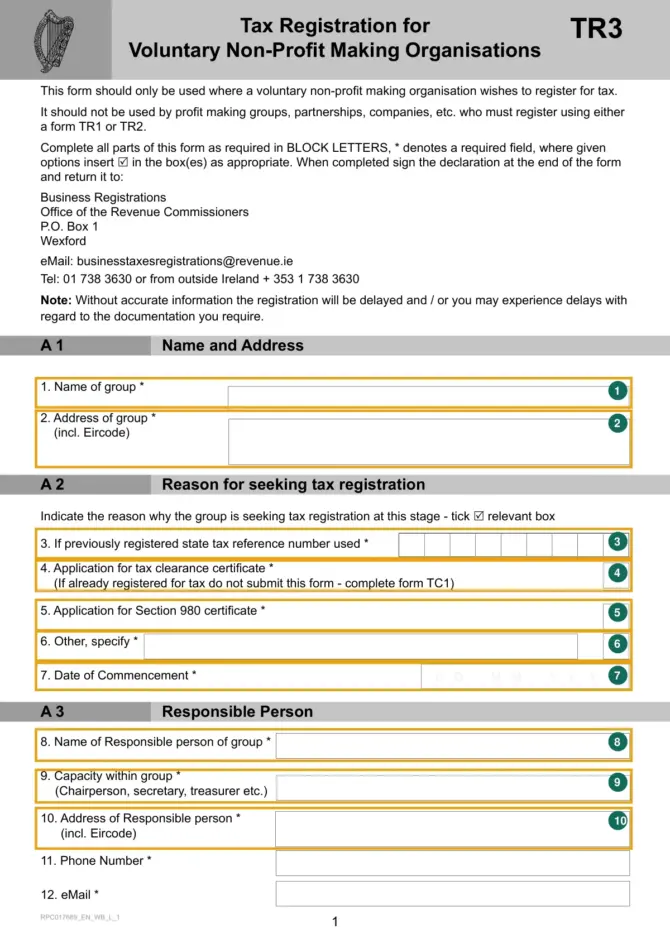
| Section | Questions | What the group enters |
|---|---|---|
| A1, name and address | 1 and 2 | Name of the group and its address with Eircode |
| A2, reason for registering | 3 to 7 | Any tax reference used before, then one reason: tax clearance, a Section 980 certificate or another reason, and the date of commencement |
| A3, responsible person | 8 to 12 | Name, capacity in the group, address with Eircode, phone and email |
| A4, other officers | 13 to 24 | Chairperson, secretary and treasurer: name, address, phone, email |
| A5, group details | 25 to 30 | Objectives, funding, any individual benefit, use of surplus funds, plans for a charity or sports exemption, Irish language box |
| A6, declaration | Page 3 | Signature, name in block capitals, capacity and date |
The reason for registering: questions 3 to 7
Question 3 asks for any tax reference number the group used before. Questions 4 to 6 are the reasons, each with a tick box:
- Question 4, application for a tax clearance certificate. The note beside it says a group already registered for tax should not send TR3 and should complete Form TC1 instead.
- Question 5, application for a Section 980 certificate. TR3 does not explain this. Section 980 of the Taxes Consolidation Act 1997 is the Capital Gains Tax withholding on certain sales: Revenue’s CG50A page says a buyer withholds 15% of the price unless the seller has a CG50A clearance certificate, and Revenue’s Form CG50 is the application for a certificate under section 980(8). TR3 does not say whether question 5 means that certificate; our guide to CG50A clearance covers the CG50 application, and Business Registrations can confirm what question 5 is for.
- Question 6, any other reason, written out.
Question 7 is the date the group started. The form marks questions 3 to 7 with an asterisk and asks you to tick the relevant reason.
On the tax clearance route, the documents differ. TR3’s own note sends already-registered groups to Form TC1. Revenue’s unregistered voluntary bodies page says that once the body has its registration number it applies through eTC, and the registration manual describes TC1 as the form for a non-resident body that only needs a number for a grant or tax clearance. The pages do not reconcile the TC1 note on TR3 with the eTC route; Business Registrations (01 738 3630) can confirm which applies to your group.
People and purpose: sections A3 to A5
Question 8 names the responsible person, and question 9 gives their capacity, with chairperson, secretary and treasurer as the form’s examples. Revenue’s registration manual says the signature on a registration form for an unincorporated body should be that of the responsible person. Questions 10 to 12 are that person’s address with Eircode, phone and email.
Section A4 repeats the same four lines for the chairperson (13 to 16), the secretary (17 to 20) and the treasurer (21 to 24). On the PDF the phone and email lines carry an asterisk while the name and address lines do not.
In section A5, questions 25 and 26 ask for the group’s objectives and how it is funded. Question 27 asks for details if any individual will benefit from the group’s activities or finances, and question 28 how any surplus is used. Question 29 asks whether the group will apply for a charity or sports exemption, with a yes box. Question 30 is a tick box for dealing with Revenue in Irish.
Ticking question 29 does not grant an exemption. Revenue’s charitable tax exemption page says the exemption is for charities registered with the Charities Regulator and has its own application. A sports body that exists only to promote an athletic or amateur game or sport applies separately for the sports body exemption, which covers Income Tax or Corporation Tax but not VAT or DIRT.
Signing TR3 and where to send it
Section A6 is a declaration that the details are true in every respect. Signature, name in block capitals, capacity and date are all required fields.
TR3 names one address, printed on page 1: Business Registrations, Office of the Revenue Commissioners, P.O. Box 1, Wexford. The same unit has the email address businesstaxesregistrations@revenue.ie and the phone number 01 738 3630 (+353 1 738 3630 from outside Ireland). The form states no fee and no deadline.
Official PDF: TR3 — Official PDF (revenue.ie)
Questions about TR3
Is TR3 used to cancel a tax registration?
The current TR3 is a registration form for voluntary non-profit groups and has no cancellation section. Revenue’s eRegistration page says active registrations are cancelled, and re-registered, through eRegistration.
Does a registered charity still pay VAT?
Revenue’s charitable tax exemption page says there is no general VAT exemption for charities, although they may claim under the Charities VAT Compensation Scheme. A charity with employees operates PAYE.
Can a profit-making club use TR3?
The form says profit-making groups, partnerships and companies register on TR1 or TR2, not TR3.
Official sources
- Form TR3, Tax registration for voluntary non-profit making organisations (RPC017689_EN_WB_L_1)
- Applications for unregistered voluntary bodies
- eRegistration
- Tax and Duty Manual Part 38-01-03a, Guidelines for Registration for IT, CT, RCT, PREM and Certain Other Taxheads (September 2026)
- Form TR1
- CGT Clearance Certificate (CG50A) and Form CG50
- Charitable tax exemption
- Sports bodies tax exemption