Form 11S is the short paper version of the Irish self-assessment Income Tax return. Revenue describes it as an extract of Form 11, the full personal return, and every entry on it carries a line number that Revenue’s guide uses for cross-reference. The current edition is for the 2025 tax year (form code 2025120S) and says on page 2 that it may only be used for that year.
The form is ten pages long. Page 1 holds the address changes, contact details and the declaration you sign; pages 2 to 8 hold the income, credit, capital gains and gift panels; pages 8 to 10 hold the self-assessment, bank details and the expression of doubt.
Who files a Form 11S, and when the full Form 11 is needed instead
You file a 2025 return if you are a “chargeable person” for self-assessment. The notes on page 1 of Form 11S list the main cases:
- you have a PAYE job or pension, and your gross income from all non-PAYE sources (deposit interest included) is €30,000 or more;
- you have a PAYE job or pension, and your net assessable non-PAYE income is €5,000 or more;
- you opened a foreign bank account in 2025 in a country that is outside the DAC2, CRS and FATCA exchange systems, or is non-cooperative;
- you are a proprietary director.
Revenue’s guide adds that self-employed people, and people with rental or investment income that is not taxed through PAYE, are typically in self-assessment.
An income tax gain from exercising a share option under section 128 does not, on its own, make you a chargeable person, although the capital gain when you later sell those shares is taxed under self-assessment.
Revenue’s Guide to Completing 2025 Pay & File Self-Assessment Returns says a chargeable person completes the full Form 11 unless everything relevant to them fits on Form 11S. In practice that means checking which panels Form 11S leaves out. It has panels A to J, L, N and P, so there is no restriction of reliefs panel (K), no chargeable assets panel (M) and no property incentives panel (O). It has no lines for residence status, and its foreign income panel covers only foreign pensions. If you need any of those, use Form 11, on paper or through the Revenue Online Service (ROS).
Some people cannot file on paper at all. The front page states that mandatory e-filers must file through ROS under section 917EA, and Revenue’s mandatory e-filing page warns of a penalty of €1,520 on each transaction for not paying and filing electronically when you are obliged to.
Deadlines for the 2025 return
The due date for a paper Form 11S is 31 October 2026. By that date you must also pay any balance of Income Tax for 2025 and your preliminary tax for 2026. The later date of 18 November 2026 applies only when you both pay and file through ROS, which means filing Form 11 online rather than posting Form 11S.
If you file late, the self-assessment panel needs a surcharge added to your tax due:
- 5% of the tax due, capped at €12,695, if the return arrives within two months of the due date (Revenue’s guide puts this as on or before 31 December 2026);
- 10% of the tax due, capped at €63,485, if it is more than two months late.
A separate 10% surcharge applies if your Local Property Tax returns and payments are not up to date when you file, even when the Income Tax return itself is on time. Once the LPT is brought up to date, that surcharge is capped at the LPT liability involved. The LPT Branch is on +353 1 738 3626.
Form 11S says Revenue will calculate the self-assessment for you if the paper return arrives by 31 August 2026. The 2025 guide (pages 10 and 62) says that date was extended to 30 September 2026. Both dates have passed, so a Form 11S posted now needs the self-assessment panel completed and signed.
Where to post Form 11S and how to pay
The return address printed on page 1 is:
Office of the Revenue Commissioners
Collector-General’s Division
PO Box 354
Limerick
The form tells you to use any envelope and write “Freepost” above the address; no stamp is needed. Quote your PPSN in any letter that goes with it.
Payment is separate from the paper return. Revenue’s notes say non-ROS customers can pay online through myAccount. Its preliminary tax page lists ROS (debit instruction, debit or credit card), myAccount (a single debit instruction from a bank account, or a debit or credit card) and direct debit, which is set up through ROS. Only Visa and Mastercard cards are accepted. Preliminary tax must be at least the lowest of 90% of the tax due for 2026, 100% of the tax due for 2025, or 105% of the tax due for 2024 where you pay by direct debit.
The blank 2025 Form 11S is on revenue.ie, and Revenue’s Forms & Leaflets Service sends paper copies on +353 1 738 3675.
Official PDF: Form 11S — Official PDF (revenue.ie)
Filling in Form 11S, panel by panel
General rules from the guide apply to the whole form: blue ink, capital letters, annual figures in euro only, and nothing written outside the boxes. Leave a panel blank if it does not apply to you. Do not attach accounts, lists or schedules, and do not write “per attached” or “as before”; Revenue sends incomplete returns back. Keep your records for six years.
A married couple or civil partners make one return covering both people’s income, unless they have formally elected to be dealt with separately. That is why most panels have “Self” and “Spouse or Civil Partner” columns.
| Page and panel | Lines | What goes in |
|---|---|---|
| Page 1 | none | Changed addresses, agent’s TAIN, contact details, nature of your main trade, signed declaration |
| Page 2, A Personal details | 2 to 13, 19, 20 | Dates of birth, civil status, basis of assessment, spouse’s details, medical card, PRSI exemption, disclosure numbers |
| Page 3, B Self-employed income | 101 to 121 | Up to two trades: receipts, expenses, profit, capital allowances, losses, farming boxes, PSWT |
| Page 3, C Irish rental income | 204 to 217 | Residential lettings separately from commercial property and land |
| Page 4, D and E PAYE, BIK, pensions | 219 to 245 | Two employments or pensions from your final 2025 payslips, Revenue refunds, employment expenses, social welfare payments |
| Page 4, F Foreign income | 302 | Foreign pensions only, with the country paying them |
| Page 5, G, H and I | 402 to 502 | Untaxed Irish income, DIRT interest, rent-a-room and childcare income, maintenance paid |
| Pages 5 to 7, J Personal tax credits | 515 to 550 | Credits you claim, rent paid, health expenses |
| Pages 7 and 8, L and N | 801 to 828 | 2025 disposals, CGT reliefs, deferral claims, net gain, gifts and inheritances |
| Pages 8 to 10, P | 936, 937 | Your own Income Tax and CGT self-assessment, each with its own signature |
| Page 10 | none | IBAN and BIC for refunds, expression of doubt |
Form 11S refers you to “the Form 11S Helpsheet” for some lines. When this guide was checked on 1 November 2026, the helpsheet link Revenue gives for 2025 Form 11S opened the 2025 Form 11 helpsheet (the two files were identical). Its line numbers follow Form 11 and do not always match Form 11S: the Form 11 helpsheet puts the employee tax credit at line 515, while Form 11S prints it at line 516. The line numbers below are the ones printed on Form 11S. If a note does not seem to fit your form, ask Revenue’s Forms & Leaflets Service on +353 1 738 3675.
Panel A: personal details
Line 2 is your date of birth, which Revenue uses for age-related credits and pension relief limits. Line 3 must be completed in every case. Fill in line 4 only if your civil status changed during 2025. Line 5 (joint assessment, separate assessment or single treatment) applies if you were married or in a civil partnership before 1 January 2025. Line 6, your spouse’s or civil partner’s PPSN, name, date of birth and date of marriage, must always be filled in under joint assessment; leaving it out can delay processing. Line 7 is the number of dependent children and line 8 is the date of death of a spouse or civil partner, for the widowed person or surviving civil partner credit.
Tick line 12 only for a full medical card; the guide says a GP visit card does not count. Line 13 is an exemption from PRSI, with the reason. Lines 19 and 20 take the transaction number Revenue assigned under the mandatory disclosure rules and any reportable cross-border arrangement reference.
Panel B: self-employed income
Line 101 says whether the trade is yours or your spouse’s, and line 102 describes it clearly. Form 11S then asks for summary figures: gross income at line 127, total expenses at line 143, net profit at line 108 and total capital allowances at line 110. If you made a loss, enter 0.00 at line 108; a loss you want to set against other 2025 income goes at line 116(d) and a loss carried forward from earlier years at line 117(a). Farmers use the boxes at line 118 for registered farm partnerships, share farming and income averaging.
Line 121 is Professional Services Withholding Tax deducted in the year, before any interim refund. Relevant Contracts Tax does not go here. You keep your business accounts; the full “Extracts from Accounts” pages are on Form 11, not on Form 11S.
Panel C: Irish rental income
Residential lettings go at lines 204 (gross rent), 205 (expenses) and 206 (net rent, 0.00 for a loss). Commercial property, land and other Irish rent go at lines 211 to 213. Wear and tear on fixtures and fittings is line 215(c) and unused losses from earlier years line 217. Keep a separate rental computation for each property. Rent-a-room income does not belong here; it goes at line 416(a).
Panels D and E: PAYE, benefits and pensions
There is space for two employments or pensions. For each, line 220 is the employer’s PAYE registered number and line 221 its name. Line 222 is the gross taxable pay for the year and line 225 the gross income for USC, both from your final payslip for 2025. Line 223 is the source of the income: employment, income in lieu of social welfare, early farm retirement pension, employment pension, or RAC/PRSA pension. Lines 224 and 226 are the net tax and net USC deducted, with a box to tick where the figure was a refund. Line 228 is the pay frequency and line 229 asks whether week 53 relief is due under section 480B.
Panel E starts with refunds Revenue itself made during 2025: PAYE refunded at line 233, PAYE underpaid that Revenue collected by cutting your 2025 credits at line 234, and USC refunded at line 235. Refunds paid through your employer’s payroll belong at line 224, not line 233. Line 240 covers employment expenses: flat rate expenses at 240(b)(i), other expenses incurred wholly, exclusively and necessarily in the job at 240(b)(ii), remote working expenses at 240(b)(iii) and remote working relief already claimed through real time credits at 240(b)(iv). The guide allows 30% of electricity, heat and broadband, apportioned by the days you worked from home, less anything your employer paid you for those costs.
Carer’s Allowance goes at line 243. Other taxable social welfare payments are added together at line 245; the form lists State Pension, Illness Benefit, Occupational Injury Benefit, Jobseeker’s Benefit, Pre-Retirement Allowance, Maternity, Paternity, Parent’s and Adoptive Benefit, and Health and Safety Benefit.
Panel F: foreign pensions
Line 302 is the only foreign income line on Form 11S. Enter a foreign state pension at 302(a), other foreign pensions at 302(b), the relief claimed at 302(c) and the paying country at 302(d), in euro. The guide asks you to send details of foreign tax that was correctly deducted, where the tax treaty gives no refund, to your Revenue office.
Panels G, H and I: other income, exempt income, maintenance
Irish income received without tax deducted goes at line 402, Irish deposit interest that had DIRT taken off at line 403(a), and other Irish income taxed at the standard rate at line 409. Line 413 is for income from any source not covered elsewhere, with the tax deducted and a description. Line 416(a) is gross income under the Rent-a-Room scheme, which the guide treats as exempt up to €14,000. Line 417 is gross income from exempt childcare services; Revenue’s helpsheet sets the 2025 limit at €15,000 before expenses. Line 502 is maintenance you paid without deducting tax, leaving out any amounts for children.
Panel J: personal tax credits and health expenses
Most credits are a box to tick or an amount:
- Line 515(a), Home Carer Tax Credit: up to €1,950 for 2025, reduced by half of the home carer’s income above €7,200, so nothing is due once that income passes €11,100.
- Line 516, Employee Tax Credit: tick it even if your employer already gives you the credit through payroll.
- Line 517, Earned Income Tax Credit, for the self-employed and proprietary directors who cannot claim the employee credit.
- Lines 518 and 519: Blind Person’s Tax Credit, guide dogs and assistance dogs.
- Line 520, Dependent Relative Tax Credit: €305 for 2025, not due if the relative’s income is over €18,028.
- Line 526, tuition fees per approved course, without registration, administration or exam fees, with boxes for part-time and training courses.
- Line 527, Single Person Child Carer Credit, with each child’s name, date of birth and PPSN, and sections (b) and (c) on page 6 when the credit passes from a primary to a secondary claimant.
- Line 528, Incapacitated Child Tax Credit: the form asks for Form ICC1 with Form ICC2 certified by a medical practitioner.
- Line 534, Rent Tax Credit: confirmations (a) to (e) and the tenancy details (f) to (q) on page 7, including the RTB number, landlord’s details and rent paid in 2025.
The guide puts the 2025 Rent Tax Credit at up to €1,000, or €2,000 for a jointly assessed couple. The form rules it out where you receive HAP, RAS or other state housing support for the tenancy, or the landlord is a Minister, the Commissioners of Public Works, a housing authority or a housing association.
Health expenses for you, and your spouse or civil partner under joint assessment, are on page 7. Nursing home costs go at line 537(a) with the resident’s PPSN and the home’s name and address, sums received back at line 541 and the net claim at line 542. Non-routine dental treatment, receipted on a Med 2, goes at line 543. Line 544 is health expenses already claimed through real time credits in 2025, line 545 other qualifying health expenses, line 549 amounts refunded by insurers or other bodies, and line 550 the net claim. The guide gives nursing home relief at your highest rate of tax and other health expenses at 20%.
Panels L and N: capital gains, gifts and inheritances
Panel L covers disposals between 1 January and 31 December 2025. You fill it in even though the Capital Gains Tax on those gains should already have been paid: by 15 December 2025 for disposals up to 30 November 2025, and by 31 January 2026 for December disposals, which is the payment made with CGT Payslip B. Line 801 describes the assets and gives the total consideration, lines 806(f) and 807(f) name any relief claimed, and lines 808 and 809 are claims to defer payment under section 599(4A)(c). Line 819 is the net chargeable gain after the personal exemption, which is at most €1,270 for each spouse or civil partner and cannot be transferred between them. Losses, including losses brought forward, are used first.
Line 828 is a tick box for a gift or inheritance received in 2025. The note beside it explains that a Capital Acquisitions Tax return is a separate obligation once the benefit, added to earlier benefits in the same group since 5 December 1991, goes over 80% of the group threshold.
The self-assessment on pages 8 and 9: lines 936 and 937
Every Form 11S must include a self-assessment by the person the return is about. If you do not make one, you may face a penalty of €250. You make it by filling in line 936 for Income Tax, line 937 for Capital Gains Tax where you had gains, and signing the declaration under each one. Signing the declaration on page 1 is not enough: without the self-assessment signature, you have not made a self-assessment.
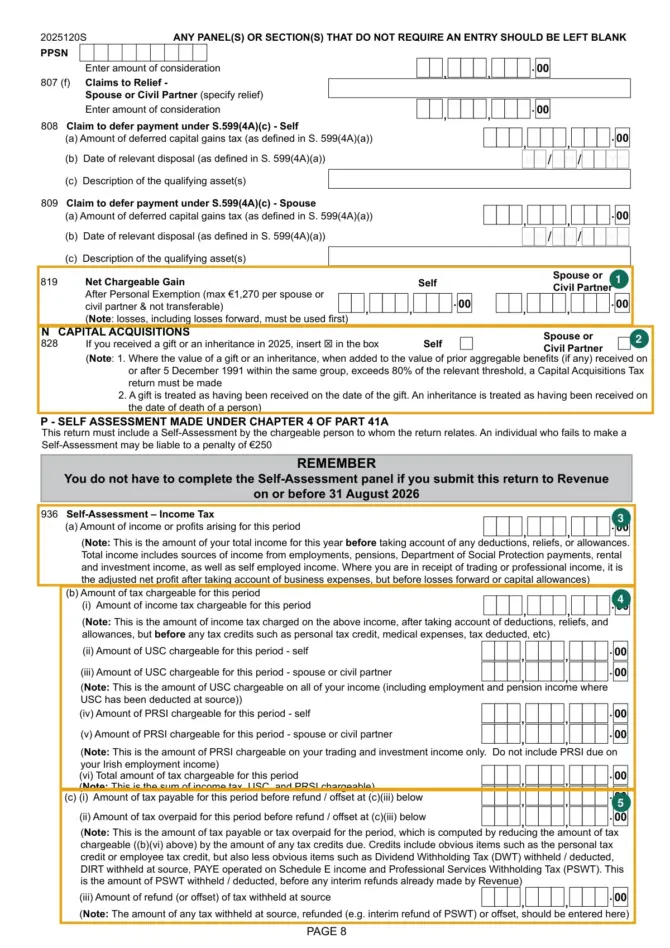
| Frame | Line | What you enter |
|---|---|---|
| 1 | 819 | Net chargeable gain after the €1,270 personal exemption, self and spouse separately |
| 2 | 828 | Tick if you received a gift or inheritance in 2025 |
| 3 | 936(a) | Total income before deductions, reliefs and allowances; trading income as adjusted net profit before losses forward and capital allowances |
| 4 | 936(b)(i) to (vi) | Income Tax chargeable before credits, USC on all income, PRSI on trading and investment income only, then the total |
| 5 | 936(c)(i) to (iii) | Tax payable or overpaid after credits, then any interim refund or offset of tax withheld at source |
The credits taken off at 936(c) include the less obvious ones the form names: Dividend Withholding Tax, DIRT, PAYE on employment income and PSWT before any interim refund. On page 9, lines 936(d) and (e) adjust that result for refunds already made. Line 936(f) is the late filing surcharge and 936(g) the LPT surcharge. Line 936(h)(i) is tax you already paid directly to the Collector-General for 2025, normally your preliminary tax, without the balancing payment you are about to make; 936(h)(ii) is tax deferred under income averaging. Line 936(i) gives the balance payable or overpaid.
Line 937 follows the same pattern for Capital Gains Tax: chargeable gains, tax chargeable after reliefs and the personal exemption, tax deferred under section 599(4A), deferred tax now due, tax payable, the two surcharges, tax already paid and the balance.
Bank details and the expression of doubt on page 10
Refunds are paid only to a SEPA account: give an IBAN of up to 34 characters and a BIC of up to 11. A jointly assessed couple can give the spouse’s or civil partner’s account too. Revenue uses that account for later refunds unless you tell it otherwise.
The expression of doubt under section 959P is for a genuine doubt about how tax law applies to an item in the return, not for general comments. Lines (a) to (e) ask for the facts, the doubt and the law behind it, the tax at stake, the supporting documents you are sending with the return, and the Revenue guidelines you consulted. The guide says the return and supporting papers must arrive by the filing date, and that you can appeal to the Tax Appeal Commissioners within 30 days if Revenue does not accept the doubt as genuine.
What gets a paper return sent back or surcharged
- Panels left half done, or “per attached” and “as before” written instead of figures: Revenue returns incomplete forms, and a surcharge can follow if the corrected return comes back late.
- Accounts, lists or schedules enclosed with the return when the form did not ask for them.
- Line 6 left empty under joint assessment, which the guide says may delay processing.
- No signature under line 936 or 937, which means no self-assessment and a possible €250 penalty.
- Filing on paper when you are a mandatory e-filer.
- Unpaid or unfiled LPT, which adds 10% to the Income Tax due.
Questions about Form 11S
Can I file Form 11S online?
Form 11S is a paper form. Online, Revenue’s filing pages send you to the pre-populated Form 11 in ROS, which also calculates your tax as you go. You need to be registered for ROS first; Revenue suggests allowing at least six working days for registration.
How do I correct a Form 11S I already posted?
Revenue’s pay and file page says paper filers contact their Revenue office to amend the return. Returns filed through ROS are amended in ROS.
What if I am late paying as well as filing?
The surcharge covers the late return. Late payment is separate: Revenue’s preliminary tax page says late payments are charged interest for each day, or part of a day, past the deadline.
Sources
- Form 11S, Income Tax Return and Self-Assessment for the year 2025 (2025120S, Revenue)
- Guide to Completing 2025 Pay & File Self-Assessment Returns (RPC020053_EN_WB_L_1)
- Helpsheet linked for 2025 Form 11S (opens the 2025 Form 11 helpsheet, RPC020302_EN_WB_L_2)
- Filing your tax return
- Pay and file system: how does it work?
- What is preliminary tax?
- What forms do you need to complete?
- Mandatory e-filing