Non-Resident Form V2A is the declaration an individual living outside Ireland signs so that an Irish company can pay dividends to them without deducting Dividend Withholding Tax (DWT). Revenue’s Tax and Duty Manual puts DWT at 25% on relevant distributions made by Irish resident companies from 1 January 2020, and the paying company has to deduct it unless it already holds a valid exemption declaration when the dividend is paid. The form on revenue.ie is dated “DWT Unit, August 2024” and carries the print code RPC018938_EN_WB_L_1.
V2A is not a Revenue application. The shareholder fills in Part 1, has their own country’s tax authority certify Part 2, and hands the form to whoever pays the dividend.
Who can use V2A, and which form a company or trust uses
The notes on page 2 of the form limit V2A to an individual who is neither resident nor ordinarily resident in Ireland for tax purposes and who is resident for tax in a “relevant territory”. A relevant territory is an EU Member State or EEA state other than Ireland, or a country with which Ireland has a Double Taxation Agreement; Revenue keeps the current treaty list on its tax agreements page. The individual must also be beneficially entitled to the dividends. Revenue’s page on exemptions for non-residents adds that the exemption is subject to the outbound payments defensive measures in Chapter 5 of Part 33 of the Taxes Consolidation Act 1997, explained in Tax and Duty Manual Part 33-05-01.
Revenue publishes three non-resident forms, and the person claiming decides which one applies:
| Form | Claimant | How it differs from V2A |
|---|---|---|
| V2A (RPC018938_EN_WB_L_1) | Individual | Part 2 certified by the tax authority of the country of residence |
| V2B (RPC018937_EN_WB_L_1) | Company | Signed by an authorised signatory of the company with no tax authority certificate; the company states which of three conditions in section 172D(3)(b) it meets (resident in a relevant territory, controlled from relevant territories, or shares traded on a recognised stock exchange). Valid from the date the declaration is made. |
| V2C (RPC018936_EN_WB_L_1) | Body of persons that is not an individual or a company, such as a charity, superannuation fund or discretionary trust | Certified by the tax authority like V2A. A discretionary trust also completes Section 3: trustees list the settlors and beneficiaries, and Revenue certifies that it has noted the information. |
Irish resident shareholders who qualify for exemption use a different declaration, which Revenue’s manual calls Composite Resident Form V3. It is not covered here.
Shareholders in the United States who hold American Depositary Receipts have a separate simplified process. Revenue’s non-resident page asks them to contact the DWT Unit rather than use V2A for ADR dividends.
How to fill in V2A, field by field
The form has four pages. Pages 1 and 2 are the cover and the notes; everything that is filled in sits on page 3, split into Part 1 for the shareholder and Part 2 for the foreign tax authority. Page 4 repeats the instructions for Part 2. The marked page 3 shows the numbered areas used in the table.
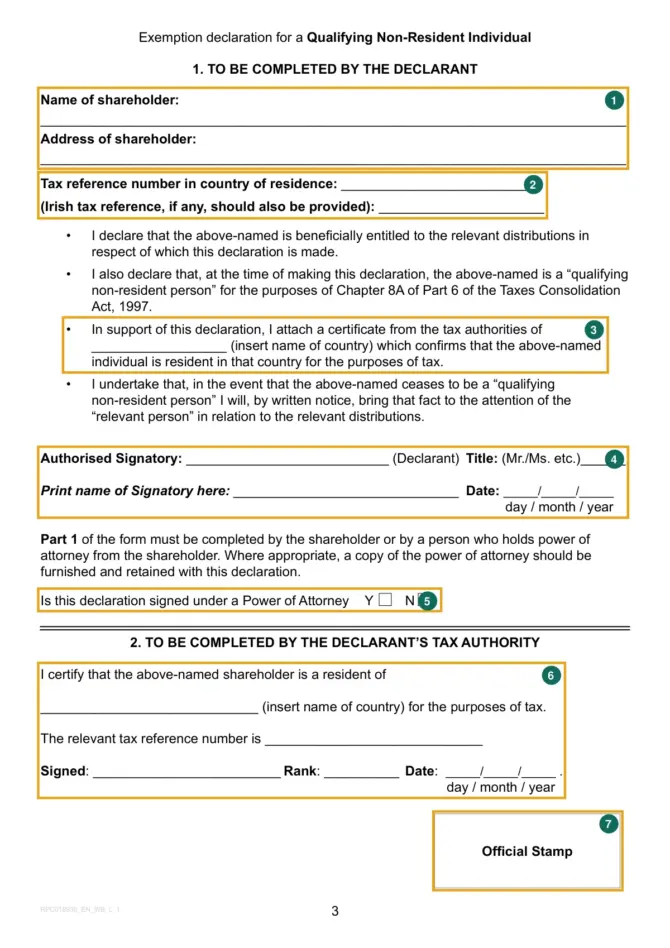
| Marker | Field on page 3 | What goes in it |
|---|---|---|
| 1 | Name and address of shareholder | The individual who is beneficially entitled to the dividends, as registered with the company or the intermediary |
| 2 | Tax reference number in country of residence; Irish tax reference | The foreign tax number, plus an Irish tax reference if the shareholder has one |
| 3 | Country named in the third declaration | The country whose tax authority issues the residence certificate attached to the form |
| 4 | Authorised signatory, title, printed name, date | Signature in ink, Mr./Ms. or other title, name in print and the date as day/month/year |
| 5 | Signed under a power of attorney, Y or N | Y if an attorney signs; a copy of the power of attorney goes with the declaration |
| 6 | Part 2, tax authority certificate | Completed by the foreign tax authority: country of residence, tax reference number, signature, rank and date |
| 7 | Official stamp | The tax authority’s stamp |
Above the signature are four printed statements the shareholder signs up to: they are beneficially entitled to the dividends covered by the declaration; they are a “qualifying non-resident person” under Chapter 8A of Part 6 of the Taxes Consolidation Act 1997 at the time of signing; a certificate from the named country’s tax authority is attached; and they will tell the “relevant person” in writing if they stop qualifying. Under that undertaking, a shareholder who becomes resident in Ireland, or moves to a country outside the EU, the EEA and Ireland’s treaty network, would fall outside the definition on page 2 and has to notify the payer.
Part 1 must be completed by the shareholder or by a person holding their power of attorney. Revenue allows the blank form to be photocopied for later declarations, but every declaration has to be signed and dated in ink so that it is an original.
Getting Part 2 certified by your tax authority
The page 4 instructions say Part 2 must be completed by the tax authority of the country where the shareholder is resident for tax. The officer certifies the country of residence and the tax reference number, signs, gives their rank, dates it and applies the official stamp. The form then goes back to the shareholder, who forwards it to the payer.
Some tax authorities do not sign foreign forms. In that case page 4 accepts a letter from the tax authority to the same effect, provided a translation of the letter into English comes with it. Revenue’s manual describes this as a certificate of residence from the tax authority in the country of residence, which Schedule 2A paragraph 8 of the Act requires for any non-resident declarant who is not a company.
Where V2A goes, and why it does not go to Revenue
Page 1 states that the completed form should not be sent to the DWT Unit to get exemption at source. It goes to the “relevant person” defined in the notes:
- the Irish resident company paying the dividend, when the shareholder holds shares directly (where a registrar handles distributions for a quoted company, Revenue’s manual gives the registrar obligations similar to the company’s);
- the qualifying intermediary (QI) through which the dividend reaches the shareholder;
- an authorised withholding agent (AWA), which takes the company’s place where the company pays dividends through one.
Both QIs and AWAs need Revenue authorisation, and Revenue publishes the list of currently approved ones on its DWT pages. Where shares are held through a chain of intermediaries, section 11.5 of Tax and Duty Manual Part 06-08A-01 says the declaration goes to the QI from which the shareholder finally receives payment, and that QI passes the exempt amount up the chain. If any intermediary in the chain is not a QI, DWT applies; ADRs are the only exception the manual mentions.
The number of forms depends on how the shares are held. Under section 11.3 of the manual, one declaration covers all the shares a QI holds for a client as nominee, whatever the number of companies. Shares held directly need one declaration per company, or one per registrar when several companies use the same registrar. A shareholder who spreads holdings across several QIs gives each QI its own declaration.
Official PDF: DWT Non-Resident V2A — Official PDF (revenue.ie)
How long the exemption lasts
Validity runs from the date the residence certificate in Part 2 is issued until 31 December of the fifth year after the year of issue. The form puts it as the year of signing plus five full calendar years. A certificate issued in March 2026 therefore covers dividends up to 31 December 2031. Revenue’s manual gives a maximum of six years, reached when a certificate is issued on 1 January.
The exemption does not roll over. Revenue’s non-resident page says the shareholder must renew it before the period ends to keep receiving dividends without DWT. Section 10.10 of the manual says the certificates have to be renewed at the end of the period for the shareholder to stay in a QI’s exempt fund.
What makes a payer send V2A back
Section 11.4 of Tax and Duty Manual Part 06-08A-01 sets the minimum the company, AWA or QI may accept, and what happens otherwise:
- A form that is not fully completed and signed cannot be accepted.
- Missing signatures, dates or stamps mean the form is returned to the shareholder for correction, and the holding stays liable to DWT until the corrected form comes back.
- The recipient must not accept a declaration or certificate it has reasonable grounds to believe is untrue or incorrect.
- Page 2 lets the blank form be photocopied, but each declaration must be signed and dated in ink to show it is an original.
- Shares held through an intermediary that is not a QI: the manual’s certification chain says withholding applies, whatever the shareholder has signed.
If DWT has already been deducted
For DWT already withheld before the payer had a valid V2A, Revenue’s page on refunds for non-residents says a qualifying non-resident can claim a refund with the DWT refund claim form, and a certified DWT exemption declaration must accompany each claim. Page 1 of the refund claim form lists the other documents required. This is why page 2 of V2A asks the shareholder to keep a copy of the completed form.
Section 15 of the manual applies the four-year limit in section 865 of the Taxes Consolidation Act 1997: a claim for DWT withheld in one tax year must reach Revenue by the end of the fourth tax year after it. DWT on a REIT dividend is reclaimed on a separate DWT REIT claim form.
Questions about V2A
Can I post V2A to Revenue in Nenagh instead of the company?
Page 1 of the form says it should not be sent to the DWT Unit for exemption at source. The exemption only exists once the paying company, AWA or QI holds the declaration.
Can someone else sign V2A for me?
A person holding your power of attorney may complete and sign Part 1. Tick Y in the power of attorney box and include a copy of the power of attorney with the declaration.
Does a broker account need a separate V2A for every Irish share I own?
If the broker is a QI holding all your shares as nominee, Revenue’s manual says one declaration is enough. Separate declarations are needed per company or registrar only for shares you hold directly.
Official sources
- Non-Resident Form V2A, Exemption from DWT for a qualifying non-resident individual (DWT Unit, August 2024, RPC018938_EN_WB_L_1)
- Non-Resident Form V2B, qualifying non-resident company and Non-Resident Form V2C, qualifying non-resident person
- Exemptions for non-residents
- Refunds for non-residents
- What are a Qualifying Intermediary (QI) and Authorised Withholding Agent (AWA)?
- Tax and Duty Manual Part 06-08A-01, Dividend Withholding Tax: details of scheme (June 2026)
- Tax and Duty Manual Part 06-08B-01, Technical guidance notes on DWT (March 2026)
- Tax and Duty Manual Part 33-05-01, outbound payments defensive measures (March 2026)
- Tax agreements (Double Taxation Agreements)