CT600C is the five-page supplement to the Company Tax Return that records group relief and consortium relief: a company with profits claiming another company’s losses, or a company with losses giving them up to a claimant. The edition HMRC publishes is CT600C (2018) Version 3, printed HMRC 04/18, for accounting periods starting on or after 1 April 2015. It travels with the CT600 and is covered by the same declaration, so the figures on it have to agree with boxes on the main return.
Which companies complete CT600C
HMRC’s guidance for the page lists three situations. You need it if the company is claiming or surrendering any amount under the group or consortium relief provisions, any amount under section 356NA(3)(b) of the Corporation Tax Act 2010 (surplus lease payments not brought into account in working out contractor ring fence profits), or a carried forward loss under the loss reform rules. A company that claims from one group member and surrenders to another fills in both the claim part and the surrender part of its own CT600C.
Group relief runs between members of the same group. In the Company Taxation Manual (CTM80151), two companies are in the same group when one is a 75% subsidiary of the other or both are 75% subsidiaries of a third company, counting direct and indirect ownership of ordinary share capital. Both companies must also be UK related: resident in the UK, or within the charge to Corporation Tax, for example through a UK permanent establishment (CTM80150).
Consortium relief uses the same boxes. CTM80530 describes a consortium as members who between them beneficially own at least 75% of the ordinary share capital of the company they own directly, each holding at least 5%. The consortium-owned company may be a trading company, a holding company of 90% trading subsidiaries, or such a trading subsidiary. If that company is a 75% subsidiary of any one company, relief goes through the group relationship and not the consortium one.
On the CT600 itself, box 105 (“Group and consortium – form CT600C”) is where you put an X to show the page is enclosed. The GOV.UK download page for Version 3 still says the form is for claims under “unrelieved foreign tax provisions” as well, wording that also appears on the page for the older CT600C (2006) Version 2. The Version 3 form has no box for foreign tax, and HMRC’s completion guidance for it does not mention foreign tax at all: its boxes cover group and consortium relief only.
Company details and period: boxes C1 to C4
Box C1 takes the company name and C2 its 10-digit Unique Taxpayer Reference. Boxes C3 and C4 are the start and end dates of the period the page covers, in DD MM YYYY format. That period cannot exceed 12 months.
Part 1: claiming group relief, boxes C5 to C40
Part 1, on page 2, is for a company that is claiming group relief in working out its Corporation Tax payable. Claims for carried forward losses do not go here: the guidance sends them to Part 3. Consortium claims do go here, with a copy of the notice of consent of each member of the consortium attached.
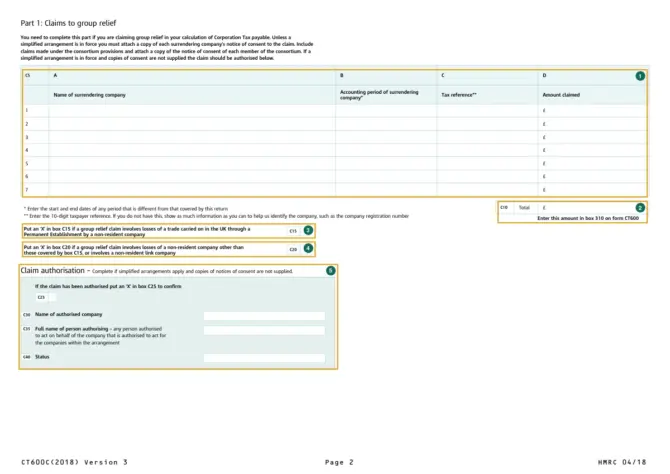
| Box | What to enter | Where it goes |
|---|---|---|
| C5, column A | Name of each surrendering company, one row per surrender (seven rows). | Stays on CT600C. |
| C5, column B | The surrendering company’s accounting period, only if it differs from the period of this return (start and end dates). | Stays on CT600C. |
| C5, column C | The surrendering company’s 10-digit tax reference, or other identifying details such as its company registration number. | Stays on CT600C. |
| C5, column D | Amount claimed from that company, in pounds. | Adds up to C10. |
| C10 | Total amount of group relief claimed. | Box 310 of the CT600. |
| C15 | X if a claim involves losses of a trade carried on in the UK through a permanent establishment of a non-resident company. | Flag only. |
| C20 | X if a claim involves losses of a non-resident company not covered by C15, or a non-resident link company. | Flag only. |
| C25 to C40 | Claim authorisation under a simplified arrangement: X in C25, then the authorised company’s name (C30), the full name of the person authorising (C35) and their status (C40). | Only when copies of consent are not supplied. |
A claim “involves” a non-resident, in the guidance’s words, if the claimant, the surrendering company or any company through which their group relationship is established is non-resident. Losses of a non-resident company, other than those of a UK permanent establishment, cannot be claimed for an accounting period starting on or after 27 October 2021. A period that straddles that date is treated as two: one ending on 26 October 2021 and one starting on 27 October 2021. CTM80310 covers the permanent establishment case behind box C15.
Each row in C5 is a separate claim. CTM97010 says a claim must name the surrendering company and state the amount in figures; “enough relief to bring profits down to” a target is not a valid claim, and a separate claim is needed from each surrendering company for each accounting period. The amount can be less than the surrendering company has available, but the total claimed from one company cannot exceed what it has available for surrender, and nothing is available until that company has made its own return (CTM97015).
Part 2: surrendering losses and other amounts, boxes C45 to C120
Page 3 is for the company giving up relief. The first block splits the surrender by type. Carried forward losses stay out of it; the guidance sends them to Part 4.
The right-hand column gives the CT600 box in which the surrendering company shows the maximum available for surrender of the same type.
| Box | Amount surrendered | CT600 maximum available box |
|---|---|---|
| C45 | Trading losses, total | 785 |
| C46 | Trading losses, Northern Ireland: leave blank | None (boxes 856 to 858 are also left blank) |
| C50 | Excess non-trade capital allowances over the income they are primarily deductible from | 840 |
| C55 | Non-trading deficit on loan relationships | 800 |
| C60 | Excess qualifying charitable donations over profits, including grassroots sport donations | 845 |
| C65 | Excess UK property business losses over profits | 810 |
| C70 | Excess management expenses over profits | 855 |
| C75 | Non-trading deficit on intangible fixed assets | 835 |
| C80 | Total of C45 to C75 | None |
Box C85 then lists each claimant: name, its accounting period if different from this return’s, its tax reference or other identifying details, and the amount surrendered to it, with five rows. C90 is the total of those amounts.
The section headed “Details of company surrendering relief” (C95 company name, C100 tax reference, C105 and C110 accounting period start and end dates, C115 full name of the person authorising, C120 status) is filled in whole only if the page is being used as the notice of consent. Above C115 sits a certificate that the information is correct and complete. Any authorised person may complete it for the company, except where a liquidator or administrator has been appointed.
A company surrendering amounts also has to fill in the losses, deficits and excess amounts section of its CT600 (COM53050). The CT600 guide asks for the maximum available for surrender as group relief in boxes 785, 800, 810, 835, 840, 845 and 855, excluding amounts available only as carried forward losses.
Parts 3 and 4: carried forward losses, boxes C125 to C225
Pages 4 and 5 repeat the claim and surrender layout for group relief for carried forward losses. The CT600 guide says this relief can be claimed for losses arising after 1 April 2017, and CTM82000 is the manual section it points to.
Part 3 is the claim. C125 has seven rows for surrendering companies (name, accounting period if different, tax reference, amount claimed) and C130 is the total, copied to box 312 of the CT600. Put an X in C135 if a claim involves losses of a UK permanent establishment of a non-resident company; Part 3 has no equivalent of C20. C140 to C155 are the simplified arrangement authorisation, as in Part 1.
Part 4 is the surrender: C160 trading losses carried forward, C161 Northern Ireland (leave blank), C165 non-trading deficit on loan relationships carried forward, C170 UK property business losses carried forward, C175 management expenses carried forward, C180 non-trading deficit on intangible fixed assets carried forward, and C185 the total. C190 lists claimant companies and C195 totals them. C200 to C225 are the surrendering company’s details and authorisation when the page doubles as the notice of consent.
For a carried forward loss, the notice of consent also has to identify the particular loss or amount being surrendered and the provision under which it was carried forward (CTM97020). Box 312’s computations must show the deductions allowance used, under section 269ZZ(1)(a) of the Corporation Tax Act 2010. If the company belongs to a deductions allowance group, the allowance is shared and the group nominates one member to submit a group allowance allocation statement, which can go as a PDF attachment with that company’s return.
Notices of consent and simplified arrangements
Outside a simplified arrangement, every group relief claim needs the surrendering company’s written consent, given to the HMRC office that deals with its returns at or before the time the claim is made. A copy goes with the claim, which is why Parts 1 and 3 ask for copies to be attached. A consortium claim also needs the consent of each consortium member (CTM97020). The notice must give both company names, the amount surrendered, the surrendering company’s accounting period and both tax references. Parts 2 and 4 of CT600C can serve as that notice if the surrendering company’s details and the authorising person are filled in.
The surrendering company then sends a copy of the consent to the HMRC office dealing with the claimant’s return, before or at the same time as the claimant files the return making the claim. For accounting periods ending on or after 1 April 2017, a surrendering company that has already had relief for an amount it now consents to surrender must amend its own return at the same time; if it does not, the notice is ineffective.
Under a simplified arrangement (Corporation Tax (Simplified Arrangements for Group Relief) Regulations 1999, SI 1999/2975), an authorised company makes claims and surrenders for the other companies in the arrangement through a written statement, and individual notices of consent can be dispensed with. On CT600C that shows as the authorisation block: C25 to C40 in Part 1 and C140 to C155 in Part 3. The arrangement changes the procedure only; it does not change the amount that can be claimed or extend the time limits (CTM97610).
A claim or a consent cannot be edited. To change an amount, the claim is withdrawn and replaced by amending the return, and a surrendering company withdraws its notice and gives a new one; a notice of withdrawal needs the claimant company’s consent attached (CTM97005, CTM97035).
How CT600C ties to the CT600
- Box 105: X to show CT600C is enclosed.
- Box 310 (group relief) equals C10. It should not exceed box 300 minus box 305.
- Box 312 (group relief for carried forward losses) equals C130. It should not exceed box 300 minus boxes 305 and 310.
- Boxes 785, 800, 810, 835, 840, 845 and 855: maximum available for surrender, completed by a surrendering company.
- Boxes 856 to 858 (Northern Ireland information): left blank, like C46 and C161.
Box 300 is profits before qualifying donations and group relief, and box 305 is qualifying donations. A payment the claimant makes to the surrendering company for the relief, up to the amount surrendered, is ignored for tax in both companies if it is made under an agreement between them (CTM80145).
Deadlines for the return and for group relief claims
CT600C has no filing date of its own. The Company Tax Return is due 12 months after the end of the accounting period it covers. Paying the Corporation Tax has a separate deadline, usually 9 months and one day after the period ends, and a group relief claim reduces the profits that tax is worked out on. A late return costs £200 after one day and another £200 after three months; at six months HMRC estimates the tax and adds 10% of the unpaid tax, and at twelve months another 10%. Three late returns in a row raise each £200 penalty to £1,000. The CT600 guide says these warnings apply to supplementary pages too.
Group relief claims run on a separate clock. CTM97045 allows a claim to be made or withdrawn up to the first anniversary of the filing date for the claimant’s accounting period, normally two years after its end. If HMRC opens an enquiry, the limit moves to 30 days after the enquiry is completed, after a notice of amendment, or after an appeal is finally determined, whichever is latest (CTM97050). A claim made after the original return is made by amending that return (CTM97005).
If the surrendering company’s available amount later falls below what it has already surrendered, it has 30 days to withdraw notices of consent, and give new ones if appropriate, so that the total fits. Otherwise HMRC can direct which claims fail or are reduced, and the claimant amends its return (CTM97070).
Checks before CT600C goes in
- C10 equals box 310 and C130 equals box 312 on the CT600.
- C3 and C4 cover no more than 12 months.
- Each C5 or C125 row names one surrendering company and gives an amount in pounds, not a formula.
- A copy of each surrendering company’s notice of consent, and each consortium member’s, is attached, or C25 to C40 (C140 to C155) are completed under a simplified arrangement.
- Carried forward loss claims are in Part 3 only, and their consents identify the loss and the provision it was carried forward under.
- C46, C161 and CT600 boxes 856 to 858 are blank.
- A surrendering company has completed the CT600 maximum-available boxes (785 to 855) and, where needed, amended its own return.
- Box 105 on the CT600 is marked.
Filing online, paper copies and where to get CT600C
HMRC’s own “File your accounts and Company Tax Return” service closed on 31 March 2026. Since 1 April 2026 the CT600 and its supplementary pages are filed with commercial software, and HMRC’s advice is to check that the software chosen can file the CT600, the tax computation and the company accounts.
The paper CT600 can be used only if the company has a reasonable excuse, is filing in Welsh, or is amending a return already submitted. A paper return, with CT600C attached, goes to Corporation Tax Services, HMRC, BX9 1AX. If the reason for paper is an IT problem with HMRC online services, form WT1 has to go with it. The PDF of CT600C (2018) Version 3 is on the GOV.UK CT600C page, and the box notes are in HMRC’s guide Completing the CT600C page for group and consortium relief.
Group relief rules can turn on share ownership tests, arrangements to sell a company and non-coinciding accounting periods (CTM80165 and CTM80210 onwards). Where those apply, the Company Taxation Manual or a tax adviser is the place to settle the amount before it goes on the page.
Official PDF: CT600C — Official PDF (assets.publishing.service.gov.uk)
Questions about CT600C
Does the surrendering company need a CT600C as well as the claimant?
Each company that claims or surrenders completes the page with its own return. The claimant fills in Part 1 or Part 3, the surrendering company Part 2 or Part 4, and Part 2 or 4 can double as its notice of consent.
Can a group relief claim be made after the CT600 has been filed?
A claim can be added by amending the return, up to the first anniversary of the filing date for that accounting period, or later where an enquiry extends the limit (CTM97005, CTM97045).
What happens if the surrendering company’s accounting period is different?
Enter its start and end dates in column B of C5 (or C85 for the claimant’s period). CTM80210 onwards explains how the relief is limited to the overlapping period.
Sources
- HMRC CT600C (2018) Version 3, Group and consortium relief, HMRC 04/18
- Completing the CT600C page for group and consortium relief, GOV.UK
- Corporation Tax: group and consortium relief (CT600C), GOV.UK
- Completing your Company Tax Return (CT600 guide), GOV.UK
- HMRC CT600 (2026) Version 3, Company Tax Return, HMRC 04/26
- Company Tax Return (CT600), GOV.UK
- Filing company accounts and tax returns if you previously used the HMRC online service, GOV.UK
- Company Tax Returns, GOV.UK
- HMRC COTAX Manual COM53050, CT600C supplementary pages
- HMRC Company Taxation Manual CTM97000 onwards, group relief claims under CTSA
- HMRC Company Taxation Manual CTM80145, claims for relief
- HMRC Company Taxation Manual CTM80150, which companies may claim and surrender
- HMRC Company Taxation Manual CTM80151, the group relationship
- HMRC Company Taxation Manual CTM80530, members of a consortium