When a married person or civil partner dies and most of their estate goes to the surviving partner, part or all of their Inheritance Tax nil rate band is left unused. That unused share is not carried over automatically. When the survivor later dies, the personal representatives claim it on Schedule IHT402 (edition HMRC 04/25), and the percentage they work out on the form increases the nil rate band on the survivor’s estate, up to double.
Who fills in IHT402
The schedule is for the estate of the person who has died now, not the estate of the spouse or civil partner who died first. Page 1 sets four conditions: the deceased died on or after 9 October 2007, their spouse or civil partner died before them, that earlier estate did not use up all the nil rate band available to it, and you want to transfer the unused amount. The IHT400 asks the question at box 29c (“Do you want to transfer any unused nil rate band from the deceased’s spouse or civil partner who died before them?”), and a Yes means using IHT402.
The GOV.UK guidance on transferring the basic threshold adds that the couple must have been married or in a civil partnership when the first death occurred. The IHT400 declaration repeats this for anyone who has filled in IHT402, and also asks you to confirm that, where no deed of variation is provided, nobody different inherited the first spouse’s estate.
Not every estate needs the schedule:
- Excepted estates where the death was on or after 1 January 2022: GOV.UK says any unused amount can be transferred and it should be claimed when you apply for probate. In Scotland, the form is C1.
- Excepted estates where the death was on or before 31 December 2021: only the full unused threshold could be claimed, on form IHT217. Transferring less than the full amount takes the estate out of the excepted category, and a full IHT400 with IHT402 is needed.
- Estates that use the reduced IHT400 because the gross value passing to anyone other than a spouse, civil partner, charity or national body is within the nil rate band: the IHT400 Notes let you add the transferred amount to the nil rate band when testing whether the reduced form applies. Question 29c is one of the questions whose schedule must still be filled in on a reduced account, alongside question 35 (IHT408, household and personal goods donated to charity) and question 36 (IHT409, pensions).
IHT402 covers the basic nil rate band only. The residence nil rate band has its own transfer schedule, IHT436 (IHT400 box 29b), and the unused 100% relief allowance for agricultural or business property is claimed on IHT437 (box 29d).
What you need from the first spouse’s estate
Boxes 1 to 17 describe the first spouse’s estate, which may have been dealt with long before. The form tells you to find out who was the executor or administrator of that estate and get information from them. If no records exist, it suggests asking the solicitor who acted for the estate, family members or close friends. You need to know who benefited under the will or intestacy and what they received, whether jointly owned assets or trust assets formed part of the estate, and whether the first spouse made chargeable gifts in the 7 years before death (10 years for deaths between 27 July 1981 and 17 March 1986).
Copies of grants and wills can be searched through the probate records service in England and Wales, Scottish Courts and Tribunals in Scotland and the Department of Justice in Northern Ireland. Death, marriage and civil partnership certificates come from the General Register Office, National Records of Scotland or nidirect.
How to fill in IHT402, box by box
The top of page 1 takes the name of the person who has died now, their date of death and the Inheritance Tax reference if you have one. Boxes 1 to 17 are all about the spouse or civil partner who died first.
| Box | What it asks | Where the answer comes from |
|---|---|---|
| 1 to 5 | First spouse’s title and names, date of death, last permanent address, date and place of marriage or civil partnership | Death and marriage certificates. Box 5 wants the building, church or register office and the locality. |
| 6 | Did they leave a will? | If Yes, enclose the will with any codicils, instruments of variation or disclaimers. |
| 7 | Net value of the estate passing under the will or intestacy | The grant, if one was taken out; otherwise all the assets less the liabilities. |
| 8 | Was a grant (confirmation in Scotland) obtained? | Yes: enclose a copy of the grant. No: enclose a copy of the death certificate. |
| 9 | Nil rate band in force at the first death | HMRC’s thresholds table, which covers Inheritance Tax, Capital Transfer Tax and Estate Duty. |
| 10 | Chargeable value of gifts in the 7 years before the first death | Value after exemptions and reliefs. |
| 11 | Box 9 minus box 10 | Calculation. |
| 12 | Residence nil rate band used, for first deaths on or after 6 April 2017 | The lower of the value of the home passing to direct descendants and the maximum residence nil rate band for that year. |
| 13 | Legacies and assets passing under the will or intestacy | Each legacy with its value, leaving out anything that passed to the person who has died now. |
| 14 to 16 | Jointly owned assets, trust assets the first spouse could benefit from, gifts with reservation | Chargeable value only, again excluding what passed to the survivor. |
| 17 | Total chargeable estate | Box 13 + box 14 + box 15 + box 16. It can be nil. |
Box 9: which nil rate band to use
Use the threshold in force on the date the first spouse died, not today’s figure. HMRC’s thresholds page lists them back to 1914: for example £312,000 for deaths from 6 April 2008 to 5 April 2009, £300,000 for 2007 to 2008 and £250,000 for 2002 to 2003. If the grant shows that tax or duty was paid on the first death, note 1 says there is no nil rate band available for transfer.
Boxes 13 to 16: what counts as chargeable
Note 3 says to enter the value that was chargeable to tax, after exemptions and reliefs. Spouse exemption has changed over the years, and the note sets out what to include for each period:
- First death before 22 March 1972: Estate Duty had no spouse exemption, so everything passing under the will, intestacy or survivorship goes in box 13, whoever received it.
- 22 March 1972 to 12 November 1974 inclusive: spouse exemption was limited to £15,000, so anything passing to the survivor above £15,000 goes in box 13.
- 13 November 1974 to 5 April 2025: no limit, unless the first spouse was UK domiciled and the survivor was not. Then the limit was £55,000, and after 6 April 2013 the nil rate band.
- From 6 April 2025: no limit, unless the first spouse was a long-term UK resident and the survivor was not, when the limit is the nil rate band.
Where a value went into box 12, box 13 must include the full value of the home, or share of it, that passed to direct descendants.
Boxes 18 to 23: working out the transferable nil rate band
Page 3 turns the unused amount into a percentage and applies it to the nil rate band at the second death. The numbered frames below match the box numbers.
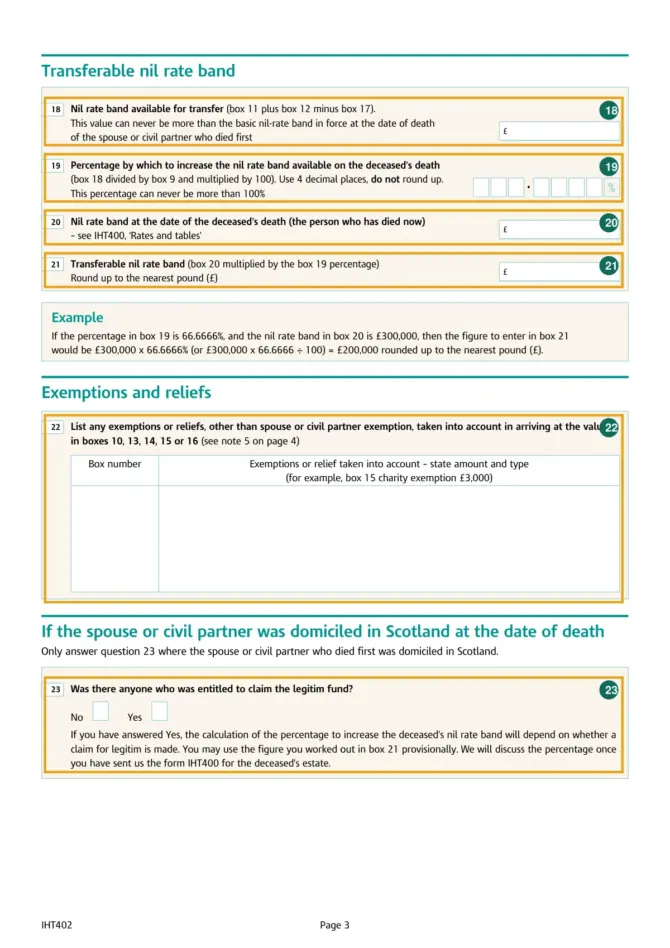
| Box | Calculation | Limit or rounding |
|---|---|---|
| 18 | Box 11 plus box 12 minus box 17 | Never more than the basic nil rate band at the first death |
| 19 | Box 18 divided by box 9, multiplied by 100 | 4 decimal places, not rounded up; never more than 100% |
| 20 | Nil rate band at the date of the second death | From IHT400 “Rates and tables” |
| 21 | Box 20 multiplied by the box 19 percentage | Rounded up to the nearest pound |
| 22 | Exemptions or reliefs, other than spouse exemption, used in boxes 10 and 13 to 16 | Box number, amount and type, for example charity exemption on box 15 |
| 23 | Was anyone entitled to claim the legitim fund? | Only where the first spouse was domiciled in Scotland |
Box 21 is the figure carried to the IHT400: it goes into box 116, “Transferable nil rate band”, and is added to the nil rate band in box 115 to give the total nil rate band in box 117. The IHT400 says not to deduct it at box 92 or 93 with the exemptions and reliefs. Nothing is paid with IHT402; any tax is worked out on the IHT400.
If you could not find out whether an exemption or relief applied on the first death, note 5 says to leave box 22 blank. If you include an asset that might have qualified but you are not sure, tell HMRC and it will discuss the point with you. A Yes at box 23 means the percentage depends on whether legitim is claimed; you can use the box 21 figure provisionally and HMRC will discuss the percentage after it receives the IHT400.
A worked example
Suppose the first spouse died in October 2008 and left £78,000 to the children and the rest to the surviving partner. There were no gifts in the previous 7 years and the death was before the residence nil rate band existed. The survivor dies in 2026.
| Box | Entry |
|---|---|
| 9 | £312,000 (threshold from 6 April 2008 to 5 April 2009) |
| 10 | £0 |
| 11 | £312,000 |
| 12 | £0 |
| 13 and 17 | £78,000 |
| 18 | £312,000 + £0 − £78,000 = £234,000 |
| 19 | £234,000 ÷ £312,000 × 100 = 75.0000% |
| 20 | £325,000 (threshold from 6 April 2009 to 5 April 2031) |
| 21 | £325,000 × 75.0000% = £243,750 |
On the survivor’s IHT400, box 116 is £243,750 and the total nil rate band in box 117 is £568,750. Had the first spouse left everything to the survivor, box 19 would be 100% and the total would be £650,000, the maximum the GOV.UK guidance gives for the basic threshold.
What goes in with IHT402
- A copy of the grant of representation (confirmation in Scotland) for the first spouse’s estate, or the death certificate if no grant was taken out
- A copy of the first spouse’s will, if there was one, with codicils
- A copy of any deed of variation or similar document that changed who inherited the first estate
- The IHT400, with box 29c answered Yes, IHT402 ticked in the list of schedules on the declaration page and box 116 filled in
IHT402 has no signature box of its own. The IHT400 declaration on pages 15 and 16 covers the account and the schedules ticked on page 15, and each person delivering the account signs page 16.
Deadline for the IHT402 claim
The claim has its own time limit: send IHT402 no later than 24 months after the end of the month in which the person who has died now died. The IHT400 Notes give the same rule. A survivor who dies on 12 March 2026, for instance, gives a deadline of 31 March 2028. The GOV.UK guidance page summarises this as within 2 years of the survivor’s death; the form and the Notes use the month-end wording.
GOV.UK says to use IHT402 with the IHT400, which is due within 12 months of the date of death, with interest payable after 6 months.
Getting IHT402 and where to send it
The fillable PDF is on the GOV.UK IHT402 page, with a Welsh version (Hawlio trosglwyddiad o haen cyfradd sero sydd heb ei defnyddio). GOV.UK says to complete it on screen in Adobe Reader. Send it with the IHT400 and the other schedules to Inheritance Tax, HM Revenue and Customs, BX9 1HT. The Inheritance Tax helpline on the form is 0300 123 1072, or +44 300 123 1072 from outside the UK.
Official PDF: IHT402 — Official PDF (assets.publishing.service.gov.uk)
Questions about IHT402
Can the unused nil rate band be claimed if the first spouse died before 2007?
The 9 October 2007 date applies to the second death. The first spouse can have died earlier, and note 3 on the form covers first deaths as far back as the Estate Duty period before 22 March 1972.
What if there are no records of the first spouse’s estate?
The form asks you to make full enquiries of people who might know, such as the solicitor who acted, the executors or family members, and to obtain copies of the grant, will and certificates from the probate registries and General Register Offices.
Does IHT402 also transfer the residence nil rate band?
The unused residence nil rate band is claimed on Schedule IHT436, answered at IHT400 box 29b. IHT402 box 12 only records how much residence nil rate band the first estate used.
Where does the IHT402 figure go on the IHT400?
Box 21 of IHT402 goes in IHT400 box 116 and is added to the box 115 nil rate band to give box 117.
Sources
- HM Revenue and Customs, Claim to transfer unused nil rate band, Schedule IHT402, HMRC 04/25 (PDF)
- GOV.UK, Inheritance Tax: claim to transfer unused nil rate band (IHT402)
- GOV.UK, Transferring unused basic threshold for Inheritance Tax
- GOV.UK, Inheritance Tax thresholds and interest rates
- HM Revenue and Customs, Inheritance Tax account IHT400, HMRC 04/26 (PDF)
- HM Revenue and Customs, Guide to completing your Inheritance Tax account, IHT400 Notes 2022, HMRC 04/26 (PDF)