IHT403 goes with an IHT400 account when the person who died had given things away, set up or added to a trust, paid life insurance premiums for someone else, or lost a right to benefit from trust assets during their lifetime. The chargeable value of gifts made in the 7 years before death reduces the nil rate band left for the estate, so the total you carry from this schedule changes the tax calculation on IHT400. The English PDF now on GOV.UK is marked HMRC 06/26: it was updated on 6 April 2026 for the new Agricultural Relief and Business Relief rules and replaced again on 22 June 2026 to correct the wording of question 12.
Which gifts go on IHT403
The schedule covers gifts and transfers made on or after 18 March 1986. A gift is wider than a cheque or a present. HMRC’s IHT400 notes count any transaction that caused a ‘loss to the donor’, and give examples such as selling a house to a son for less than its open market price, granting a lease below full market rent, rearranging the shares of a private company or altering the rights attached to them, and agreeing to act as guarantor for someone else’s debts. Where you cannot tell whether a transaction belongs on the form, the notes say to phone the Inheritance Tax Helpline on 0300 123 1072.
Gifts to a spouse or civil partner that are covered by the Spouse or Civil Partner Exemption stay off the schedule, and so do small gifts of up to £250. On the £3,000 limit, the form and the notes are worded differently. Page 1 of IHT403 says not to report gifts where the total value was £3,000 or less in any tax year. The IHT400 notes (printed page 14, question 30) let you answer No and skip the schedule only where the remaining gifts were outright gifts to an individual of money or listed stocks and shares wholly covered by the Annual Exemption, or regular gifts out of income that did not exceed £3,000 in each year. A non-cash gift worth less than £3,000, such as a piece of furniture, is inside the form’s wording but outside the notes’ list. Neither document resolves this, so check with the helpline before leaving such a gift off.
Questions 1 to 6 on page 1
Enter the deceased’s name, date of death and the Inheritance Tax reference number if you already have one. Then answer the six Yes or No questions by putting an X in one box for each. A Yes to any of them means full details on pages 2 to 7; a Yes to question 6 extends that to page 8.
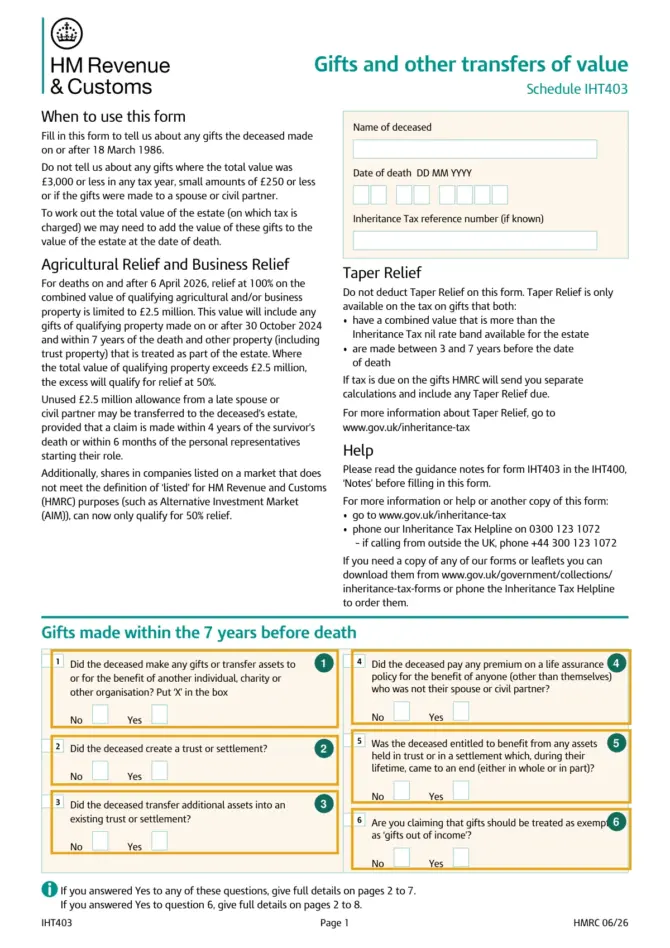
| Question | Answer Yes when | What the IHT400 notes add |
|---|---|---|
| 1 | The deceased made gifts or transferred assets to or for the benefit of another individual, a charity or another organisation. | Includes sales below market value and other ‘loss to the donor’ arrangements. |
| 2 | The deceased created a trust or settlement. | For gifts into trust on or after 22 March 2006, HMRC calculates tax at the rate for the date of the gift, unless one of the disabled person trust conditions applies. |
| 3 | The deceased added assets to an existing trust or settlement. | Same rules as question 2. |
| 4 | The deceased paid a premium on a life assurance policy for the benefit of anyone other than themselves, their spouse or civil partner. | Send a copy of the policy and related documents such as trust deeds and loan agreements. |
| 5 | The deceased was entitled to benefit from trust assets and that entitlement ended, wholly or partly, during their lifetime. | The entitlement may have ended under the trust terms or because the deceased asked the trustees to change it. |
| 6 | You are claiming that gifts were exempt as ‘gifts out of income’. | Complete the income and expenditure table at boxes 20 to 22 as well as the gift details. |
For question 4, one copy is enough when there are several identical policies, but every premium paid must still be listed, even if you are claiming the gifts out of income exemption. If the deceased also bought an annuity at any time and the life policy was taken out after 27 March 1974, send the annuity documents too: the notes warn that the out of income exemption may not be available against the premiums in that situation. The same policy can also belong on IHT410, life assurance and annuities, which covers policies payable to beneficiaries under a trust when the deceased paid the premiums.
Page 2: who HMRC contacts about tax on the gifts
If Inheritance Tax is due on the gifts, the people who received them are liable for it, separately from any tax on the estate. A year after the date of death, the executors or administrators also become jointly liable for the tax on the gifts. HMRC can only contact you about the gifts if the recipients have authorised you to deal with HMRC on their behalf.
Page 2 asks whether they have. If the answer is Yes, go straight to question 7. If No, enter the people HMRC should contact about the tax on lifetime gifts: surname or agent name, first names, phone number, address and postcode. There is room for six contacts.
Whether the recipients pay anything depends on the total. The IHT400 notes explain that gifts below the nil rate band use it up first: the estate then has less nil rate band, and the personal representatives pay the resulting tax on the estate. When the gifts add up to more than the nil rate band, tax falls on the gifts themselves and the recipients pay it.
How to fill in box 7, column by column
Box 7 runs across pages 3 and 4 and lists the gifts made within the 7 years before death. Each row is one gift.
| Column | What to enter |
|---|---|
| Date of gift | Day, month and year. |
| Name and relationship | The person, charity or organisation that received the gift and how they were related to the deceased, for example son, daughter or business partner. |
| Description of assets | Cash, the address of a house, the number of shares in a named company, or the premium paid on an insurance policy. |
| Type of exemption or relief | For example charity exemption, Agricultural Relief or Business Relief. For a charity, give its full name, the country where it is established and its HMRC charities reference if available. |
| A, value at date of gift | The value when the gift was made. |
| B, exemptions or reliefs deducted | The amount of exemption or relief taken off. Taper Relief is never deducted here. |
| C, percentage of relief claimed | 100% or 50%. |
| D, net value | A minus B. |
Add up column D and copy the total to IHT400 box 113, or to box 4 of the separate IHT400 Calculation form if the simple calculation on IHT400 does not fit the estate. Box 4 of the Calculation form says not to include gifts with reservation there; they go to IHT400 box 104 through box 17 of this schedule.
Taper Relief reduces only the tax on gifts made between 3 and 7 years before death, and only where the combined gifts exceed the nil rate band available for the estate. The form says not to deduct it: HMRC sends separate calculations including any Taper Relief due. Fall in value relief is handled the same way. It can apply when an asset given away was worth less at the date of death, and only if the gifts exceed the nil rate band. To claim it, the notes say to put the date-of-death value in the description of assets column without altering the value figures; HMRC looks at the claim after the grant.
Exemptions you can deduct in column B
The amounts below come from the exemptions section of the IHT400 notes (printed page 78) and the GOV.UK page on gifts.
- Small gifts: up to £250 per person in any tax year, to any number of people. GOV.UK adds that this cannot be used for someone who has received another allowance from the deceased.
- Annual exemption: £3,000 in a tax year. Any unused part can be carried forward to the next tax year only.
- Gifts on a marriage or civil partnership: £5,000 from a parent or step-parent of either party, £2,500 from a grandparent, £1,000 from anyone else.
- Normal expenditure out of income: exempt if the gifts came from income and not capital, formed an established pattern and did not reduce the deceased’s usual standard of living.
- Spouse or civil partner: transfers are exempt, except that where the giver was a long-term UK resident and the recipient was not, the exemption is limited to the nil rate band at the time (£55,000 for transfers before 6 April 2013). For transfers on or before 5 April 2025 the test is domicile.
- Charities and registered housing associations: outright gifts are exempt. Outright gifts to a political party are exempt if at the last general election before the gift it had at least 2 MPs elected, or one MP and at least 150,000 votes.
One exception applies to box 7. When a gift with reservation turns into an outright gift because the reservation ended, the notes say no exemptions can be deducted from its value.
Agricultural Relief and Business Relief for deaths from 6 April 2026
New rules apply where a gift of qualifying agricultural or business property was made on or after 30 October 2024 and the donor died on or after 6 April 2026. Relief at 100% is limited to a combined £2.5 million per individual. That £2.5 million includes qualifying gifts made within 7 years of the death and other property, trust property included, that is treated as part of the estate. Value above it qualifies for relief at 50%. Shares in companies on a market that is not ‘listed’ for HMRC purposes, such as AIM, now qualify only for 50%. Column C exists for this split: enter 100% or 50% for each gift.
Unused allowance from a spouse or civil partner who died earlier can be transferred to the deceased’s estate. The claim must be made within 4 years of the survivor’s death or within 6 months of the personal representatives starting their role. IHT400 question 29d sends that claim to Schedule IHT437.
Gifts with reservation and pre-owned assets, boxes 8 to 17
A gift with reservation is one the recipient did not fully own, or one the deceased kept some benefit from. The notes give three examples: a house given to a son while the parent lived on there without paying rent, a painting given away that stayed on the parent’s wall, and a building society account put in a daughter’s name while the parent kept the interest. Unlike outright gifts, there is no 7-year limit: these questions cover every gift on or after 18 March 1986.
Questions 8 and 9 ask whether the deceased kept use, enjoyment or a benefit from a gifted asset, or whether the recipient never took full possession. Questions 10 and 11 apply to houses and land: whether the deceased, or their spouse or civil partner, kept a significant right or interest that let them occupy or benefit, or was party to an arrangement such as a lease or trust. A Yes to any of them means a row in the box 12 table, where column A is the value at the date of death.
In the house and painting examples, paying rent at the market rate means the asset is not added to the estate, but the gift is still reported in this section. If the reservation ended within the 7 years before death, do not list the gift here. Put it in box 7 instead, valued at the date the reservation ended, because HMRC treats that date as the date of the gift.
Questions 13 to 15 deal with pre-owned assets, the Income Tax charge introduced in the 2005 to 2006 tax year on assets someone gave away but kept benefiting from, or helped another person buy and then benefited from. The table at box 16 is needed when the deceased elected, on form IHT500, to have the asset treated under the reservation of benefit rules (question 14), or contributed to the purchase of an asset they benefited from (question 15). It asks for the date of transfer or purchase, the date of the IHT500 election, a description (the address for a house or land), the POA reference number, the exemption or relief and columns A to D on date-of-death values. An election cannot be made on the deceased’s behalf after death.
Box 17 is the box 12 total plus the box 16 total. Copy it to IHT400 box 104.
Earlier transfers and gifts out of income, boxes 18 to 22
Question 18 asks whether the deceased made chargeable transfers in the 7 years before the earliest gift listed in box 7. HMRC needs these to work out tax on the later gifts, not on the estate. If the answer is No, go to box 20 if you answered Yes to question 6; otherwise the form is finished. If Yes, give the details in box 19, and leave their value out of every tax calculation.
A chargeable transfer here is a gift not wholly covered by exemptions that was made before 18 March 1986, or made between 18 March 1986 and 21 March 2006 to a company or the trustees of a discretionary trust, or made on or after 22 March 2006 to anyone other than an individual, a disabled trust or a bereaved minor’s trust arising when an immediate post-death interest ends. Gifts from one individual to another do not go in box 19. In the 06/26 edition, column A of this table is headed ‘Value at date of death’.
Page 8 is filled in only if question 6 was answered Yes. It sets out the deceased’s income and spending for each tax year in which gifts were made, so you can show the gifts came from income and not capital.
| Box | Lines on the form |
|---|---|
| 20 Income | Tax year, salary, pensions, interest (including PEPs and ISAs), investments, rents, the income element of annuities, other income, minus Income Tax paid, giving net income. |
| 21 Expenditure | Mortgages, insurance, household bills, Council Tax, travelling costs, entertainment, holidays, nursing home fees, other spending and the total. |
| 22 | Surplus or deficit for the year (net income minus total expenditure) and the gifts made. |
You do not have to send bank statements or bills with the form, but HMRC may ask for documentary evidence of the income and spending afterwards.
Papers to send or keep ready
- A copy of each life assurance policy behind a Yes at question 4, with any trust deeds and loan agreements.
- Annuity documents where the deceased bought an annuity and paid premiums on a policy for someone else taken out after 27 March 1974.
- Records of the deceased’s income and spending for each year covered by box 20 to 22, in case HMRC asks.
Where IHT403 goes and when it is due
IHT403 has no deadline of its own. It is sent with the IHT400 account, which the IHT400 notes say must reach HMRC within 12 months of the date of death. A late account without a reasonable excuse can bring a penalty of up to £200, and a further penalty of up to £3,000 if the delay reaches 2 years after the death. IHT403 itself has no signature box; the notes have you sign IHT400 and fill in the schedules before sending them together. Post the account and schedules to Inheritance Tax, HM Revenue and Customs, BX9 1HT. In Scotland, if you completed form C1, send HMRC a copy and keep the original for the Sheriff Court.
Download the 8-page HMRC 06/26 PDF from the GOV.UK IHT403 page, which also has a Welsh version added in May 2026. Use the IHT400 notes for deaths on or after 1 January 2022. Those notes still place the gifts out of income table on page 6 of IHT403; on the 06/26 form it is page 8 and page 6 holds the pre-owned assets questions, so follow the box numbers used above.
Official PDF: IHT403 — Official PDF (assets.publishing.service.gov.uk)
Official sources
- Schedule IHT403, gifts and other transfers of value (HMRC 06/26)
- Inheritance Tax: gifts and other transfers of value (IHT403), GOV.UK
- IHT400 notes, deaths on or after 1 January 2022 (HMRC 04/26)
- IHT400 Inheritance Tax account (HMRC 04/26)
- IHT400 Calculation (HMRC 08/26)
- How Inheritance Tax works: rules on giving gifts, GOV.UK