Schedule IHT401 is where personal representatives set out the case that the person who died was domiciled outside the UK, so that HMRC charges Inheritance Tax only on the UK part of the estate. Since the move to long-term UK residence on 6 April 2025, the schedule has a narrower job: the HMRC 04/25 edition is for every death up to 5 April 2025, and for later deaths only where a double taxation convention applies because of the deceased’s domicile.
Who fills in IHT401, and when IHT401a is the right schedule
The route starts on the IHT400 itself. Box 6 asks whether the deceased died on or before 5 April 2025.
- Death on or before 5 April 2025: box 6a asks where the deceased was domiciled at death. If you tick “other country”, the IHT400 tells you to complete IHT401 and go to box 8.
- Death on or after 6 April 2025: box 6b asks whether the deceased was a long-term UK resident immediately before death. A “No” sends you to Schedule IHT401a, not IHT401. IHT401 comes back in only at box 48c, which asks whether the deceased’s domicile affects the way a double taxation convention applies; “Yes” means use IHT401.
The IHT400 Notes define a long-term UK resident as someone resident in the UK for at least 10 of the 20 tax years immediately before the tax year of death. For deaths up to 5 April 2025, two rules in the Notes treat a foreign-domiciled person as domiciled in the UK: being resident for Income Tax purposes for at least 15 of the 20 tax years ending with the tax year of death (17 of 20 for deaths before 6 April 2017), or having been domiciled in the UK under English law at any time in the 3 years before death. If either applies, the deceased is taxed on the worldwide estate. You still name the foreign country on the IHT400, complete the rest of the account as for a UK domiciliary and say in the “Additional information” boxes that the deceased was deemed domiciled.
Some estates need no IHT400 at all. Where the deceased was not a long-term UK resident (for deaths before 6 April 2025, died domiciled outside the UK), the UK estate was only cash or listed shares and securities passing under a will, intestacy or survivorship, and its gross value is no more than £150,000, the Notes treat it as an excepted estate. The form for that is IHT207, or C5(OUK) in Scotland.
How to fill in IHT401, box by box
Page 1 opens with the name of the deceased, the date of death and the Inheritance Tax reference number if you have one. The frames below show the “When to use this form” panel (1), box 1 (2), box 2 (3), boxes 3 to 5 (4) and the residence question in box 6 (5).
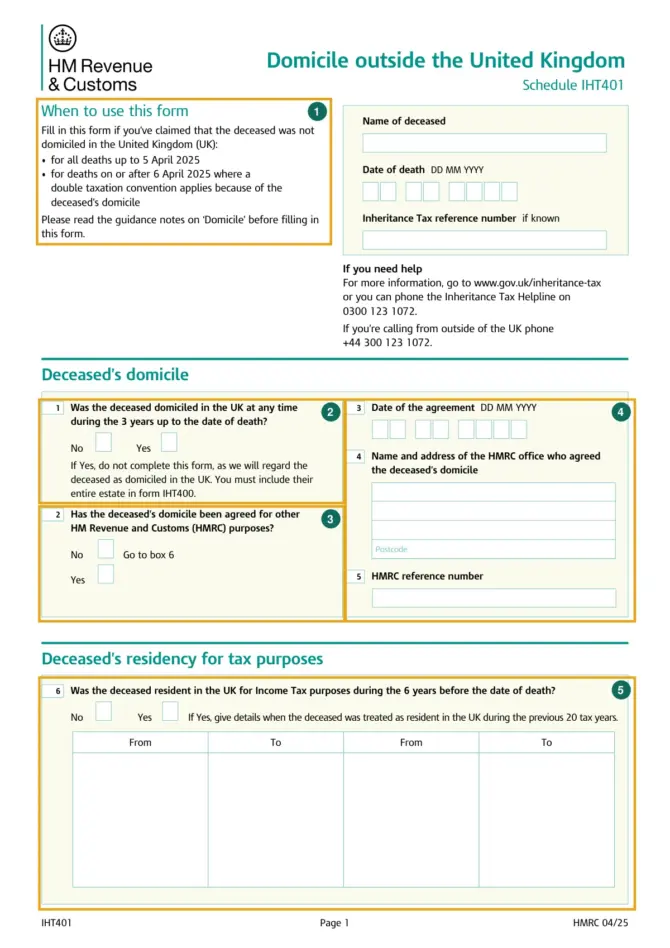
| Box | What it asks | What to put |
|---|---|---|
| 1 | Was the deceased domiciled in the UK at any time in the 3 years up to death? | If Yes, stop: HMRC regards the deceased as UK domiciled and the entire estate goes on the IHT400. |
| 2 to 5 | Has domicile been agreed for other HMRC purposes? | If No, go to box 6. If Yes, the date of the agreement, the name and address of the HMRC office that agreed it, and the HMRC reference. |
| 6 | Resident in the UK for Income Tax in the 6 years before death? | If Yes, the From and To dates when the deceased was treated as UK resident in the previous 20 tax years. |
| 7 to 10 | Birth town and country, nationality at birth, domicile of origin, nationality at death | Facts for each, as at the dates asked. |
| 11 | Dates the deceased left the UK to set up their main home abroad | Each date, if there was more than one move. |
| 12 to 14 | Education and employment, visits to the UK, why the deceased did not intend to stay in or return to the UK | Narrative, with any evidence you have for box 14. |
| 15 to 19 | Female deceased only: married on or before 1 January 1974? | If Yes, the husband’s birthplace, nationality at birth and later, and his education and employment up to 1 January 1974. |
| 20 to 22 | Who benefits under the law or will of the claimed country of domicile, any spouse or civil partner exemption, how the estate is distributed | Beneficiaries, the surviving spouse’s assets if you deduct the exemption, and how you established the distribution. |
| 23 to 25 | Assets outside the UK, double taxation convention, foreign tax on UK assets | Yes or No to each, with an approximate sterling value for assets abroad. |
Boxes 1 to 6: domicile already settled, and UK residence
Box 2 covers the case where HMRC has already agreed the deceased’s domicile for another tax; boxes 3 to 5 identify that agreement. Box 6 is about Income Tax residence, not domicile. If the deceased was UK resident at any time in the 6 years before death, list every period of UK residence in the last 20 tax years in the From and To columns.
Boxes 7 to 14: the deceased’s life history
HMRC says on page 2 that it asks these questions to get a full picture of the deceased’s life before deciding domicile. Domicile of origin (box 9) is not the same as birthplace: the IHT400 Notes explain that it is usually the father’s domicile at the date of birth, the mother’s if the parents were not married, and an adoptive parent’s for an adopted child. Box 13 wants each UK visit with its length, the address stayed at and the purpose. Box 14 is the argument itself, so attach the evidence that supports it. If the boxes run out, the form points to the “Additional information” box on the IHT400 or a separate sheet. IHT401 still says page 16 of the IHT400; on the HMRC 04/26 IHT400 the “Additional information” boxes are on page 19.
Boxes 15 to 19: women married before 1974
If the deceased was male, go straight to box 20. For a woman, box 15 asks whether she married on or before 1 January 1974, because a married woman’s domicile followed her husband’s for marriages before that date. If she did, boxes 16 to 19 ask about the husband. Box 19 covers his education and employment while she was married to him, up to and including 1 January 1974, and every husband she had before that date.
Boxes 20 to 25: the estate under foreign law
Box 20 asks who benefits under the law or will that applies in the claimed country of domicile. Box 22 asks how the estate is to be distributed and how you established it; if you took professional advice from someone in that country, attach a copy. If you tick Yes at box 21 to deduct spouse or civil partner exemption, give brief details of the assets the survivor will receive. The IHT400 Notes add that where the deceased was married or in a civil partnership and was not a long-term UK resident (or, for earlier deaths, not domiciled in the UK), the personal representatives can elect for the deceased to be treated as long-term UK resident (or UK domiciled), and the election cannot be withdrawn once made. Boxes 23 to 25 are Yes or No questions; only box 23 asks for a figure.
When domicile is outside the UK, the IHT400 Notes say to fill in the IHT400 with details of UK assets only, except lifetime transfers made while the deceased was a long-term UK resident or, before 6 April 2025, UK domiciled. UK property still goes on Schedule IHT405, Houses, land, buildings and interests in land, and UK bank and building society accounts on Schedule IHT406, Bank and building society accounts.
What goes in the envelope with IHT401
- The IHT400, with IHT401 ticked in the list of schedules on the declaration page
- A copy of any professional advice from the claimed country of domicile (box 22)
- Evidence supporting box 14
- Any separate sheet used for boxes 12 to 14 or 19
- IHT401a as well, if the death was on or after 6 April 2025 and the deceased was not a long-term UK resident
Deadline for the IHT400 and IHT401
IHT401 has no deadline of its own; it is part of the Inheritance Tax account. The IHT400 must reach HMRC within 12 months of the date of death, and interest is payable after 6 months. The IHT400 Notes say that sending it later without a reasonable excuse can mean a penalty of up to £200, and up to a further £3,000 if the delay runs to 2 years after the death. If there is tax to pay, apply for an Inheritance Tax reference at least 3 weeks before you send the account.
Getting IHT401 and where to send it
The fillable PDF is on the GOV.UK IHT401 page, with a Welsh version (IHT401 Welsh, also 04/25). Send it with the IHT400 and the other schedules to Inheritance Tax, HM Revenue and Customs, BX9 1HT. The Inheritance Tax helpline printed on the form is 0300 123 1072, or +44 300 123 1072 from outside the UK.
Official PDF: IHT401 — Official PDF (assets.publishing.service.gov.uk)
Questions about IHT401
Is IHT401 still used for deaths after 5 April 2025?
Only where a double taxation convention applies because of the deceased’s domicile, which is IHT400 box 48c. Whether the deceased was a long-term UK resident is answered at box 6b, and a “No” there leads to IHT401a.
Does a foreign-domiciled estate list its overseas assets on the IHT400?
The IHT400 carries UK assets only, apart from lifetime transfers made while the deceased was a long-term UK resident or UK domiciled. IHT401 box 23 does ask whether there were assets outside the UK and for their approximate value.
Who counts as deemed domiciled for a death before 6 April 2025?
Someone UK resident for at least 15 of the 20 tax years ending with the tax year of death, or domiciled in the UK under English law at any time in the 3 years before death. In either case IHT401 is not used and the worldwide estate is taxed.
Sources
- HM Revenue and Customs, Domicile outside the United Kingdom, Schedule IHT401, HMRC 04/25 (PDF)
- GOV.UK, Inheritance Tax: domicile outside the United Kingdom (IHT401)
- HM Revenue and Customs, Inheritance Tax account IHT400, HMRC 04/26 (PDF)
- HM Revenue and Customs, Guide to completing your Inheritance Tax account, IHT400 Notes 2022, HMRC 04/26 (PDF)
- GOV.UK, Inheritance Tax: long-term United Kingdom (UK) residence (IHT401a)