CT600K is a one-page supplement to the Company Tax Return for a company that has received, or is owed, restitution interest from HMRC: interest on a claim that tax was paid under a mistake of law or collected unlawfully, where a court or a settlement has fixed the interest above simple interest at a statutory rate. That interest is taxed separately at 45% under Part 8C of the Corporation Tax Act 2010, and the page works out how much of that tax is still to pay after what HMRC kept back when it paid the interest. The form on GOV.UK is CT600K (2017) Version 3, printed HMRC 04/17, for accounting periods starting on or after 1 April 2015.
When a company needs CT600K
HMRC’s notes for the page say to complete it if the company is chargeable to Corporation Tax on restitution interest under Part 8C and has restitution interest that is not exempt from the charge. Section 357YC defines restitution interest by three conditions, all of which must be met.
- Condition A: the profits are interest paid or payable by HMRC on the company’s right to restitution for an amount paid to HMRC under a mistake of law relating to a taxation matter, or for HMRC’s unlawful collection of an amount of tax.
- Condition B: a court has made a final determination that HMRC must pay the interest, or HMRC has entered into an agreement in final settlement of the claim under which the interest is paid or kept.
- Condition C: the interest determined or agreed is not limited to simple interest at a rate equal to or lower than a statutory rate.
A determination is final once it cannot be varied on appeal, for example because the time for appealing has run out or permission to appeal was refused; a possible appeal out of time is ignored (section 357YC(8) and (9)). It makes no difference whether the interest comes under a judgment, as an interim payment in proceedings, or under a settlement. “Interest” includes any amount worked out by reference to the time value of money.
Some companies and amounts fall outside the charge. A charitable company is not charged on restitution interest at all (sections 357YA(2) and 357YB(1A)). For a life insurance company, the part of the interest that represents policyholder income in with-profits funds is treated as if it were not restitution interest (section 357YDA). Interest that HMRC paid before Condition B was met, and that was limited to simple interest at no more than a statutory rate, is not restitution interest either (section 357YD). A “statutory rate” means a rate set for tax purposes in an Act or in rules made under one (section 357YU).
The words “equivalent to or lower than” in Condition C were added by the Corporation Tax Act 2010 (Part 8C) (Amendment) Regulations 2025 (SI 2025/1253), in force from 15 January 2026. HMRC’s tax information note on the change says Part 8C is aimed at compound interest awarded in High Court claims, and that a company awarded simple interest at a rate no higher than a statutory one is outside the rules. An award stays inside Part 8C where part of it was simple interest at a statutory rate but the whole payment comes to more than a statutory rate would give. The CT600K completion notes, last updated in January 2024, still give the older wording of Condition C, so for interest paid on or after 15 January 2026 the amended section 357YC on legislation.gov.uk is the text to check against.
How the 45% charge and HMRC’s deduction work
Section 357YK sets the restitution payments rate at 45%. Restitution interest is left out of the company’s total profits (section 357YL(1)), which is why the CT600 guide tells companies to keep it out of box 170 with other non-trading loan relationship profits. No losses, reliefs or set-offs can reduce the 45% tax, and amounts of Income Tax or Corporation Tax that would normally be set against the company’s liability cannot be set against it either (section 357YL(2) to (4)).
When HMRC pays interest on a mistake-of-law or unlawful-collection claim that is not limited to simple interest at or below a statutory rate, it must deduct tax at 45% of the gross payment and give the company a written notice showing the gross payment and the amount deducted (section 357YO). That notice is the record behind box K25. The deduction counts as paid by the company towards its Part 8C liability for the accounting period (section 357YP). A company that disagrees with the deduction can appeal to HMRC in writing within 30 days of the notice (section 357YS). If HMRC deducted too much, it pays interest on the excess from the date of deduction until the excess is repaid (section 357YR).
The interest belongs to the accounting period in which it is recognised in the company’s accounts under generally accepted accounting practice (section 357YE). If the company’s accounts do not follow GAAP, or it draws up no accounts, the amounts are worked out as if GAAP-compliant accounts had been drawn up (section 357YF). Where Condition A is only met after that period has ended, the adjustments are made anyway and the usual time limits for adjustments do not apply.
Filling in boxes K1 to K35
The page has a company information block and a tax calculation block. The numbers on the image below match the rows of the table.
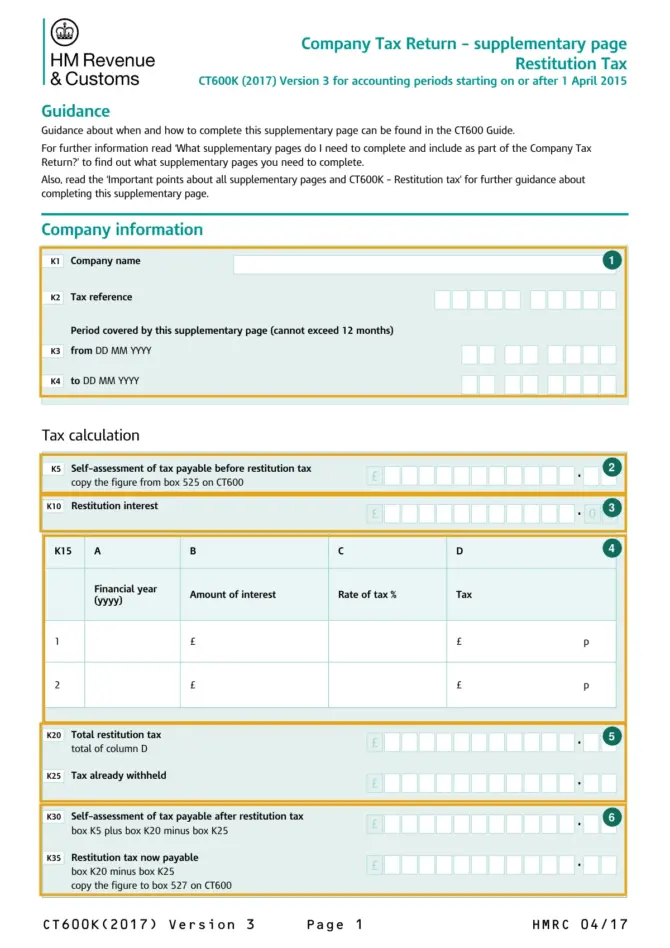
| Marker | Box | What goes in it | Taken from or sent to |
|---|---|---|---|
| 1 | K1, K2 | Company name and the company’s 10-digit Unique Taxpayer Reference. | Same as on the CT600. |
| 1 | K3, K4 | Start and end dates of the accounting period, DD MM YYYY. The period cannot be longer than 12 months. | Same period as the CT600. |
| 2 | K5 | Self-assessment of tax payable before restitution tax. | Copied from box 525 of the CT600. |
| 3 | K10 | Restitution interest arising in the accounting period, in whole pounds (the pence boxes are printed as 00). | The interest recognised in the accounts for the period (section 357YE). |
| 4 | K15, columns A to D | For each financial year the period falls in: the year (yyyy), the amount of interest, the rate of tax and the tax. Two rows. | Column D rows add up to K20. |
| 5 | K20 | Total restitution tax: D1 plus D2. | Feeds K30 and K35. |
| 5 | K25 | Tax HMRC withheld from the payment that relates to this accounting period. It cannot be more than K20. | HMRC’s notice of the deduction under section 357YO. |
| 6 | K30 | Self-assessment of tax payable after restitution tax: K5 plus K20 minus K25. | Stays on CT600K. |
| 6 | K35 | Restitution tax now payable: K20 minus K25. | Copied to box 527 of the CT600. |
Column A takes the financial year as four digits. Section 1119 of the Corporation Tax Act 2010 names a financial year after the April it begins in, so the financial year 2026 begins in April 2026. An accounting period that runs across 31 March falls in two financial years, which is what the second row of K15 is for. With the rate fixed at 45% in section 357YK, column C carries 45 on both rows, and each row’s tax is 45% of the interest in column B.
Box K25 only takes the deduction that relates to this accounting period. Section 357YO(6) says the 45% is applied to the gross payment, so the gross figure on HMRC’s notice, and not the net amount received, is the one to compare with K10.
K30 adds K5 and the net restitution tax, but it has no place for box 526 of the CT600 (coronavirus support scheme overpayments). If box 526 has an amount, box 528 on the CT600 will be higher than K30 by that amount.
Where CT600K figures go on the CT600
- Box 141 on page 1, “Restitution tax – form CT600K”: put an X to show the page is included.
- Box 170: restitution interest stays out of non-trading loan relationship profits.
- Box 525: self-assessment before restitution tax and coronavirus overpayments, box 510 minus box 515. This is the figure copied to K5.
- Box 527: the K35 figure.
- Box 528: total of boxes 525, 526 and 527, the company’s self-assessment.
- Box 595, tax already paid: leave out any restitution tax.
The CT600 guide says supplementary pages form part of the return and are covered by its declaration, and that its warnings about late and incorrect returns and late payment also apply to them.
When the return and the restitution tax are due
CT600K goes in with the Company Tax Return, which is due 12 months after the end of the accounting period, and the late filing penalties on the GOV.UK Company Tax Returns page start at £200 for the return as a whole.
Corporation Tax for an accounting period is due on the day after nine months from the end of the period (Taxes Management Act 1970, section 59D). Section 357YT tells a company to ignore tax charged at the restitution payments rate when working out its quarterly instalment payments, so a large company leaves the restitution tax out of its instalment calculations.
HMRC can also raise its own assessment of restitution tax under section 357YQ, and the company then has 30 days from the notice of assessment to pay. Since 15 January 2026 such an assessment can be made up to 2 years after the end of the accounting period in which Condition B was met, or within the normal assessment time limits if those run later. HMRC’s note says this applies where the accounting period in which the claim is finally determined ends after the regulations came into force.
Checks before sending CT600K
- The interest meets all three conditions in section 357YC, and none of the exclusions for charitable companies, policyholder income or simple interest at a statutory rate applies.
- K3 and K4 match the CT600 accounting period and cover 12 months or less.
- K5 equals box 525 of the CT600.
- K15 has one row per financial year in the period and K20 equals D1 plus D2.
- K25 is no more than K20 and agrees with HMRC’s deduction notice for this period.
- K35 equals K20 minus K25 and appears in box 527; box 528 is 525 plus 526 plus 527.
- Box 141 on the CT600 has an X, restitution interest is not in box 170 and restitution tax is not in box 595.
Getting CT600K and sending the return
The blank CT600K PDF is on the GOV.UK publication page Corporation Tax: Restitution Tax (CT600K), and HMRC’s box notes are at Completing the CT600K page for Restitution Tax. The publication page still points to an online return; HMRC’s page on the closure of its “File your accounts and Company Tax Return” service says that service shut on 31 March 2026, so the CT600 with this page now goes through commercial software.
HMRC accepts a paper CT600 only from a company with a reasonable excuse or one filing in Welsh, and the paper form can also be used to amend a return already sent. The postal address on the CT600 publication page is Corporation Tax Services, HMRC, BX9 1AX, and a paper CT600K goes with the paper CT600 it belongs to.
Part 8C also has rules for restitution interest that ends up with a different company, for example after a transfer of the right to the claim, a company leaving the UK or a group company being wound up (sections 357YM to 357YNB), and an anti-avoidance rule in section 357YH. Those cases are not covered by the box notes; the legislation or a tax adviser is where the amount should be settled before it goes on the page.
Official PDF: CT600K — Official PDF (assets.publishing.service.gov.uk)
Questions about CT600K
HMRC already took 45% when it paid the interest. Is there anything left to pay?
The deduction counts towards the Part 8C liability for the period (section 357YP), and it goes in K25. K35 is K20 minus K25, so where the full 45% of the gross interest for the period was withheld, K35 is nil.
Do charities need to complete CT600K?
Section 357YA(2) takes charitable companies out of the charge on restitution interest, so a charitable company has no restitution tax to report on this page.
Can losses or group relief reduce the restitution tax?
Section 357YL says no reliefs or set-offs may be given against Corporation Tax charged at the restitution payments rate, and restitution interest is not part of total profits, so losses claimed on the CT600 do not reach it.
Sources
- HMRC CT600K (2017) Version 3, Restitution Tax, HMRC 04/17
- Completing the CT600K page for Restitution Tax, GOV.UK
- Corporation Tax: Restitution Tax (CT600K), GOV.UK
- Completing your Company Tax Return (CT600 guide), GOV.UK
- HMRC CT600 (2026) Version 3, Company Tax Return
- Company Tax Return (CT600), GOV.UK
- Corporation Tax Act 2010, Part 8C, restitution interest, legislation.gov.uk
- Changes to restitution interest rules in Part 8C of the Corporation Tax Act 2010, HMRC tax information note, 1 December 2025
- Taxes Management Act 1970, section 59D, legislation.gov.uk
- Corporation Tax Act 2010, section 1119, legislation.gov.uk
- Company Tax Returns, GOV.UK
- Filing company accounts and tax returns if you previously used the HMRC online service, GOV.UK