Alabama Form 20S is the return an S corporation files when it does business in Alabama or has income from Alabama sources. Most of it reports income that passes through to the shareholders: page 1 turns the federal Form 1120-S figures into Alabama ordinary income, and Schedule K splits the separately stated items into the amounts that go on each shareholder’s Alabama Schedule K-1. The corporation itself pays tax on Form 20S only in three cases: built-in gains, LIFO recapture and excess net passive income. This guide follows the 2025 Form 20S and its 2025 instructions. The Department of Revenue’s forms page lists Form Year 2025 as the current Form 20S, and no 2026 Form 20S appears on its forms list yet; the 2025 form is for calendar year 2025 and for fiscal or short years beginning in 2025.
Which S corporations file Form 20S
The Department’s pass-through entity page requires every S corporation, except financial institutions, that does business in Alabama or derives income from Alabama sources, including income from property located there, to file an Alabama income tax return. Physical presence creates nexus, and so does crossing any factor presence threshold, which for tax years beginning on or after January 1, 2025 is $68,000 of property, $68,000 of payroll, $675,000 of sales, or 25% of total property, payroll or sales. A Florida S corporation with no Alabama employees that sells $700,000 of equipment to Alabama customers in 2025 is over the sales figure.
An S corporation claiming exemption under Public Law 86-272 checks the PL86-272 box on page 1 and must complete Alabama’s Nexus Questionnaire. Qualified subchapter S subsidiaries and disregarded entities that the S corporation owns 100% are listed on Schedule DE on page 3, each with name, FEIN, income from all sources and Alabama-source income.
New on the 2025 form: electing PTE and revoking PTE boxes
The 2025 instructions open with one What’s New item. An S corporation that elects to be taxed as an electing pass-through entity, or revokes that election, checks the matching box on page 1. The Electing PTE box has to be checked for every year the election stays in effect, and the election or revocation cannot be made by amending Form 20S after the extended due date. A return with neither box checked is treated as a non-electing PTE.
The pass-through entity page adds that, for tax periods beginning on or after January 1, 2025, the box goes on the timely filed Form 20S, extensions included, and that an electing entity also files Form EPT.
How to fill out page 1 of Form 20S
Page 1 has a header with ownership details and four boxes of check marks, then 37 numbered lines in four bands: federal income, federal deductions, Alabama adjustments and tax due. The markers on the image follow the table.
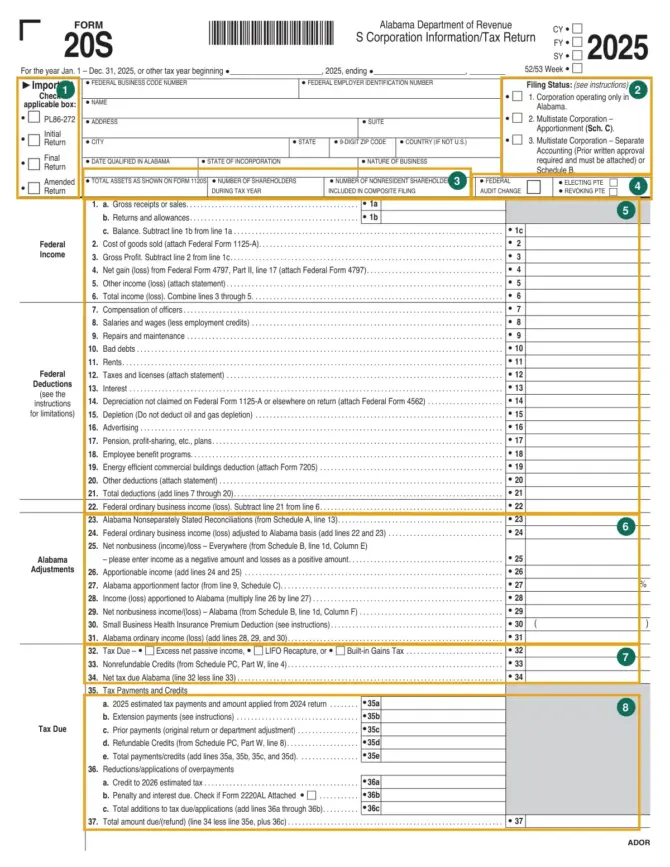
| Marker | Part of page 1 | What goes there |
|---|---|---|
| 1 | Check applicable box | PL86-272, initial, final or amended return. “Amended” is for any reason other than an IRS audit. |
| 2 | Filing status | One box: 1 for a company operating only in Alabama; 2 for a multistate company using the Schedule C factor, or one operating only in other states; 3 for separate accounting with the Department’s prior written approval attached, or for a company that only allocates nonbusiness items on Schedule B. |
| 3 | Ownership line | Total assets from Form 1120-S, number of shareholders during the year, and number of nonresident shareholders included in the composite filing. |
| 4 | Federal audit change, Electing PTE, Revoking PTE | Federal audit change when amending because of an IRS audit; one of the PTE boxes when the election is in effect or revoked. |
| 5 | Lines 1a to 22 | Copied from federal Form 1120-S: gross receipts, cost of goods sold (Form 1125-A), Form 4797 gain, deductions, and federal ordinary business income on line 22. |
| 6 | Lines 23 to 31 | Schedule A reconciliations, nonbusiness income from Schedule B, the Schedule C factor, the health insurance premium deduction and Alabama ordinary income. |
| 7 | Lines 32 to 34 | Excess net passive income, LIFO recapture or built-in gains tax, less nonrefundable credits from Schedule PC. |
| 8 | Lines 35a to 37 | Estimated and extension payments, prior payments on an amended return, refundable credits, overpayment credited to 2026, penalty and interest, and the amount due or refund. |
The header also asks for the date the corporation qualified in Alabama, its state of incorporation and the nature of the business, and in the top right corner CY, FY or SY. A 52/53 week year is a fiscal year, and the instructions say a calendar year box is not appropriate for 52/53 week filers.
Lines 1 to 31: from federal income to Alabama ordinary income
Lines 1 through 21 are the amounts on the corporation’s federal Form 1120-S, with all federal schedules attached, and line 22 subtracts total deductions from total income. Line 23 brings in the net Schedule A reconciliation and line 24 is the sum. A multistate company then removes nonbusiness items on line 25 (income as a negative amount, loss as a positive amount), applies the Schedule C factor on line 27 and adds back the Alabama share of nonbusiness items on line 29.
Line 30 is 100% of the health insurance premiums paid during the year that qualify under Act 2011-155 for qualifying employees under an employer-provided plan, with the computation attached. The form prints the line in parentheses. Line 31 adds lines 28, 29 and 30 and also goes on Schedule K, line 1.
Lines 32 to 37: the corporation’s own tax
Line 32 is not a tax on line 31 and is not where a composite payment goes. It holds only these taxes, each with a computation schedule attached:
- LIFO recapture tax, for a corporation that converted to an S corporation after December 31, 1989 (§40-18-161);
- built-in gains tax, for a corporation that became an S corporation after December 31, 1989 (§40-18-174);
- excess net passive income tax, owed when the S corporation has subchapter C earnings and profits, passive investment income above 25% of gross receipts and taxable income at year end (§40-18-175 and Rule 810-3-174-.02).
The instructions warn that leaving out the computation schedule may bring penalties and additional filing requirements. An electing PTE fills in lines 32 to 37 only if it owes one of these three taxes; its own PTE tax is reported on Form EPT and on Schedule K, line 25.
Line 35a is last year’s overpayment carried over plus estimated payments made with Form PTE-V, with a schedule; 35b is tax paid before filing, such as an extension payment; 35c is used only on an amended return; 35d is refundable credits from Schedule PC. Line 36a is the overpayment credited to 2026 estimated tax. Line 36b is penalty and interest: a late return owes 10% of the line 32 tax or $50, whichever is greater, unpaid tax adds 1% per month up to 25%, and interest runs from the unextended due date at the federal rate of 26 U.S.C. §6621. Check the box on line 36b if Form 2220AL is attached.
Where the 2025 instructions and the printed form disagree
Several line references in the 2025 Form 20S instructions do not match the line labels printed on the 2025 Form 20S:
| Item | Instructions (2025) say | Form 20S (2025) prints |
|---|---|---|
| Schedule A, line 13 | Carry to page 1, line 22 | Line 23 takes “Schedule A, line 13” |
| Schedule B, line 1d, Column E | Also entered on page 1, line 24 | Line 25 takes “Schedule B, line 1d, Column E” |
| Schedule B, line 1d, Column F | Also entered on page 1, line 28 | Line 29 takes “Schedule B, line 1d, Column F” |
| Lines 33 and 35d | Schedule PC, Part T, lines 4 and 8 | Schedule PC, Part W, lines 4 and 8 |
| Line 34 | Subtract line 32 from line 33 | Line 32 less line 33 |
| Line 37 | Subtract line 34 from line 35e, then add line 36c; a positive result is the amount owed | Line 34 less line 35e, plus 36c |
| Schedule K, line 1 | Alabama ordinary income from page 1, line 30 | Ordinary income from page 1, line 31 |
This guide describes the lines as the form labels them and does not decide which document governs. Before filing a return where the difference changes a figure, ask the Department’s Pass-Through Entity Section at (334) 242-1170, Option 6, the number printed in the 2025 Form PTE-C instructions.
Schedules A to E on pages 2 and 3
Schedule A reconciles federal ordinary business income to Alabama law. Additions are state and local income taxes deducted federally (the instructions name the electing pass-through entity tax as one), related member interest and intangible expenses not covered by an exception in Section 40-18-24 with Schedule PAB attached, other items, gain on property that took 2008 Economic Stimulus Act bonus depreciation or extra Section 179 expense, and contributions not deductible because a state credit such as the Growing Alabama credit was claimed. Deductions include expenses disallowed federally because of a federal credit, refunds of state and local income taxes, aid to the Alabama State Industrial Development Authority, other items, and the recapture difference left by Alabama’s decoupling from the 2008 Act. A multistate entity does not use Schedule A for nonbusiness items.
Schedule B is left blank by an entity that operates only in Alabama. Lines 1a to 1d are nonseparately stated nonbusiness items, and lines 1e to 1h are separately stated ones; for each, Columns A and B are gross income everywhere and in Alabama, C and D the related expense, E and F the net. The Column B and Column D totals on line 1h go to Schedule K, lines 10 and 17.
Schedule C is the sales factor: Alabama receipts over receipts everywhere, every amount positive, line 9 as a percentage with four decimal places. An entity that operates only in Alabama skips the schedule and enters 100% on line 9. Separate or direct accounting needs the Department’s written approval.
Schedule D apportions the federal LIFO recapture tax from Form 1120-S, line 22a, by the Schedule C factor, and the result goes to Schedule K, line 16. Schedule E is the Alabama accumulated adjustments account, adjusted in a manner similar to Section 40-18-164 starting on the first day of the S period. It may differ from the federal accumulated adjustments account, and line 6 subtracts the federal distributions figure from Schedule K, line 19.
Schedule K, Schedule G and the balance sheet
Schedule K on page 4 has three columns. For lines 2 to 20, other than lines 10 and 17, Column A is the federal amount as adjusted to Alabama law, Column B the Schedule C factor and Column C the product, which is the Alabama amount. With a 40.0000% factor, $50,000 of net rental real estate income becomes $20,000 in the apportioned column. Lines 21, 22 and 25 are filled in only in the apportioned column: credits from Schedule PC, Part W, line 9; composite payments made for owners; and the electing PTE tax from Form EPT, line 2. Any adjustment on lines 2, 3a, 7, 8 or 9 needs a short explanation showing the federal amount, the adjustment and the Alabama amount. The last column of Schedule K names the Alabama Schedule K-1 line for each item.
Every S corporation completes Schedule G. It asks for a description of Alabama operations, where the records are kept, the FEIN and name used on the privilege tax return if different, net unrealized built-in gain, accumulated earnings and profits, and yes or no answers on canceled non-shareholder debt, a terminated or revoked QSub election, Forms 1099 and termination of S status. Schedule L on page 5 follows the federal Schedule L instructions, with statements explaining any federal-to-state differences.
What to send with Form 20S
- A complete copy of federal Form 1120-S with all federal K-1s, statements and attachments; voluminous schedules may be left out if a list of them is attached.
- An Alabama Schedule K-1 for each person or entity that was a shareholder at any time during the year.
- The computation schedule for any line 32 tax and the line 30 premium computation.
- Schedule PAB, Schedule PC and Schedule OZ when those lines are used, and Schedule NRA for a nonresident shareholder who elects out of the composite return.
- The federal extension form when the return is filed under extension.
- Form PTE-V and a check, only when a payment is mailed with the return.
Form PTE-C, Form EPT and their payments are not attached to Form 20S. The instructions say a return missing the federal Form 1120-S or the Alabama K-1s is not complete and can be treated as delinquent.
When Form 20S is due, how to pay and where to mail it
Form 20S is due by the 15th day of the 3rd month after the tax year ends: March 15 for a calendar-year S corporation, moved to the next business day when that date falls on a weekend or state holiday. A U.S. Postal Service cancellation by midnight of the due date is timely. A federal extension is recognized, but it does not extend the time to pay.
Estimated tax is due when the Alabama liability is more than $500, in four installments by the 15th day of the 4th, 6th, 9th and 12th months. Payments of $750 or more must be electronic under Section 41-1-20, through My Alabama Taxes (ACH debit) or ACH credit with ALDOR pre-approval; smaller payments by check go with Form PTE-V, payable to the Alabama Department of Revenue.
An S corporation with assets of $5 million or more at year end must e-file, as must a preparer of 25 or more original corporate or partnership returns in a calendar year. Since tax year 2023 the Department rejects a paper return that was required to be e-filed, and a late electronic return can cost $50 for each Schedule K-1 submitted with it.
| Return | Mail to |
|---|---|
| With a payment | Alabama Department of Revenue, Pass Through Entity Section, P.O. Box 327444, Montgomery, AL 36132-7444 |
| Without a payment | Alabama Department of Revenue, Pass Through Entity Section, P.O. Box 327441, Montgomery, AL 36132-7441 |
Official PDF: Form 20S — Official PDF (revenue.alabama.gov)
Questions about Alabama Form 20S
Does an electing pass-through entity still file Form 20S?
The election is made by checking the Electing PTE box on Form 20S, and the pass-through entity page says an electing entity files Form EPT in addition to Form 20S, so both returns are filed for each year the election is in effect.
What happens with nonresident shareholders?
An S corporation may file the composite return, Form PTE-C, paying 5% on behalf of its nonresidents, or file Schedule NRA with Form 20S for owners who elect out. The Schedule NRA election stays in effect until the owner tells the corporation in writing that it wants to join the composite filing.
Who signs Form 20S?
An officer signs page 2 and adds title, date and daytime phone. A paid preparer signs the preparer section, and the box above the signature line lets the Department discuss the return with that preparer.
Official sources
- Form 20S, 2025 S Corporation Information/Tax Return (PDF)
- Form 20S instructions, 2025 (PDF)
- S-Corporation Information/Tax Return, forms page (Form Year 2025)
- Pass-Thru Entities: Partnerships and S Corporations
- What is the mailing address for Form 20S?
- Due Dates, Alabama Department of Revenue
- Form PTE-C and Schedule PTE-CK1 instructions, 2025 (PDF)