Alabama Form 65 is the Partnership/Limited Liability Company Return of Income: the yearly Alabama return of a general or limited partnership, an LLC or LLP taxed as a partnership, and any other syndicate, pool or joint venture that is not a corporation, estate, trust or sole proprietorship under Alabama income tax law. The 2025 form has six pages and starts from the federal Form 1065. Page 1 takes the federal ordinary business income and converts it to Alabama ordinary income; Schedules A, B and C on pages 2 and 3 supply the adjustments, the nonbusiness items and the apportionment factor; Schedule K on page 4 carries each item to the partners’ Alabama Schedules K-1. A non-electing partnership pays no tax with Form 65 itself; tax for nonresident members goes on the composite return, Form PTE-C, and an electing entity’s tax on Form EPT.
Which partnerships and LLCs file Form 65
The Alabama Department of Revenue (ALDOR) says that all partnerships (except financial institutions) doing business in Alabama or deriving income from Alabama sources, including income from property located in the state, have to file an Alabama return. Nexus exists under traditional constitutional tests such as physical presence, and also under the factor presence standard of Act 2015-505. For tax years beginning on or after January 1, 2025, an entity has substantial nexus in any period in which it exceeds one of these Alabama amounts:
- $68,000 of property,
- $68,000 of payroll,
- $675,000 of sales, or
- 25% of its total property, total payroll or total sales.
A Tennessee LLC taxed as a partnership with no office in Alabama but $700,000 of sales to Alabama customers in 2025 is over the sales threshold and files Form 65. Because it also sells in other states, it checks filing status 2 and completes Schedule C. If any of its members lives outside Alabama at any time in the year, it generally also files the composite return for them.
An entity that claims exemption under Public Law 86-272 checks the PL86-272 box on page 1 and has to complete Alabama’s Nexus Questionnaire, which the instructions place on My Alabama Taxes.
What changed on the 2025 Form 65
The What’s New section of the 2025 instructions is about the electing pass-through entity boxes on page 1. A partnership or LLC making the election or revoking it checks Electing PTE or Revoking PTE. The Electing PTE box has to be checked every year the election is in effect, Form 65 cannot be amended after the extended due date to make or revoke the election, and a return with neither box checked is treated as a non-electing PTE. ALDOR’s pass-through page adds that an electing entity also files Form EPT, and that from tax periods beginning on or after January 1, 2025 the box goes on the timely filed return, extensions included.
How to fill out page 1 of Form 65
The page has a header for the entity and the federal Form 1065 numbers in lines 1a to 22, then the Alabama computation in lines 23 to 34. The markers on the image match the table.
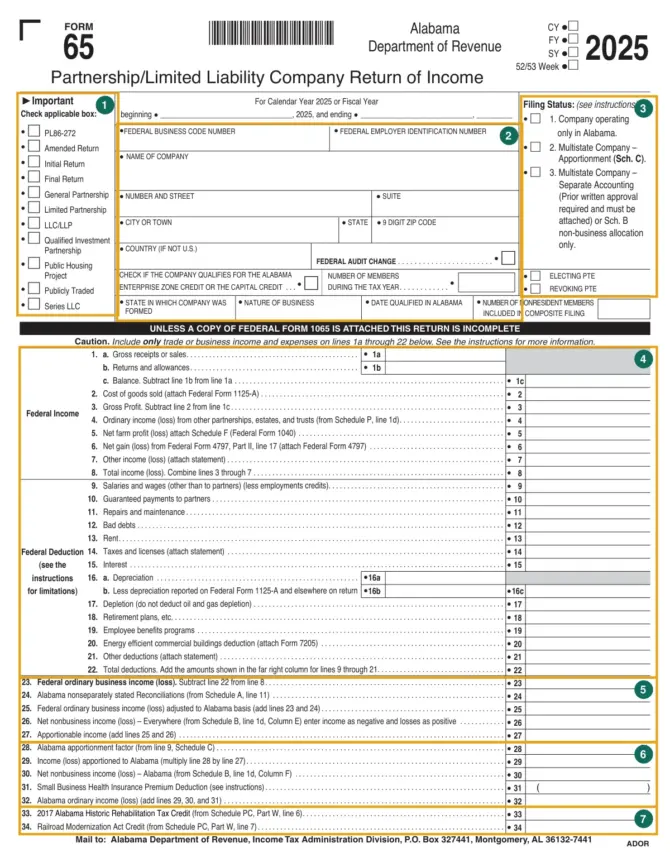
| Marker | Part of page 1 | What goes there |
|---|---|---|
| 1 | Check applicable box | All boxes that apply: PL86-272, Amended Return, Initial Return, Final Return, General Partnership, Limited Partnership, LLC/LLP, Qualified Investment Partnership, Public Housing Project, Publicly Traded, Series LLC. Above them, the calendar, fiscal, short or 52/53 week year box and the year’s beginning and ending dates. |
| 2 | Entity information | Federal business code and FEIN, name and address, Federal Audit Change box, Enterprise Zone or capital credit box, number of members during the year, state where formed, nature of business, date qualified in Alabama, number of nonresident members included in the composite filing. |
| 3 | Filing status and PTE boxes | One status only: 1 for a company operating only in Alabama, 2 for a multistate company using Schedule C apportionment (also used by a taxpayer with operations in other states only), 3 for separate accounting with prior written permission, or for a taxpayer allocating only nonbusiness items on Schedule B. Then Electing PTE or Revoking PTE if either applies. |
| 4 | Lines 1a to 22 | The amounts from the corresponding lines of federal Form 1065, except lines 8 and 21, which the instructions call totals. Attach all federal schedules. Only trade or business income and expenses belong here. |
| 5 | Lines 23 to 27 | Line 23 is line 8 minus line 22. Line 24 comes from Schedule A, line 11; line 25 adds them. Line 26 is Schedule B, Column E, line 1d, with income entered as a negative and a loss as a positive amount. Line 27 adds lines 25 and 26. |
| 6 | Lines 28 to 32 | Line 28 is the factor from Schedule C, line 9; line 29 multiplies line 27 by it. Line 30 is Schedule B, Column F, line 1d. Line 31 is 100% of qualifying health insurance premiums for employees under Act 2011-155, with a computation attached. Line 32, Alabama ordinary income, adds lines 29 to 31 and is also entered on Schedule K, line 1. |
| 7 | Lines 33 and 34 | The refundable parts of the 2017 Alabama Historic Rehabilitation Tax Credit and the Railroad Modernization Act Credit from Schedule PC. |
Use the Federal Audit Change box when the return is amended because of an IRS audit, and the Amended Return box for any other amendment. A calendar year return covers January 1 to December 31 and is not used by 52/53 week filers, whose year ends on a set weekday.
Schedules A to E on pages 2 and 3
Schedule A reconciles federal ordinary business income to Alabama law. Additions are related member interest or intangible expenses (line 1, with Schedule PAB attached unless an exception in section 40-18-24.2 is shown), the bonus depreciation and additional section 179 item tied to the 2008 Federal Economic Stimulus Act (line 2), other reconciling items with documentation (line 3), state income taxes that are not deductible such as the electing pass-through tax (line 4), and contributions not deductible because a state credit such as the Growing Alabama credit is claimed (line 5). Deductions are expenses not deducted federally because a federal credit was claimed, such as the jobs credit (line 7), the 2008 stimulus recapture difference with the property identified (line 8), and other items with documentation (line 9). Line 11 is line 6 minus line 10. A multistate entity does not put nonbusiness items on Schedule A.
Schedule B allocates nonbusiness income, losses and expenses as defined in section 40-27-1. An entity operating only in Alabama skips it. Nonseparately stated items go on lines 1a to 1c and separately stated items on lines 1e to 1g; for each one, Column A is gross income everywhere, Column B Alabama gross income, Columns C and D the related expenses, and Columns E and F the net amounts. Expenses that relate to both business and nonbusiness income are prorated under Rule 810-27-1-.01.
Schedule C is the apportionment factor. Every amount is positive. Lines 1 to 7 take gross receipts from sales, dividends, interest, rents, royalties, gross proceeds from capital and ordinary gains, and other receipts, in an Alabama column and an Everywhere column. Line 9 is the Alabama total (8a) divided by the Everywhere total (8b), entered as a percentage with four decimal places. If line 1 Everywhere does not match line 1 of federal Form 1065, attach a reconciliation. An entity that operates only in Alabama skips Schedule C and enters 100% on line 9.
Schedule D lists each disregarded entity owned 100%, with name, FEIN, income from all sources and Alabama income. Schedule E is completed by every partnership and LLC: whether the company was dissolved, sold or incorporated, whether an Alabama business privilege tax return was filed (or the entity is exempt) and under which FEIN, net worth, an email address, and two questions about ownership of 50% or more.
Schedule K, Schedule L and Schedule P
Schedule K on page 4 has three columns: the federal amount adjusted for Alabama law (A), the apportionment factor from Schedule C (B) and the apportioned amount (C = A times B). The right margin names the line of the Alabama Schedule K-1 where each total goes. Line 1 is Alabama ordinary income. Lines 2 to 10 and 12 to 20 follow federal Schedule K: rental real estate (attach Form 8825), other rental income, guaranteed payments, interest, dividends, royalties, capital gains with the Schedule OZ opportunity zone line (8b) and the section 40-18-8.1 exclusion (8c), section 1231 gain (attach Form 4797), the section 179 deduction, contributions, investment interest, depletion, casualty losses, tax-exempt income, distributions and investment items. Lines 11 and 17 take the separately stated nonbusiness items from Schedule B. Credits from Schedule PC go on line 21, composite payments made for owners on line 22, and the electing PTE tax from Form EPT, line 2 on line 23; these three are entered only in the apportioned column. Adjustments to lines 2, 3a, 8, 9 or 10 need an explanation showing the federal amount, the adjustment and the Alabama amount. A multistate entity does not use Schedule K to allocate separately stated business income.
Schedule L is the balance sheet at the beginning and end of the year, following the federal Form 1065 Schedule L instructions; differences from the books or from the federal figures are explained in a statement. Schedule P lists every partnership, estate and trust that paid the entity income, with name, address and FEIN, income from all sources in column (d) and from Alabama sources in column (e); the total goes to page 1, line 4.
Where the 2025 instructions and the form give different line numbers
Several cross-references in the 2025 Instructions for Form 65 (PDF created December 1, 2025) do not match the 2025 Form 65 or the 2025 Schedule PC:
| Item | Printed on the 2025 form | 2025 instructions text |
|---|---|---|
| Schedule A, line 11 | Page 1, line 24 is “from Schedule A, line 11” | Line 24 instruction agrees; the Schedule A, line 11 instruction says carry it to page 1, line 23, and refers to line 5 where the form subtracts line 10 from line 6 |
| Schedule B, line 1d | Column E goes to page 1, line 26; Column F to line 30 | Lines 26 and 30 instructions agree; the Schedule B instructions say line 25 and line 29 |
| Schedule B, line 1h | Schedule K, lines 11 (Column B) and 17 (Column D) | Schedule B instructions say Schedule K, lines 12 and 18 |
| Schedule K, line 1 | “page 1, line 32” | Line 32 instruction agrees; the Schedule K, line 1 instruction says page 1, line 31 |
| Page 1, lines 33 and 34; Schedule K, line 21 | Schedule PC, Part W, lines 6 and 7 (the 2025 Schedule PC also says Part W, line 9 goes to Schedule K, line 21) | Schedule PC, Part T, lines 6, 7 and 9; Part T on the 2025 Schedule PC is the Childcare Facility Tax Credit |
This guide describes the lines as the form prints them and does not decide between the two documents. ALDOR’s Pass-through Entity Section answers questions at (334) 242-1170, Option 6.
Attachments, signature and the electronic filing rule
The instructions say a return without the following is not complete and can be treated as delinquent because of improper preparation:
- a complete copy of federal Form 1065 with all federal K-1s, statements and attachments (voluminous schedules may be left out if a list of them is attached and they are provided on request);
- an Alabama Schedule K-1 for every person or entity that was a partner or owner at any time during the year.
Other attachments depend on the lines used: Schedule PAB, the line 31 computation, Schedule PC, Forms 8825 and 4797, Schedule OZ, prior written approval for filing status 3, and the federal extension form if the return is filed under an extension. Do not attach Form PTE-C, Form EPT, their payments or any other completed tax form to Form 65.
A general partner signs page 2 under penalties of perjury, with date, daytime phone and Social Security number, and page 2 also names a contact person for the return. A paid preparer signs and completes the preparer section; the signature may be by hand, rubber stamp, mechanical device or computer program, and the preparer gives the entity a copy. The box above the signature authorizes ALDOR to discuss the return with the preparer. Appointing someone to represent the partnership before ALDOR more broadly is done on Alabama Form 2848A, the power of attorney.
Partnerships with 50 or more partners at the end of the tax year must e-file, for that year and all later years. So must every preparer who prepared 25 or more original corporate or partnership returns with tax software in a calendar year. Since the 2023 tax year ALDOR rejects a paper return that was required to be e-filed, late filing penalties can follow, and failing to file the electronic return on time can bring a $50 late filing penalty for each Schedule K-1 submitted.
Nonresident members, composite payments and exemptions
A partnership with one or more nonresident owners or members at any time during the year generally files a composite return and makes composite payments for them on Form PTE-C; ALDOR’s pass-through page gives the rate as 5 percent and the due date as the 15th day of the third month after the year ends. Composite payments made for owners show on Schedule K, line 22. Relief from the composite payment requirement is considered case by case on Form PTE-R, which must be received at least 30 days before the original due date of the composite return.
A nonresident member can certify exemption on Schedule NRC-Exempt, attached to Form 65 and Form PTE-C every year; without it the entity has to make the payment. The six groups the instructions list are REITs that are not captive REITs and have no Alabama income because of the dividends paid deduction, exempt organizations whose Alabama share is not unrelated business taxable income, insurance companies subject to the premiums tax, pre-approved tiered structures (which also file Forms PTE-R and NRA-R 30 days before the original due date and attach ALDOR’s written approval every year), nonresidents whose only Alabama income is from a capital credit project that offsets the tax, and C corporations with losses in the three latest years that expect a loss for the current year.
A Qualified Investment Partnership under section 40-18-24.2 marks the QIP indicator on page 1 and on each K-1, and nonresident members receiving exempt income from it get a K-1 with the exempt amount on Line J.
When Form 65 is due and where to mail it
A calendar year return is due by March 15 after the year closes, and a fiscal year return by the 15th day of the third month after the year closes. If the 15th falls on a Saturday or Sunday, the instructions move the deadline to the following Monday; for 2025 calendar year returns March 15, 2026 was a Sunday. ALDOR’s pass-through page also names state holidays. A federal extension of time to file is recognized in Alabama, and the federal extension form is submitted with the Alabama return. The extension does not extend the time to pay tax.
Paper returns go to the address on the form:
Alabama Department of Revenue
Income Tax Administration Division
P.O. Box 327441
Montgomery, AL 36132-7441
The instructions add “Pass Through Entity Unit” as a line of the same address. The 2025 form is on ALDOR’s forms page for Form 65, form year 2025, with the separate 2025 instructions. This page explains the form and is not tax advice for a particular partnership.
Official PDF: Form 65 — Official PDF (revenue.alabama.gov)
Questions about Alabama Form 65
Does Form 65 have to include the federal Form 1065?
Page 1 says the return is incomplete unless a copy of federal Form 1065 is attached, and the instructions require all federal K-1s, statements and attachments with it.
Is tax paid with Form 65?
The return has no balance due line. Composite tax for nonresident members is paid with Form PTE-C, and an electing entity’s tax is reported on Form EPT and shown on Schedule K, line 23.
Can a partnership make the electing PTE election on an amended return?
Only until the extended due date. The 2025 instructions say Form 65 cannot be amended after the extended due date to make or revoke the election.
What does a partnership that operates only in Alabama skip?
It checks filing status 1, leaves Schedules B and C blank and enters 100% on Schedule C, line 9, so line 28 on page 1 is 100%.
Official sources
- Alabama Department of Revenue, Form 65, Partnership/Limited Liability Company Return of Income, 2025
- Alabama Department of Revenue, Instructions for Form 65, 2025
- Alabama Department of Revenue, Forms page: Form 65, form year 2025
- Alabama Department of Revenue, Pass-Thru Entities: Subchapter K Entities (Partnerships) and S Corporations
- Alabama Department of Revenue, What is the mailing address for Form 65?
- Alabama Department of Revenue, Schedule PC, Pass-Through Credits, 2025
- Alabama Department of Revenue, Instructions for Form PTE-C and Schedule PTE-CK1, 2025
- Alabama Department of Revenue, Form 2848A (Rev. 9/18), Power of Attorney and Declaration of Representative