Alabama Form 41 is the Fiduciary Income Tax Return: the yearly Alabama income tax return that the fiduciary of a trust or estate files, starting from the federal Form 1041. The 2025 form has four pages. Page 1 computes Alabama taxable income and the tax, page 2 holds Schedule A (the income distribution deduction) and Schedule B (the charitable deduction), page 3 is Schedule C, which turns the federal income and deductions into Alabama amounts, and page 4 is Schedule K, the summary of what the beneficiaries receive on their Alabama Schedules K-1. Capital gains, rents and grantor statements go on separate schedules made for Form 41 only: Schedule D, Schedule E and Schedule G.
Which trusts and estates file Form 41
The filing requirement comes from section 40-18-29(a) of the Code of Alabama. The 2025 instructions and ALDOR’s fiduciary page list these fiduciaries:
- every resident trust with net income over $1,500 for the year;
- every nonresident trust with any net income from Alabama after deductions;
- any trust, resident or nonresident, claiming a qualifying net operating loss, which has to file in the year of the loss to use it on later returns.
A testamentary trust administered in Huntsville whose only 2025 income is $4,000 of bank interest is a resident trust over the $1,500 line and files. A Florida trust that owns a rental house in Gulf Shores reports only the Alabama rent and expenses; nonresident estates and trusts report Alabama source income from property owned or business transacted in Alabama, and explain each difference from the federal amount.
The page 1 entity list also includes a decedent’s estate, Chapter 7 and Chapter 11 bankruptcy estates, a pooled income fund and a qualified funeral trust, and the form asks for the decedent’s Social Security number when the return is for a decedent’s estate. The filing requirement list in the 2025 instructions and on ALDOR’s fiduciary page names trusts only and gives no separate income threshold for an estate. An executor who is unsure whether a particular estate has to file can ask ALDOR through the Help Center’s online help request, or at 334-242-1170, the number printed in the Form 41 instructions.
Grantor trusts under 26 U.S.C. §671 also file (sections 40-18-25(g) and 40-18-29). They complete the top of page 1, show that the trust is a grantor trust, enter zeros on page 1, lines 1 to 7, page 2, lines 1 to 15 and page 3, lines 1 to 19, and complete Schedule G, the Grantor’s Statement of Income, Deductions, and Other Items. A charitable remainder annuity trust (CRAT), charitable remainder unitrust (CRUT) or tax exempt organization (TEO) follows the normal instructions for lines 1 to 5, enters zero on line 5a and checks the box for its type. For a TEO, the due date is the due date of its federal income tax return.
Form 41 is an income tax return. ALDOR’s fiduciary page notes that estates of people who died after December 31, 2004 are not required to file for the Alabama estate tax, which is a separate tax.
How to fill out page 1 of Form 41
The top of page 1 identifies the trust or estate and its fiduciary; lines 1 to 12 compute the tax. The markers on the image match the table.
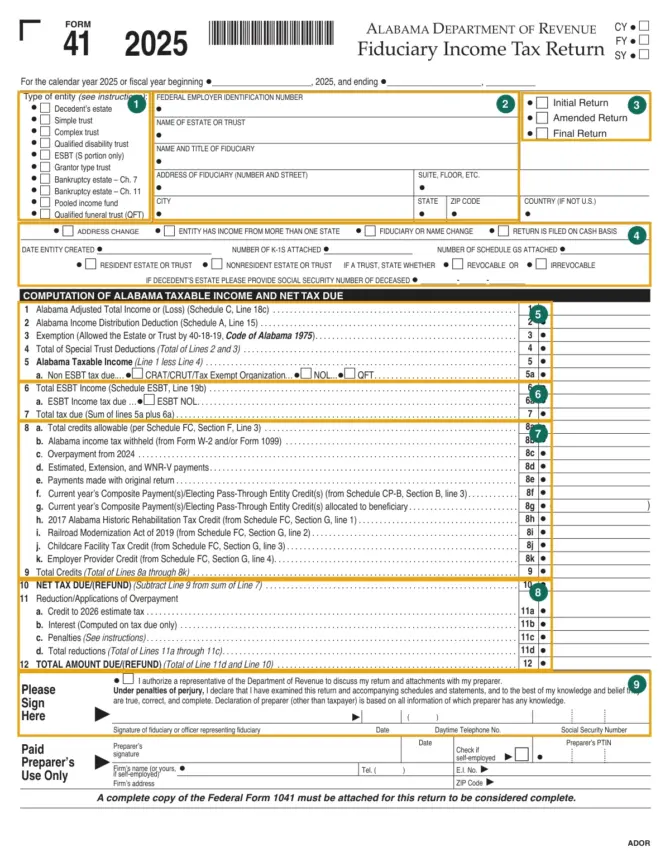
| Marker | Part of page 1 | What goes there |
|---|---|---|
| 1 | Type of entity | Decedent’s estate, simple trust, complex trust, qualified disability trust, ESBT (S portion only), grantor type trust, bankruptcy estate (Chapter 7 or 11), pooled income fund or qualified funeral trust. |
| 2 | Identification | The estate’s or trust’s own FEIN, its name, the name and title of the fiduciary and the fiduciary’s address. The instructions say not to use the EIN of the accounting firm, the trustee, the attorney’s firm or an interest payor. |
| 3 | Return type | Initial, amended or final return. |
| 4 | Status lines | Address change, income from more than one state, fiduciary or name change, cash basis; date the entity was created; number of K-1s and Schedules G attached; resident or nonresident; revocable or irrevocable for a trust; the decedent’s SSN for a decedent’s estate. |
| 5 | Lines 1 to 5a | Line 1 from Schedule C, line 18c; line 2 from Schedule A, line 15; line 3 the exemption; line 4 lines 2 plus 3; line 5 line 1 minus line 4; line 5a the tax from the computation worksheet, with the CRAT/CRUT/TEO, NOL or QFT box if it applies. |
| 6 | Lines 6 to 7 | ESBT income from Schedule ESBT, line 19b; line 6a is 5% of line 6; line 7 adds lines 5a and 6a. |
| 7 | Lines 8a to 9 | Credits from Schedule FC, Alabama tax withheld, last year’s overpayment, estimated, extension and WNR-V payments, payments with the original return, composite and electing pass-through entity credits, the part allocated to beneficiaries, refundable credits on lines 8h to 8k, and the total on line 9. |
| 8 | Lines 10 to 12 | Net tax due or refund, the part of an overpayment credited to 2026 estimated tax, interest, penalties and the total due or refund. |
| 9 | Authorization and signature | The box allowing ALDOR to discuss the return with the preparer, and the signature, date, daytime phone and SSN of the fiduciary or the officer representing the fiduciary. |
The CY, FY and SY boxes beside the form title and the dates on the first line show whether the return is for calendar year 2025 or a fiscal or short year beginning in 2025.
Lines 3 to 5a
The exemption on line 3 is $1,500, the amount section 40-18-19 allows a single individual. A nonresident estate or trust with income or business in Alabama and other states apportions it. The tax on line 5a comes from the worksheet in the instructions: 2% on the first $500 of Alabama taxable income, 4% on the next $2,500 and 5% on everything over $3,000. A trust with $10,000 on line 5 owes $10 + $100 + $350 = $460. For a CRAT, CRUT or NOL, check the box and attach the computation; for a qualified funeral trust, check QFT.
Lines 6 and 6a
An electing small business trust attaches Schedule ESBT. The ESBT column holds the income and deductions from the S corporation stock, and the non-ESBT column takes the Schedule C, column C amounts. If an ESBT net operating loss applies, check ESBT NOL and attach Schedule NOL-F85A.
Lines 8a to 9
Attach the W-2 or 1099 for line 8b. Line 8f is the total from Schedule CP-B, which is attached when composite payments or electing pass-through entity credits are claimed; ALDOR’s FAQ adds that the fiduciary lists the name and FEIN of the entity that made a composite payment. Line 8g is the part of those payments allocated to beneficiaries, entered as a negative number. Lines 8h to 8k are the refundable parts of the 2017 Alabama Historic Rehabilitation Tax Credit, the Railroad Modernization Act of 2019 credit, the Childcare Facility Tax Credit and the Employer Provider Credit, from Schedule FC, Section G, lines 1 to 4.
Lines 10 to 12
Line 10 is line 7 minus line 9: a positive number is tax owed, a negative number an overpayment. Interest on line 11b runs from the due date without extension to the date paid, at the rate in 26 U.S.C. §6621. Line 11c is the penalty for filing late, after the due date with extension: 10% of the tax on line 10 or $50, whichever is greater, due even when the return shows a refund or zero. Tax not paid by the due date also carries 1% a month, up to 25%. If line 12 shows an amount owed, Form FDT-V must go with the payment.
Where the 2025 instructions and the form differ
A few references in the 2025 Form 41 instructions do not match the 2025 form or schedules. This guide gives both and does not choose; ALDOR can confirm the right entry.
| Item | 2025 Form 41 or schedule | 2025 Form 41 instructions |
|---|---|---|
| Line 8c | “Overpayment from 2024” | “any overpayment from the 2023 return” |
| Line 9 | “Total of Lines 8a through 8k” | sum of lines 8a to 8i, although the instructions also describe lines 8j and 8k |
| Schedule C, line 3 | Schedule D (Form 41), line 11 goes to Schedule C, column C, line 3 | Schedule C section says Schedule D, line 8; Schedule D section says lines 9 and 11 |
| Line 12 indicator | no electronic payment box on page 1 | “please check the indicator box” if paid electronically |
Schedules A and B on page 2
Schedule A computes the Alabama income distribution deduction, generally under 26 U.S.C. §§651 and 661 with amounts determined under Alabama law. Lines 1 to 7 build Alabama distributable net income: line 1 is page 1, line 1; line 2 subtracts capital gain allocated to corpus and not distributed; line 4 adds back, as a positive number, capital loss that did not affect distributions; line 5 is tax exempt interest excluded for Alabama; line 6 holds other adjustments, each explained in an attachment. Line 8 is the accounting income of a complex trust under the governing instrument and local law. Line 9 (simple and complex trusts) is income required to be distributed currently, and line 10 (estates and complex trusts) the other, second tier distributions. Line 13 removes the tax-exempt part of the distributions, line 14 is line 7 minus line 5, and line 15, the smaller of lines 13 and 14 and never below zero, goes to page 1, line 2.
Schedule B is the Alabama charitable deduction and is not completed for a simple trust or a pooled income fund. Line 1 is the amount of gross income paid or permanently set aside for charity under 26 U.S.C. §642(c), without capital gains allocated to corpus; line 2 removes the Alabama tax-exempt part, which unless the trust instrument says otherwise is line 1 times tax-exempt income over gross income; line 4 adds capital gains allocated to corpus and given or set aside for charity. Line 5 goes to Schedule C, line 13, column C.
Schedule C: from federal Form 1041 to Alabama amounts
Schedule C has three columns: column A as reported on federal Form 1041, column B the Alabama adjustments (increases positive, decreases negative, with supporting documents), and column C the Alabama amount. Lines 1 to 8 are income: interest, dividends, capital gain from Schedule D (Form 41), business income with federal Schedule C attached, rents and pass-through income from Schedule E, Part II (line 5a), estate and trust income from Schedule E, Part III, line 26 (line 5b), farm income with federal Schedule F, Form 4797 gain and other income. Lines 10 to 16 are deductions: interest, taxes, fiduciary fees, the charitable deduction, attorney, accountant and preparer fees, other deductions, and miscellaneous itemized deductions subject to the 2% floor. Net operating losses are not entered on Schedule C, and a grantor trust does not complete it.
The instructions name the usual Alabama adjustments:
- interest on U.S. obligations, taxable federally, is exempt in Alabama;
- interest on bonds of other states and their local governments, exempt federally, is taxable in Alabama (section 40-18-14), while Alabama and Alabama local bonds stay exempt;
- federal passive activity loss limits do not apply in computing Alabama taxable income;
- wages reduced federally because of an employment tax credit can be deducted for Alabama;
- capital gains and losses follow section 40-18-8: the whole gain is taxable and the whole loss deductible in the year it occurs, without the federal capital loss limit.
Line 11 includes the deduction for federal estate tax and federal income tax. ALDOR’s FAQs add that federal income tax paid by the estate or trust is deductible on Form 41, and that federal estate tax paid on Form 706 is claimed in the year paid. The 2% floor on line 16 uses Alabama adjusted gross income: Schedule C, line 9, column C minus administration costs on lines 12, 14 and 15, minus the income distribution deduction (page 1, line 2) and minus the exemption (page 1, line 3), using zero if negative. Line 18a has to match line 17 of page 1 of the federal Form 1041, and line 18c, which equals line 18a minus line 18b, goes to page 1, line 1. Line 19 reports tax exempt income, with an explanation.
Schedule K and the beneficiaries’ K-1s
Schedule K on page 4 summarizes the Alabama Schedules K-1 (Form 41), line for line. Column A is the Alabama distributable income deducted on page 1, line 2, both Alabama and non-Alabama sourced. Column B is the nonresident beneficiaries’ share of non-Alabama source income, and column C, column A minus column B, is the amount reportable to Alabama by resident and nonresident beneficiaries. Line 9 cannot be below zero. Under section 40-18-25(b) income keeps the character it had when the estate or trust received it, so the page 1, line 2 deduction is allocated among the classes of income, generally under Internal Revenue Code §§652 and 662.
The return counts as complete only with a complete copy of federal Form 1041, all federal K-1s, statements and attachments; without it the return is treated as delinquent. Voluminous depreciation and similar schedules can be left out if a list of them is attached. An Alabama Schedule K-1 or Schedule G is also attached for each person or entity that was a beneficiary at any time during the year.
When Form 41 is due, how to pay and where to mail it
A calendar year Form 41 is due by April 15 after the year ends, and a fiscal or short year return by the 15th day of the fourth month after it closes. A due date on a Saturday, Sunday or holiday moves to the next business day. A federal extension of time to file is recognized for Alabama, and ALDOR’s fiduciary page says the federal extension form is submitted with the Alabama return. The extension does not extend the time to pay: the tax is due by the original due date. Alabama law does not require estimated payments for estates and trusts; voluntary ones can be sent with Form FDT-V.
Payments can be made electronically by direct debit through e-file software or through My Alabama Taxes (MAT), including without a MAT login (Make a Payment, with banking information, filing period, payment type and FEIN or Alabama tax account number). Checks and money orders are payable to the Alabama Department of Revenue with Form FDT-V enclosed. MAT payment help: 1-800-322-4106 or 334-242-1170, option 5.
ALDOR’s fiduciary page says estates and trusts with 20 or more beneficiaries at the end of the taxable year must e-file Form 41 for that year and later years, and that a preparer who prepares 25 or more original fiduciary returns with software in a calendar year must e-file all of them. Rule 810-3-29-.08 has applied the mandate since taxable years beginning in 2016.
Paper returns go to one of two post office boxes:
| Return | Address |
|---|---|
| With a payment | Alabama Department of Revenue, Income Tax Administration Division, Alabama Form 41, P.O. Box 327444, Montgomery, AL 36132-7444 |
| Without a payment | Alabama Department of Revenue, Income Tax Administration Division, Alabama Form 41, P.O. Box 327440, Montgomery, AL 36132-7440 |
ALDOR’s FAQ on the Form 41 mailing address gives the same two boxes with older section names (Pass Through Entity Section; Individual and Corporate Tax Division). The 2025 form is on ALDOR’s forms page for the Fiduciary Income Tax Return, form year 2025. This page explains the form and is not tax advice for a particular estate or trust.
Official PDF: Form 41 — Official PDF (revenue.alabama.gov)
Questions about Alabama Form 41
Is the charitable deduction on Form 41 the federal amount?
Column A of Schedule C, line 13 shows the federal deduction. ALDOR’s FAQ says Alabama allows charitable contributions to the same extent as for an individual, shown in column C, and Schedule B on page 2 computes that amount.
Does a trust with less than $1,500 of income have to file?
A resident trust files when its net income is over $1,500, but any trust claiming a qualifying net operating loss has to file in the loss year to use the loss later, and a nonresident trust files with any Alabama net income.
What happens if the federal Form 1041 is not attached?
The instructions call that improper preparation: the return can be treated as a delinquent return.
Official sources
- Alabama Department of Revenue, Form 41, Fiduciary Income Tax Return, 2025
- Alabama Department of Revenue, Instructions for Form 41, 2025
- Alabama Department of Revenue, Forms page: Fiduciary Income Tax Return, form year 2025
- Alabama Department of Revenue, Alabama Fiduciary, Estate, and Inheritance Tax
- Alabama Department of Revenue, Schedule D (Form 41), Profit or Loss from Sales of Assets, 2025
- Alabama Department of Revenue, Schedule K-1 (Form 41), 2025
- Alabama Department of Revenue, Forms Mailing Addresses
- Alabama Department of Revenue, What is the mailing address for Form 41?
- Alabama Department of Revenue, Is the Fiduciary Income Tax Return, Form 41, under the e-file mandate?
- Alabama Department of Revenue, Can charitable deductions made by the estate/trust be claimed as a deduction on the Alabama Form 41?
- Alabama Department of Revenue, Can the federal income tax paid on federal Form 1041 be claimed as a deduction on the Alabama Form 41?
- Alabama Department of Revenue, Can I claim the federal estate taxes paid as a deduction on the Alabama Form 41?
- Alabama Department of Revenue, Can composite payments made on behalf of the estate/trust by a partnership be claimed on the Alabama Form 41?
- Alabama Department of Revenue, Help Center