An Alabama partnership or LLC that files Form 65 has to prepare a separate Alabama Schedule K-1 for every partner. The 2025 version is titled “Owner’s Share of Income, Deductions, Credits, etc.” and fits on one page: Parts I and II identify the entity and the partner, and Part III splits each income and deduction item into an Alabama share and, for resident partners, a share from all sources. The Department of Revenue’s K-1 instructions state that the federal Schedule K-1 cannot be used in its place, because the two layouts differ.
Who prepares the Alabama K-1 and who receives it
The Form 65 instructions list two attachments without which the return is not complete and can be treated as delinquent: a full copy of federal Form 1065 with all federal K-1s, and a completed Alabama Schedule K-1 for each person or entity that was a partner or owner at any time during the taxable year. A partner who sold out in June still gets one.
Every partnership or S corporation (financial institutions excepted) that does business in Alabama or has income from Alabama sources must file. For tax years beginning on or after January 1, 2025, the Department’s pass-through page treats an entity as having substantial nexus once it exceeds $68,000 of Alabama property, $68,000 of payroll, $675,000 of sales, or 25% of its total property, payroll or sales. S corporations use their own Form 20S K-1; this guide covers only the Form 65 schedule. Alabama’s other K-1, the Schedule K-1 (Form 41) that an estate or trust gives its beneficiaries, has a different layout.
The partner receiving the K-1 may be an individual or an entity. The instructions warn corporations and Subchapter K entities that owning an interest in a partnership doing business in Alabama can by itself create Alabama nexus for them and bring them under the Multistate Tax Compact.
How to fill out Schedule K-1 (Form 65), part by part
The numbered frames in the image follow the order of the table below. Parts I and II are on the left half of the page; Part III, the money columns, runs down the right half.
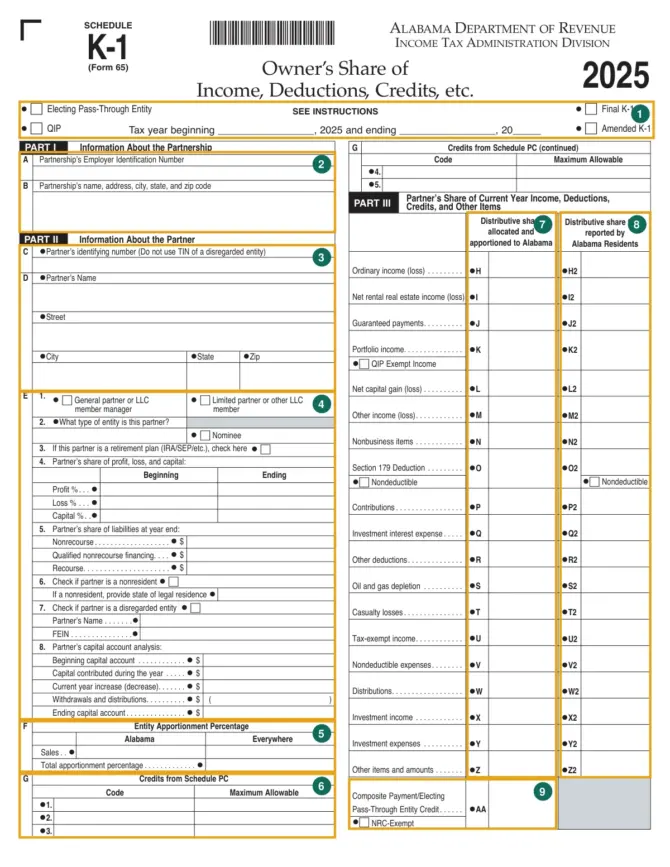
| Marker | Area on the form | What the partnership enters |
|---|---|---|
| 1 | Heading boxes | Check Electing Pass-Through Entity or QIP if they apply. Fill in the tax year dates for a fiscal or short year. On the right, check Final K-1 or Amended K-1. |
| 2 | Part I, lines A and B | The partnership’s federal EIN, then its name and mailing address. |
| 3 | Part II, lines C and D | The partner’s SSN or federal ID number, name and address. For a partner that is a disregarded entity, line C takes the TIN of the beneficial owner, never the disregarded entity’s own TIN. |
| 4 | Line E, items 1 to 8 | General or limited status (E1); type of partner, with the Nominee box (E2); retirement plan box (E3); profit, loss and capital percentages at the start and end of the year (E4); share of nonrecourse, qualified nonrecourse and recourse liabilities (E5); nonresident box and state of legal residence (E6); disregarded entity box with that entity’s name and FEIN (E7); capital account analysis (E8). |
| 5 | Line F | The entity’s sales from Form 65 Schedule C, lines 8a (Alabama) and 8b (everywhere), and the apportionment percentage from Schedule C, line 9. |
| 6 | Line G | The partner’s share of credits from Schedule K, line 21, one code per row with the maximum allowable amount. Rows 4 and 5 continue at the top right. |
| 7 | Part III, first column | Lines H to Z, the distributive share allocated and apportioned to Alabama. Completed for every partner. |
| 8 | Part III, second column | Lines H2 to Z2, the share to be reported by Alabama residents, from all sources. Completed for resident partners only. |
| 9 | Line AA | Composite payment or electing pass-through entity credit made for this partner, plus the NRC-Exempt box. |
For the tax year line in the heading, the 2025 K-1 instructions still say to give the period if the return covers something “other than the 2024 calendar year”; the form itself prints 2025 and a line reading “Tax year beginning ___, 2025 and ending ___, 20__”, which is where a fiscal or short year goes.
On line E2 the instructions want the partner’s type spelled out: individual, S corporation, C corporation, estate, trust, partnership, disregarded entity, exempt organization, foreign government or nominee. An LLC partner that is not disregarded is described by its federal classification, corporation or partnership. For a nominee, the type of owner it represents goes in as a code: I, C, F (estate or trust), P, DE, E, IRA or FGOV.
The credit codes for line G run from A (Alabama Enterprise Zone Credit) through N (Growing Alabama Credit), then Q to V, ending with V for the Income Tax Capital Credit; there is no O or P. Claim them in that order. If five rows are not enough, the rest goes on an attachment to the K-1. The amounts come from Schedule PC, Pass Through Credits, which the Form 65 instructions require whenever credits are claimed.
The two columns of Part III
The Alabama share in the first column is what a nonresident partner reports to Alabama. A resident partner is taxed on income from inside and outside the state, so the second column shows that partner’s share of the entity’s income from all sources. For a resident, both columns are filled; for a nonresident, only the first. Line AA has no second column; that cell is shaded.
A worked illustration with round numbers: a partnership earns $240,000 of ordinary income, its Schedule C apportionment factor is 40%, and two partners each hold 50%. Alabama’s share is $96,000, so line H shows $48,000 for each partner. With no Schedule A adjustments and no health insurance premium deduction in play, the resident partner’s line H2 shows $120,000, half of the income from everywhere. The nonresident’s H2 stays blank.
Guaranteed payments on line J follow the same split, and the owner instructions say it outright: a resident individual gets the entire amount of guaranteed payments, a nonresident individual the apportioned amount.
Where each Part III line comes from and where the partner reports it
Page 4 of Form 65 prints, beside every Schedule K line, the K-1 line it feeds. The table pairs that mapping with the owner instructions for partners who are individuals and file Alabama Form 40 or Form 40NR.
| K-1 line | Item | Form 65 Schedule K source | Individual partner reports it on |
|---|---|---|---|
| H | Ordinary income (loss) | Line 1 | Schedule E |
| I | Net rental real estate income (loss) | Lines 2 and 3c | Schedule E |
| J | Guaranteed payments | Line 4 | Schedule E |
| K | Portfolio income; QIP Exempt Income box | Lines 5 to 7 | The schedule that fits each type, with an explanation of the types and amounts |
| L | Net capital gain (loss) | Lines 8d and 9 | Schedule E |
| M | Other income (loss) | Line 10 | Schedule E |
| N | Nonbusiness items | Line 11 minus line 17 | The schedule that fits each item, with a statement of nature and amount |
| O | Section 179 deduction; Nondeductible box | Line 12 | Form 4562 |
| P | Contributions | Line 13a | Schedule A |
| Q | Investment interest expense | Line 13b | Form 4952A |
| R | Other deductions | Line 14 | The schedule that fits each deduction |
| S | Oil and gas depletion | Line 15 | Schedule E, with the partnership’s computation |
| T | Casualty losses | Line 16 | Form 4684 |
| U | Tax-exempt income | Lines 18a and 18b | Disclosure encouraged on Form 40 or 40NR |
| V | Nondeductible expenses | Line 18c | Disclosure encouraged on Form 40 or 40NR |
| W | Distributions | Lines 19a and 19b | Schedule D, for the part that is reportable income |
| X | Investment income | Line 20a | Form 4952A |
| Y | Investment expenses | Line 20b | Form 4952A |
| Z | Other items and amounts | Line 20c | The schedule that fits each item, with an explanation |
| AA | Composite payment or electing PTE credit | Lines 22 and 23 | Form 40 or Form 40NR |
| G | Credits | Line 21 | Schedule OC and/or Schedule NTC |
Several lines need paperwork sent to the partner with the K-1. Line K needs a breakdown of the portfolio income by type, and line N a statement of the nature and amount of each item. Line S needs the depletion computation, because Alabama’s rules on oil and gas depletion differ from federal law. Lines U, W and Z need an explanation of what makes up the figure. Line N2 takes the partner’s share of Schedule B, Column E, line 1h.
On line O, estates and trusts cannot take the section 179 deduction. The partnership still enters their share and checks the Nondeductible box. On line K, a qualified investment partnership checks QIP Exempt Income when the portfolio income is exempt for the nonresident owner. On line AA, the NRC-Exempt box is for a nonresident member who has certified exemption from composite payments, and Schedule NRC-Exempt must be attached when it is checked.
Line H2 needs care. The 2025 K-1 instructions tell the partnership to subtract the resident’s share of the Business Health Insurance Premium Deduction “(page 1, line 30)” from the share of federal ordinary business income “(page 1, line 24)”. On the 2025 Form 65, line 30 is net nonbusiness income for Alabama, line 31 is the Small Business Health Insurance Premium Deduction, line 23 is federal ordinary business income, and line 24 is the Schedule A reconciliation. The 2024 instructions carry the same line numbers. Neither booklet says whether H2 starts from line 23 or from line 25, the federal amount adjusted to Alabama basis, so a preparer with Schedule A adjustments should confirm the figure with the Department of Revenue.
What changed for 2025: the electing PTE box
The only item under “What’s New” in the 2025 Form 65 instructions concerns the electing pass-through entity choice, which also appears in the K-1 heading. The Electing PTE box on Form 65 must be checked every year the election is in effect. The election or a revocation cannot be made by amending Form 65 after the extended due date. A return with neither the Electing box nor the Revoking box checked is treated as a non-electing PTE. An electing entity also files Form EPT, and its tax shows up on Schedule K, line 23 and then on the partner’s line AA.
What makes a Form 65 incomplete or costly
- A partner without an Alabama K-1. The return is incomplete and may be treated as delinquent unless a K-1 is attached for everyone who was a partner at any time during the year.
- Sending federal K-1s instead. The K-1 instructions rule this out because the formats differ.
- Leaving out Schedule NRC-Exempt. Without it attached to Form 65 and Form PTE-C, the partnership has to make the composite payment as originally required.
- Filing on paper when e-filing is required. Partnerships with 50 or more partners at year end must e-file, and so must preparers who prepared 25 or more original corporate or partnership returns with software in a calendar year. Paper returns in that group are rejected. Not e-filing on time could also bring a $50 late filing penalty for each Schedule K-1 submitted with the return.
- Stapling PTE-C or EPT to Form 65. The Form 65 instructions say not to attach those forms or their payments.
When Form 65 is due and where the 2025 K-1 is published
The K-1s go in with Form 65. Calendar-year returns are due by the 15th day of March after the year closes, and fiscal-year returns by the 15th day of the third month after the year ends; a 15th that falls on a Saturday or Sunday moves to the following Monday. For calendar year 2025, March 15, 2026 was a Sunday, so the date was Monday, March 16, 2026. Alabama recognizes a federal extension, and the federal extension form must be submitted with the Alabama return. An extension to file does not extend the time to pay tax.
Paper returns go to Alabama Department of Revenue, Income Tax Administration Division, Pass Through Entity Unit, P.O. Box 327441, Montgomery, AL 36132-7441. The blank 2025 K-1 is a fillable PDF on the Department’s forms page, listed under form year 2025 as “Schedule K-1 (Form 65 Only)”, and the two-page K-1 instructions are a separate PDF.
Official PDF: Schedule K-1 (Form 65) — Official PDF (revenue.alabama.gov)
Questions about the Alabama Schedule K-1 (Form 65)
Which column does a nonresident partner use?
The first column of Part III, the share allocated and apportioned to Alabama. The owner instructions tell nonresidents to report that column and residents to report the second, all-sources column.
Does a partner who left during the year get an Alabama K-1?
Every person or entity that was a partner at any time during the taxable year needs one attached to Form 65. Check Final K-1 in the heading for that partner.
Where does an individual partner claim the line G credits?
On Schedule OC and/or Schedule NTC of Form 40 or Form 40NR, using the same codes and order shown on the K-1.
Official sources
- Schedule K-1 (Form 65), Owner’s Share of Income, Deductions, Credits, etc., 2025
- Instructions for the Preparation of Schedule K-1 (Form 65), 2025
- Form 65, Partnership/Limited Liability Company Return of Income, 2025
- Instructions for Form 65, 2025
- Forms page: Schedule K-1 (Form 65 Only), form year 2025
- Pass-Thru Entities: Subchapter K Entities (Partnerships) and S Corporations
- FAQ: What is the mailing address for Form 65?
- Instructions for the Preparation of Schedule K-1 (Form 65), 2024 (for the line H2 comparison)