Schedules D and E are one sheet in the Alabama Form 40 package: Schedule D on the front, Schedule E on the back. Schedule D lists each sale of real estate, stock, bonds, mutual fund gains or business property and arrives at one net figure for Form 40, page 2, Part I, line 3. Schedule E collects rents, royalties and your share of partnership, S corporation, estate and trust income, and its total goes on line 5 of the same part. Both are part of the 2025 Form 40 PDF published by the Alabama Department of Revenue (ALDOR), on PDF pages 40 and 41.
Who attaches Schedules D and E to Form 40
You need Schedule D if you sold real estate, stocks, bonds or other capital assets during 2025, if a mutual fund or brokerage statement reports capital or ordinary gains to you, or if you had an involuntary conversion of capital assets not held for a trade or business or a profit-seeking transaction. You need Schedule E for rents, royalties, and income or loss passed through to you by a partnership, S corporation, estate or trust. Any of these keeps you off the short Form 40A, whose conditions include not claiming income or loss from Schedules C, D, E or F.
Residency decides which sales belong on the Form 40 version:
- A full-year resident enters all sales for the entire year.
- A part-year resident enters the sales made during the period of Alabama residence.
- Alabama property sold after you stopped being a resident goes on Form 40NR, which has its own Schedules D and E in the nonresident booklet.
The Schedule D instructions state the rule that shapes the whole page: under Alabama law the entire gain is taxable and the entire loss is deductible in the year in which it occurs.
How to fill out Schedule D, column by column
The 2025 Schedule D has 20 rows, one per sale, under the heading “Net Profit or Loss From Sale of Real Estate, Stocks, Bonds, etc.” The letters in the table match the markers in the image, and line 1 is the single total at the bottom.
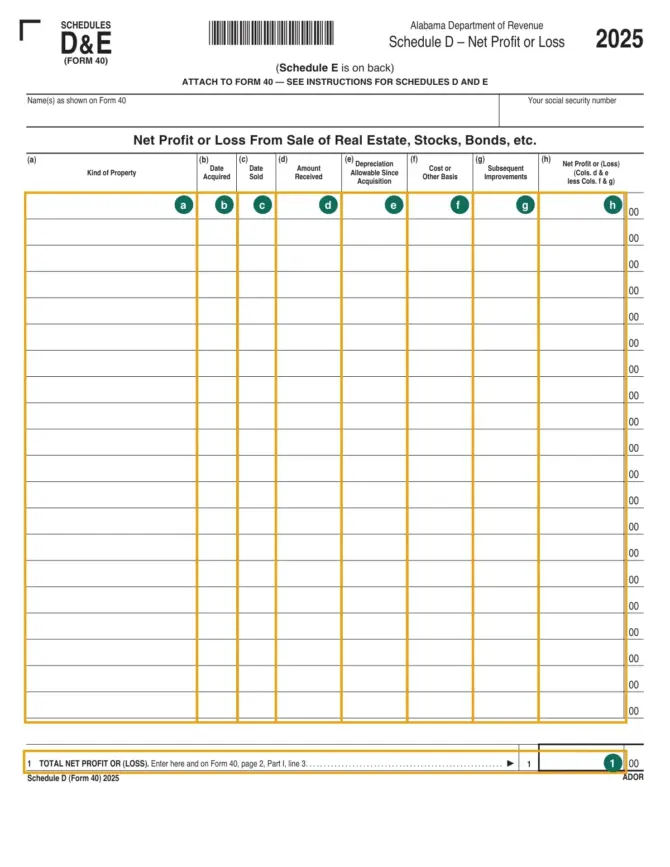
| Column | Printed heading | What to enter |
|---|---|---|
| (a) | Kind of Property | For real estate, the location and a description of the land and improvements. For bonds, the issuer, the issue, the denomination and the amount. For stock, the corporation, class, number of shares and capital changes affecting basis. For a mutual fund or brokerage statement, the fund’s or firm’s name. |
| (b) | Date Acquired | The date you acquired the property. |
| (c) | Date Sold | The date of the sale. |
| (d) | Amount Received | What you received from the sale. |
| (e) | Depreciation Allowable Since Acquisition | Depreciation allowable on the property since you acquired it. |
| (f) | Cost or Other Basis | Usually cost; the basis rules below cover gifts, inheritances and older property. |
| (g) | Subsequent Improvements | Improvements made after acquisition. |
| (h) | Net Profit or (Loss) | Columns (d) and (e) less columns (f) and (g). For a fund statement, the net capital or ordinary gain it reports. |
| Line 1 | Total net profit or (loss) | The total of column (h), also entered on Form 40, page 2, Part I, line 3. |
Column (h) prints “(Loss)” in parentheses, but the general instructions on page 7 of the booklet ask for negative numbers with a minus sign and no parentheses, and for amounts rounded to whole dollars. When 20 rows are not enough, the fillable PDF has a “Check here if you have more than one Schedule D” box; the instructions also allow separate sheets that repeat headings (a) through (h).
Two kinds of sale need more than a row. Selling your personal residence produces a gain taxable to the same extent as on your federal return, but a loss on it is not deductible. Selling business property is reported as a net gain or loss here, with a copy of federal Form 4797 attached, because Alabama does not print its own version of that form.
A row with made-up figures: a rental house bought for $150,000, with $20,000 of later improvements and $30,000 of depreciation allowable, sells for $180,000. Column (h) is $180,000 plus $30,000, minus $150,000 and $20,000, which is $40,000.
Which basis goes in column (f)
The basis is usually what the property cost. If you use anything other than cash cost, attach an explanation of the basis. The booklet gives these other rules:
- Property acquired before December 31, 1932: fair market value on December 31, 1932.
- Gift or transfer in trust on or after December 31, 1932 and before March 15, 1985: fair market value on the date acquired.
- Gift on or after March 15, 1985: the donor’s basis, except that for figuring a loss, fair market value at the time of the gift is used when it is lower than that basis.
- Transfer in trust (not by gift, bequest or devise) on or after March 15, 1985: the grantor’s basis, increased by gain or decreased by loss the grantor recognized on the transfer.
- Inherited property: fair market value at the decedent’s death; the value appraised for federal estate tax, or the alternate value, counts as that value.
Involuntary conversions follow 26 U.S.C. §1033 when you elect it. Installment sales follow Internal Revenue Code Section 453, except 453(i) on recapture income, and the booklet lists federal Form 6252 as the form to use. Sales under revolving credit plans and sales of stock, securities or other property traded on established markets made after 1987 cannot use the installment method.
How to fill out Schedule E Part I for rentals and royalties
Part I has three property columns, A, B and C, and a Totals column. Rent from property you own or control and royalties from copyrights, mineral leases and similar rights go here; if you were paid in property instead of cash, report its fair market value. The note at the top of Part I sends a business of renting personal property, run under a federal employer identification number, to federal Schedule C instead.
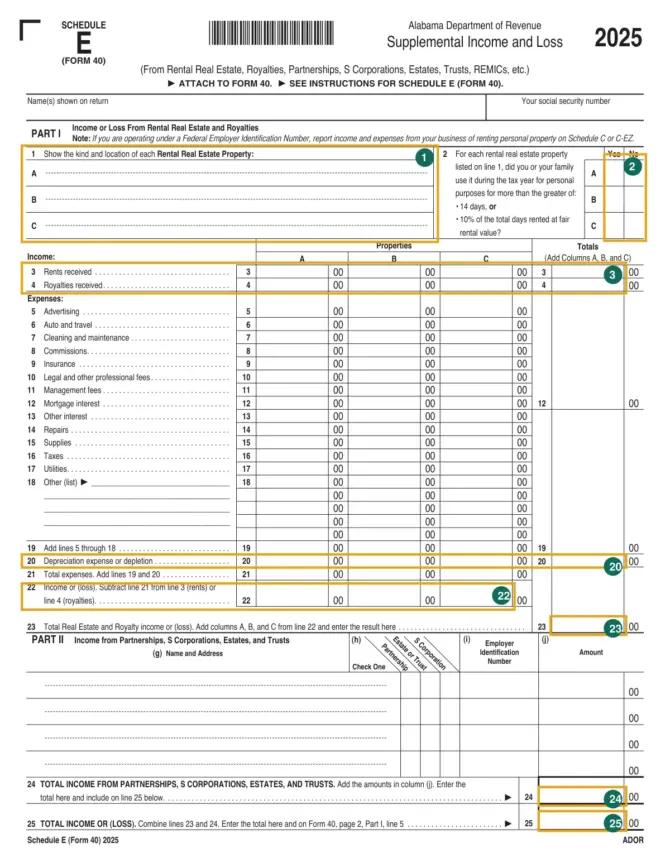
| Line | What it asks |
|---|---|
| 1 | The kind of rental real estate (brick house, apartment complex) with street address, city or town and state, and your ownership percentage if under 100%. |
| 2 | Yes or No for each property: did you or your family use it for personal purposes for more than 14 days or 10% of the days rented at fair rental value, whichever is greater. |
| 3 and 4 | Rents received and royalties received, per property and in total. |
| 5 to 18 | Expenses per property: advertising, auto and travel, cleaning and maintenance, commissions, insurance, legal and professional fees, management fees, mortgage interest, other interest, repairs, supplies, taxes, utilities, and other (listed). |
| 19 | Lines 5 through 18 added. |
| 20 | Depreciation expense or depletion. |
| 21 | Total expenses: lines 19 and 20. |
| 22 | Income or loss: line 21 subtracted from line 3 for rents or line 4 for royalties. |
| 23 | Columns A, B and C of line 22 added. |
Lines 5 to 18 take ordinary and necessary expenses such as taxes, interest, repairs, insurance, management fees and agent’s commissions. The value of your own labor and amounts paid for capital investments or improvements are not deductible there. When part of the investment interest deduction from Form 4952A, line 6 is attributable to royalties, that part goes on Schedule E; the rest goes on Schedule A, line 13.
For line 20, Alabama treats federal ACRS depreciation as a reasonable allowance for assets placed in service from January 1, 1981 through 1986, and MACRS under I.R.C. §168 for assets placed in service after December 31, 1986; the §179 deduction has been allowed for taxable years beginning after December 31, 1989. Land apart from its improvements and inventories are not depreciated. Depletion applies to royalty income from mines and oil and gas wells. For oil and gas wells it is 12 percent of the gross income from the property, excluding rents or royalties you paid on it, capped at 50 percent of the property’s net income figured without depletion, and never less than the federal allowance.
Schedule E Part II: partnerships, S corporations, estates and trusts
Part II has four rows. For each source give the name and address in column (g), check Partnership, Estate or Trust, or S Corporation in column (h), enter the employer identification number in column (i) and the amount in column (j). Line 24 adds column (j); line 25 combines lines 23 and 24 and goes to Form 40, page 2, Part I, line 5.
Partners report their share of income whether or not it was distributed, or the net loss up to their basis, for the partnership year ending within your tax year. S corporation shareholders report their pro rata share from the Schedule K-1 the same way. Estate and trust beneficiaries report the taxable part from the fiduciary’s statement and keep that statement rather than attaching it. A loss from an irrevocable trust cannot be claimed in Part II under ALDOR rule 810-3-25-.05(8)(b).
The booklet’s page 24 maps the lines of the Alabama Schedule K-1 to the individual return:
| Alabama K-1 line | Where an individual owner reports it |
|---|---|
| H, I, L, M, S; J (partnership K-1 only) | Schedule E. Line S needs a computation with the K-1, because Alabama’s oil and gas depletion rules differ from federal law. |
| W; AC (S corporation K-1 only) | The reportable-income portion goes on Schedule D, with a detailed explanation accompanying the K-1. |
| K, N, R, Z | The schedule that fits the nature of the item; K, N and Z come with an explanation of the amounts. |
| G | Schedule OC |
| P | Schedule A |
| Q, X, Y | Form 4952A |
| O | Form 4562 |
| T | Form 4684 |
A sizeable gain or a profitable year of rents does not change this year’s return, but it can affect next year’s payments. ALDOR’s filing information page requires estimated payments when the expected Alabama tax after credits and withholding is over $500, due April 15, June 15, September 15 and January 15 for calendar-year filers, and those go in with the Alabama Form 40ES vouchers.
What the 2025 booklet lists as new
One of the eight items under “What’s New For 2025” concerns Schedule D. Act 2024-0447, the Sound Money Tax Neutrality Act, amends Section 40-18-14 so that net capital gain from exchanging precious metal bullion is excluded from Alabama income tax beginning January 1, 2025. Page 7 of the booklet defines bullion as coins, bars or rounds of primarily refined gold, silver, platinum or palladium, marked and valued mainly by weight, purity and content. The other seven items (the ID Confirmation Quiz, the vehicle loan interest deduction, the expanded military pay exemption and four Schedule OC credits) do not involve Schedules D and E.
Where to get Schedules D and E, and when Form 40 is due
ALDOR does not post Schedules D and E as a separate file. They are pages 40 and 41 of the 2025 Form 40 PDF, and the instructions are on pages 23 and 24 of the Form 40 booklet. Attach the schedules to Form 40; the booklet’s list of forms describes them as Schedule D&E.
Form 40 is due on the federal due date, April 15 for most individuals according to ALDOR’s filing information page, moving to the next business day when it falls on a weekend or state holiday. You get an extension to October 15, 2026 without filing anything, but interest on unpaid tax still runs from the original due date, and apart from taxpayers abroad no extension exceeds six months. For 2025 returns both dates had passed at this check.
You can file through My Alabama Taxes (MAT) at no charge, through a practitioner’s e-file, or on paper. Paper returns for 2025 go to one of these ALDOR boxes in Montgomery:
| Return | Address |
|---|---|
| Refund on line 35 | P.O. Box 154, Montgomery, AL 36135-0001 |
| Payment on line 30, with Form 40V | P.O. Box 2401, Montgomery, AL 36140-0001 |
| No refund and no payment | P.O. Box 327469, Montgomery, AL 36132-7469 |
| Amended or prior-year return | Income Tax Administration Division, P.O. Box 327464, Montgomery, AL 36132-7464 |
For questions on a sale or a K-1 item, the booklet’s page 3 lists nine Taxpayer Service Centers; the Montgomery center is at 2545 Taylor Road, phone (334) 242-2677.
Questions about Alabama Schedules D and E
Where do mutual fund capital gain distributions go on the Alabama return?
On Schedule D: the fund or brokerage firm’s name in column (a) and the net capital or ordinary gain in column (h). Interest and dividends from the same statement belong on Schedule B, which Form 40 filers complete when their interest and dividends total $1,500 or more.
Can I deduct a loss on selling my home in Alabama?
A loss on the sale of a personal residence is not deductible. A gain is taxable to the same extent as on your federal return.
Do I attach the K-1 or the trust statement?
The Schedule E instructions tell estate and trust beneficiaries not to attach the fiduciary’s statement and to keep it for their records. For a business property sale, attach a copy of federal Form 4797.
Official sources
- Alabama Department of Revenue, Form 40 (2025), with Schedules D and E on PDF pages 40 and 41
- Alabama Department of Revenue, Form 40 booklet, tax year 2025 (Schedules D and E instructions, pages 23 and 24)
- Alabama Department of Revenue, Individual Income Tax: General Information for Individuals