Alabama Schedule K-1 (Form 20S) is the one-page statement an S corporation prepares for each of its shareholders when it files the 2025 Alabama Form 20S. It reports the shareholder’s stock percentage, the corporation’s sales factor, any Schedule PC credits, and every Schedule K item split into an Alabama amount and, for Alabama residents, an amount from all sources. The Department of Revenue’s instructions say the federal Schedule K-1 from Form 1120-S cannot stand in for it, because the layouts are different.
Which S corporations prepare it, and for whom
A K-1 goes into the Form 20S package for every person or tax entity that held shares at any point in the taxable year, so a shareholder who sold in the spring is still listed. The Form 20S instructions treat the return as incomplete, and open to treatment as delinquent, unless it carries a full copy of federal Form 1120-S with all federal K-1s plus a completed Alabama K-1 for each shareholder.
The filing obligation itself sits with the corporation. Any S corporation other than a financial institution that does business in Alabama or has income from Alabama sources, including income from property in the state, files Form 20S. For tax years starting on or after January 1, 2025, the Department’s pass-through page and the Form 20S instructions put the factor presence thresholds at $68,000 of property, $68,000 of payroll, $675,000 of sales, or 25% of total property, payroll or sales.
Shareholders that are not individuals get a separate warning in the K-1 instructions: holding an interest in a pass-through entity that does business in Alabama can by itself give them nexus, meaning a presence that makes them subject to Alabama income tax. The rest of the shareholder instructions are written for individuals filing Form 40 or Form 40NR. The K-1 that an Alabama estate or trust gives its beneficiaries is a separate form, the Alabama Schedule K-1 (Form 41).
Filling out the 2025 K-1, box by box
The frames in the image below carry the same numbers as the first column of this table. Everything to the left of Part III describes the corporation and the shareholder; the two money columns on the right are where most of the work is.
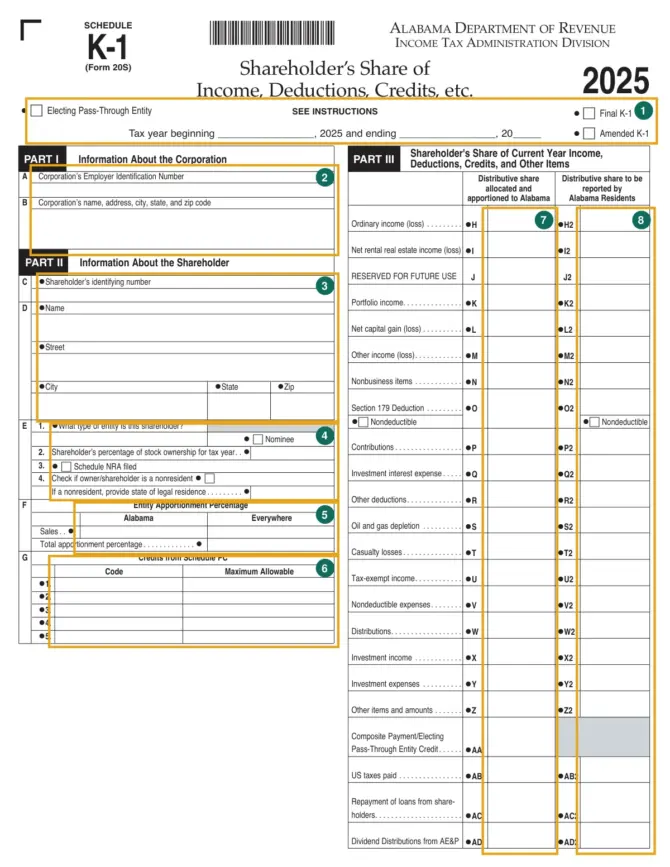
| Frame | Boxes | What goes in them |
|---|---|---|
| 1 | Heading | Electing Pass-Through Entity box if the corporation made that election; beginning and ending dates only when the year is not calendar 2025; Final K-1 or Amended K-1 on the right. |
| 2 | Part I, lines A and B | The corporation’s federal EIN, then its name and mailing address. |
| 3 | Part II, lines C and D | The shareholder’s Social Security number or federal ID number, name, street, city, state and ZIP. |
| 4 | Line E1 to E4 | Type of shareholder and the Nominee box (E1), percentage of stock owned for the year (E2), Schedule NRA filed (E3), nonresident box and state of legal residence (E4). |
| 5 | Line F | Alabama and Everywhere sales from Form 20S Schedule C, lines 8a and 8b, and the total apportionment percentage from Schedule C, line 9. |
| 6 | Line G | Up to five Schedule PC credits: the letter code and the shareholder’s maximum allowable amount. |
| 7 | Part III, first column | The shareholder’s share of each item allocated and apportioned to Alabama, lines H to AD. Completed for residents and nonresidents. |
| 8 | Part III, second column | Lines H2 to AD2, the share from all sources. Completed for Alabama residents only. |
For line E1 the instructions accept individual, estate, trust, disregarded entity, exempt organization or nominee (custodian). When the Nominee box is checked, E1 also shows whom the nominee holds for, using these codes: I individual, C corporation, F estate or trust, P partnership, DE disregarded entity, E exempt organization, IRA individual retirement arrangement, FGOV foreign government.
Line F repeats figures from the corporation’s own return. Alabama apportions a multistate S corporation by a sales factor (Alabama sales over Everywhere sales, Act 2021-1), and Schedule C is skipped by a corporation that operates only in Alabama; it enters 100% on Schedule C, line 9, which is the figure that then belongs on line F.
Line G takes the shareholder’s pro rata share of the credit on Form 20S Schedule K, line 21, which in turn comes from Schedule PC. The codes have to be listed in this order: A Enterprise Zone, B Basic Skills Education, C Coal, D Full Employment Act of 2011, E Veteran’s Employment Act employer credit, F Veteran’s Employment Act business start-up expenses, G Qualified Irrigation System/Reservoir System, H 2013 Historic Rehabilitation, I taxes paid to a foreign country, J Career-Technical Dual Enrollment, K Investment Credit (Alabama Jobs Act), L Alabama Accountability Act, M Port Credit, N Growing Alabama, Q Innovate Alabama, R Workforce Housing, S Employer Tax Credit, T Childcare Facility, U Employer Provider, V Income Tax Capital Credit. The 2025 list has no O or P. A shareholder with more than five credits gets the rest on an attachment to the K-1.
Alabama column and resident column in Part III
Every shareholder, wherever they live, gets the first column: the share of income or loss allocated and apportioned to Alabama. The second column is filled only for residents, and it holds the resident’s share from all sources, including what the corporation earned in other states. The split follows the definition of gross income in the instructions: for a resident it covers income from inside and outside Alabama, for a nonresident only income from property owned or business done in Alabama.
A worked case with round numbers: a corporation has $80,000 of ordinary income and a sales factor of 25%, so $20,000 is apportioned to Alabama. Shareholder A lives in Montgomery and owns 60%; shareholder B lives in Georgia and owns 40%. On line H, A’s first column shows $12,000 and B’s shows $8,000. A’s line H2 shows $48,000, the 60% share of everything the corporation earned. B’s second column stays empty.
Line AA, the composite payment or electing pass-through entity credit, has no second column at all; that cell is shaded on the form.
Where each line comes from on Form 20S
Part III pulls its figures from the Apportioned Amount column of Form 20S Schedule K. The last column shows where an individual shareholder reports the amount according to the owner instructions on page 2 of the K-1 instructions.
| K-1 line | Item | From Schedule K | Individual reports it on |
|---|---|---|---|
| H | Ordinary income (loss) | Line 1 | Schedule E, Form 40 or 40NR |
| I | Net rental real estate income (loss) | Lines 2 and 3c | Schedule E |
| J | Reserved for future use | None | None |
| K | Portfolio income | Lines 4 to 6 | The schedule that fits the type of income; an explanation of the types goes with the K-1 |
| L | Net capital gain (loss) | Lines 7d and 8 | Schedule E |
| M | Other income (loss) | Line 9 | Schedule E |
| N | Nonbusiness items | Line 10 minus line 17 | The schedule that fits each item; a statement of their nature and amounts goes with the K-1 |
| O | Section 179 deduction | Line 11 | Form 4562 filed with Form 40 or 40NR |
| P | Contributions | Line 12a | Schedule A |
| Q | Investment interest expense | Line 12b | Alabama Form 4952A |
| R | Other deductions | Line 13 | The schedule that fits the deduction |
| S | Oil and gas depletion | Line 14 | Schedule E, with a computation attached to the K-1 |
| T | Casualty losses | Line 15 | Form 4684 |
| U | Tax-exempt income | Lines 18a and 18b | Disclosure encouraged on Form 40 or 40NR |
| V | Nondeductible expenses | Line 18c | Disclosure encouraged on Form 40 or 40NR |
| W | Distributions | Line 19 | Reportable part on Schedule D, with a detailed explanation |
| X and Y | Investment income and expenses | Lines 20a and 20b | Alabama Form 4952A |
| Z | Other items and amounts | Line 20c | The schedule that fits each item |
| AA | Composite payment / electing PTE credit | Lines 22 and 25 | Form 40 or 40NR |
| AB | U.S. taxes paid | Line 16 | Form 40 or 40NR |
| AC | Repayment of loans from shareholders | Line 23 | Reportable part on Schedule D |
| AD | Dividends from accumulated earnings and profits | Line 24 | The schedule that fits; also reported to the shareholder on Form 1099-DIV |
Lines N and N2
N2 does not come from Schedule K. It is the shareholder’s share of Form 20S Schedule B, Column E, line 1h, the separately stated nonbusiness items for all states.
Line O
Estates and trusts cannot take the section 179 deduction. When the shareholder is one, the corporation still enters the share and checks the Nondeductible box under line O.
Line AB
The U.S. taxes on Schedule K, line 16 come from Form 20S Schedule D, which apportions only the LIFO recapture tax from federal Form 1120-S by the Alabama factor.
The line H2 references in the 2025 instructions
For residents, the 2025 K-1 instructions build line H2 by subtracting the shareholder’s share of the Business Health Insurance Premium Deduction “(page 1, line 29)” from the share of federal ordinary business income “(page 1, line 23)”. The 2025 Form 20S itself is numbered differently: federal ordinary business income is line 22, line 23 is the Alabama nonseparately stated reconciliations from Schedule A, line 24 is federal ordinary business income adjusted to Alabama basis, line 29 is Alabama net nonbusiness income, and the Small Business Health Insurance Premium Deduction is line 30.
The two documents therefore point to different lines, and neither says which return figure H2 should start from. This guide does not choose one. Before finishing H2, ask the Department’s Pass-Through Entity Section at (334) 242-1170, Option 6, the number given in the 2025 Form PTE-C instructions.
Nonresident shareholders: composite payment or Schedule NRA
Lines E3 and AA connect to how the corporation handles tax for nonresident owners. An S corporation can either file Form PTE-C, a composite return paying tax at 5% on behalf of its nonresidents, or file Schedule NRA for a nonresident owner who elects out of the composite filing. Schedule NRA is attached to Form 20S itself, not to the composite form, and is filed every year. The owner’s election stays in force until the owner tells the corporation in writing that they want back into the composite filing.
According to the 2025 PTE-C instructions, the corporation does not have to make a composite payment for a nonresident shareholder who certifies in writing, under penalty of perjury and before the return’s original due date, that they have fully paid their Alabama tax on their share. If that shareholder then does not pay, the corporation must pay the tax within 60 days after notice and demand from the Department.
What changed for 2025: checking the electing PTE box
The “What’s New” note in the 2025 Form 20S instructions concerns the box that also appears at the top of the K-1. An S corporation making the Electing Pass-Through Entity election, or revoking it, checks the box on Form 20S, and the electing box has to be checked every year the election is in effect. The election or revocation cannot be made by amending Form 20S after the extended due date. A return with neither the electing nor the revoking box checked is treated as a non-electing PTE. An electing entity also files Form EPT.
When Form 20S is due and where it is mailed
Form 20S, with every K-1 attached, is due by the 15th day of the third month after the tax year ends. The pass-through page moves a due date that falls on a Saturday, Sunday or state holiday to the next business day; March 15, 2026 is a Sunday, so a calendar-year 2025 return is due Monday, March 16, 2026. Alabama recognizes the federal extension, which has to be submitted with the Alabama return, but the extension does not extend the time to pay.
A paper return goes to one of two boxes depending on whether a payment is enclosed:
| Return | Address |
|---|---|
| With payment (check and Form PTE-V) | Alabama Department of Revenue, Pass Through Entity Section, P.O. Box 327444, Montgomery, AL 36132-7444 |
| Without payment | Alabama Department of Revenue, Pass Through Entity Section, P.O. Box 327441, Montgomery, AL 36132-7441 |
A balance due of $750 or more has to be paid by electronic funds transfer; a smaller amount sent by check goes with Form PTE-V. The K-1 itself has no signature line; the officer signs page 2 of Form 20S.
Corporations with assets of $5 million or more, and returns prepared by a preparer who files 25 or more such returns in a calendar year, must be filed electronically. Since the 2023 tax year the Department rejects a paper return that was required to be e-filed.
The blank 2025 K-1 is posted on the Department’s forms page as “Schedule K-1 (Form 20S Only)”, form year 2025, file 25f20sschk1.pdf. It is a fillable PDF.
Official PDF: Schedule K-1 (Form 20S) — Official PDF (revenue.alabama.gov)
What the Department penalizes or rejects
- A Form 20S sent without a completed Alabama K-1 for each shareholder, or without the full federal Form 1120-S and its federal K-1s, is not a complete return and can be treated as delinquent.
- Copies of federal K-1s in place of the Alabama form. The K-1 instructions rule this out.
- Paper filing when e-filing is mandated: the return is rejected, late filing penalties can apply, and the pass-through page adds a possible $50 late filing penalty for each Schedule K-1 submitted with the return.
- Forgetting the electing PTE box. Without it, the return is treated as non-electing, and the election cannot be added by amendment after the extended due date.
- A late Form 20S: the instructions set a failure to timely file penalty of 10% of the tax on line 32 or $50, whichever is greater, and 1% per month, up to 25%, for tax not paid by the due date.
Questions about the Alabama Form 20S K-1
Does a nonresident shareholder need an amount in the second column?
The instructions reserve the second column of Part III for resident shareholders; a nonresident reports the Alabama amounts from the first column.
Where does an individual shareholder claim the line G credits?
On Schedule OC and/or Schedule NTC of Form 40 or Form 40NR, applying the codes and order shown on page 1 of the K-1 instructions.
What does the shareholder do with line AD?
Dividends paid out of accumulated earnings and profits are also reported to the shareholder on Form 1099-DIV, and an individual reports them on the matching schedule of Form 40 or 40NR.
Official sources
- Schedule K-1 (Form 20S), Shareholder’s Share of Income, Deductions, Credits, etc., 2025
- Instructions for the Preparation of Schedule K-1 (Form 20S), 2025
- Form 20S, S Corporation Information/Tax Return, 2025
- Instructions for Form 20S, 2025
- Instructions for Form PTE-C and Schedule PTE-CK1, 2025
- Forms page: Schedule K-1 (Form 20S Only), form year 2025
- Pass-Thru Entities: Subchapter K Entities (Partnerships) and S Corporations
- FAQ: What is the mailing address for Form 20S?