Form AR1100PET is the return a partnership, LLC or S corporation files once its owners have chosen to have Arkansas income tax paid at the entity level under the Elective Pass-Through Entity Tax Act (Act 362 of 2021). The entity computes one tax for all of its members, at 3.9% on income other than capital gains and 1.95% on capital gains for 2025, and the income taxed this way is excluded from the members’ own Arkansas income tax. The edition in use is the 2025 AR1100PET, four pages, with page 1 revised 5/29/2025. The Department of Finance and Administration (DFA) forms page lists it under 2025, posted 01/08/2026, with the booklet reposted 02/10/2026; the only 2026 item there is the AR1100ESPET estimated tax vouchers.
Who can elect the pass-through entity tax and how the election is made
The tax is open to partnerships, Subchapter S corporations and limited liability companies. It is not available to C corporations, qualified subchapter S subsidiaries, trusts, sole proprietorships, or LLCs taxed as C corporations for federal purposes. The six entity boxes on page 1 of the return reflect that list: LLC, LLP, LP, Partnership, SMLLC and S-Corp.
Owners holding the voting power must agree to it, and once they do, nobody is left out. The booklet states that every owner member must participate and that a member cannot opt out after the entity makes the election. The booklet contrasts this with a composite return, which covers only the nonresident members who elect to be included.
There are three ways to elect, all before the due date of the return as extended:
- Form AR362-E on paper, signed by a partner or member authorized to sign the return, or by a corporate officer for an S corporation. The form says the election holds for the year shown and each later year until it is revoked.
- Registering for the tax in ATAP, the Arkansas Taxpayer Access Point.
- Filing the AR1100PET itself before the due date. The AR362-E notes that the paper election is not required, but DFA asks entities that want to send estimated or extension payments first to file it so the payments land on the right account.
Revocation works the same way, on Form AR362-R or in ATAP, again before the due date or extended due date. The entity needs its own federal employer identification number (FEIN); the booklet explains that each electing entity must have a unique FEIN so its returns and payments are kept apart from other entities with the same owner.
Two DFA documents describe the vote differently. Pages 4 and 9 of the 2025 instructions, and the affirmation printed on Form AR362-E (R 6/25/2025), require owner members holding more than 50% of the voting power. Page 8 of the same booklet says Act 362 lets members holding 50% or more make the election. An entity whose owners are split exactly 50/50 can ask the Pass-Through Entity Tax Section which wording applies, at (501) 371-7692 or passthrough.entitytax@dfa.arkansas.gov.
The election changes what the owners file. A nonresident member does not have to file an Arkansas individual return if all of the member’s Arkansas income comes from entities that pay this tax. Tax credits the members earn individually cannot be used against the entity’s tax. An S corporation that files an AR1100PET for a year does not also file Form AR1100S for that year.
What the 2025 booklet lists as new
Page 5 of the instructions, “What’s New for 2025”, is mostly about Act 719 of 2025. That act moves sales of services and intangibles to market-based sourcing, sets a $250,000 receipts nexus threshold for nonresident corporations and partnerships with no physical presence, and replaces business and nonbusiness income with apportionable and non-apportionable income. The booklet dates those changes to tax years beginning on or after January 1, 2026, so they do not reach a 2025 return. The page also lists Act 696 (USDA relief payments exempted), Acts 701 and 838 (amended forest and opportunity zone incentives) and Acts 881 and 882 (new credits for headquarters relocation and for modernization and automation).
How to fill out page 1 of the AR1100PET
Page 1 is where the tax is figured and paid. Its lines 1 and 3 are fed by the later pages: an entity working only in Arkansas takes them from Schedule K on page 2, while a multistate entity takes them from page 3. The numbers on the image below match the rows of the table.
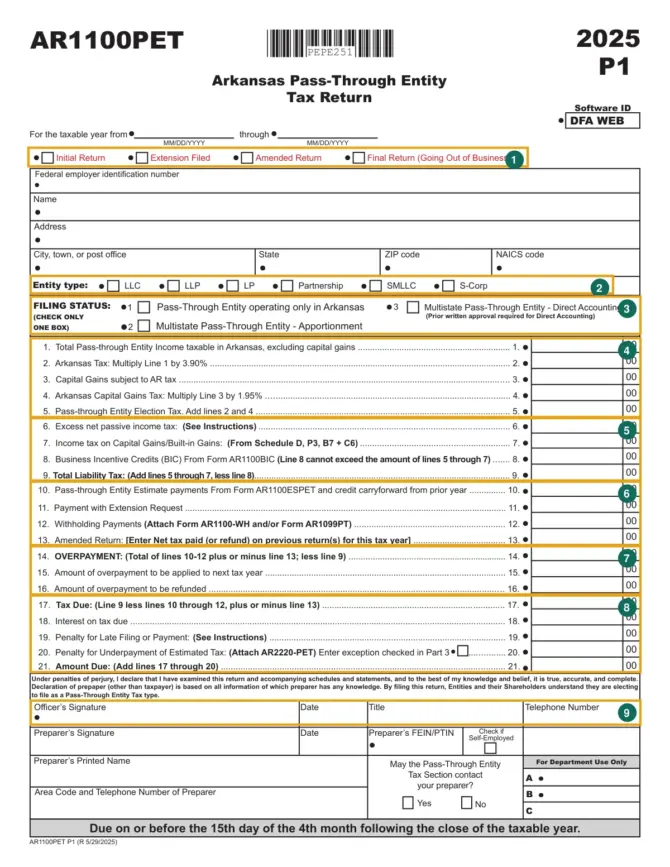
| Marker | Part of page 1 | What goes there |
|---|---|---|
| 1 | Initial Return, Extension Filed, Amended Return, Final Return | Mark the boxes that apply. Final Return means going out of business. Extension Filed is checked when a federal Form 7004 or an Arkansas AR1155-PET was filed. |
| 2 | Entity type | LLC, LLP, LP, Partnership, SMLLC or S-Corp. FEIN, name, address and NAICS code go in the boxes above. |
| 3 | Filing status, one box only | 1: operating only in Arkansas. 2: multistate, apportionment. 3: multistate, direct accounting, which needs DFA’s prior written approval. |
| 4 | Lines 1 to 5 | Line 1 is taxable income excluding capital gains, taxed at 3.90% on line 2. Line 3 is capital gains subject to Arkansas tax, taxed at 1.95% on line 4. Line 5 adds lines 2 and 4. |
| 5 | Lines 6 to 9 | Line 6: excess net passive income tax. Line 7: tax on capital gains or built-in gains from Schedule D, B7 plus C6. Line 8: business incentive credits from Form AR1100BIC, capped at lines 5 through 7. Line 9: lines 5 to 7 less line 8. |
| 6 | Lines 10 to 13 | Line 10: AR1100ESPET estimates and last year’s carryforward. Line 11: payment sent with an extension request. Line 12: withholding, with Form AR1100-WH or AR1099PT attached. Line 13: on an amended return only. |
| 7 | Lines 14 to 16 | Overpayment, split between the amount carried to next year (line 15) and the amount refunded (line 16). |
| 8 | Lines 17 to 21 | Tax due, interest, the late filing or payment penalty, the estimated tax penalty from AR2220-PET, and the amount due on line 21. |
| 9 | Officer’s signature | Signed and dated by an officer; title and phone number beside it. Paid preparers complete the boxes underneath. |
Line 6 applies only to an S corporation that has C corporation earnings and profits at year end, passive investment income above 25% of gross receipts, and taxable income. The booklet gives an 11-line worksheet that ends at 4.3% of the smaller of excess net passive income or taxable income; the computation goes on a separate schedule attached to the return. For a corporation that has always been an S corporation, line 6 does not apply.
Line 8 is the entity’s own choice. Act 362 lets the entity apply Arkansas income tax credits it holds against this tax; a credit it does not use can pass to the members as the credit’s own statute allows. The credit claim is made on Form AR1100BIC, which has its own guide: Arkansas AR1100BIC.
On line 13 of an amended return, tax paid on the earlier return for the same year is entered as a positive number, and a refund or larger overpayment carried forward from it as a negative number.
Page 2: Schedule K when the entity operates only in Arkansas
Schedule K is required for every AR1100PET. It totals the members’ shares of the entity’s income, deductions, credits and other items, in two columns: “Total Under Arkansas Law” (federal amounts adjusted to Arkansas law) and “Arkansas Source Amount” (the apportioned or allocated share). An entity operating only in Arkansas completes both columns and must attach Form AR-KREC reconciling them; a multistate filer attaches Schedule AR1100ADJ for its adjustments.
The schedule’s own lines run from 1 to 22. Lines 1 to 10 are income items, with Form 8825 attached for rental real estate on line 2, federal Schedule D for lines 7 and 8 and Form 4797 for line 9. Lines 11 to 12c are deductions (Form 4562 with the Section 179 amount). Lines 13 to 18c are information items: guaranteed payments, credits, basis items, tax-exempt income, distributions and investment items. Line 13 is reported for information only and stays out of line 19.
Line 19 is the net income: add lines 1 through 6 and line 10, add line 9 only if it is a loss, then subtract lines 11 through 12c. Capital gains are kept out of that total and brought together on line 22 (lines 7 and 8, plus line 9 if a gain). Lines 20 to 22 are completed only under filing status 1; line 20 is the net operating loss deduction with Form AR1100NOL attached, and line 21 is line 19 less line 20. The booklet says losses arising in 2024 and later may be carried forward up to 10 tax years.
The instructions point to different columns for carrying line 21 to page 1. The line 1 instruction on page 11 of the 2025 booklet says line 1 must equal Schedule K line 21 in the “Total Under Arkansas Law” column for filing status 1. The Schedule K instruction on page 14 says entities operating only in Arkansas report lines 21 and 22 from the Arkansas column on page 1, lines 1 and 3 (it calls the form “AR1100PT”). The two columns can differ, which is why the AR-KREC reconciles them, and the booklet does not settle which one page 1 takes. The Pass-Through Entity Tax Section, (501) 371-7692, can confirm the column before the return is filed.
Page 3: apportionment and Schedule D for multistate entities
Filing status 2 entities use page 3. A note in the middle of the page says that if the apportionment factor in Section B comes to 100%, the page is not completed and the return is filed under status 1.
- Part A starts from federal ordinary business income (Form 1120-S or 1065) and adds or subtracts Arkansas adjustments listed on Schedule AR1100ADJ, giving total apportionable income on line A4.
- Part B is the single sales factor that applies to tax years beginning on or after January 1, 2021: Arkansas sales in column A, sales everywhere in column B, and the percentage in column C to six decimal places, as in 26.123456%. Gross receipts are used. For 2025, sales shipped from Arkansas to a state where the seller is not taxable count 71.42% to Arkansas and 28.58% to the destination state. An entity in a special industry (construction, broadcasting, publishing, airlines, trucking, pipelines and others listed in the booklet) checks the box on line 4 and takes the percentage from Form AR-718.
- Part C multiplies A4 by the line 5 percentage, adds income allocated directly to Arkansas on C2 (including Arkansas partnership income the entity receives, with the AR K-1s attached), and subtracts the apportioned net operating loss on C3, limited to the amount needed to absorb C1 and C2. C4 goes to page 1, line 1.
Schedule D on the same page has three parts. Part A apportions capital gains and ends on line 6, which goes to page 1, line 3. Parts B and C apply only to S corporations: Part B to those that elected S status before 1987 and are still taxed on certain capital gains (it has a $25,000 statutory minimum and a 4.30% rate), and Part C to the built-in gains tax for elections made after December 31, 1986. B7 and C6 are added together on page 1, line 7.
Page 4: the members’ shares and the AR K-1s
Page 4 lists every member: name, a check mark if an Arkansas resident (or business domiciled in Arkansas), SSN or FEIN, percentage owned in stock, percentage owned in profit, loss or capital, income minus capital gain, capital gains, and tax. A page holds 21 members. Beyond that, a paper filer adds more page 4s or may send a spreadsheet on CD or USB with the same columns, and an electronic filer includes the member schedules as attachments. The booklet warns not to write “APPLIED FOR” anywhere on the return in place of an identification number.
Each member also gets an AR K-1, filled in with the figures that would have been used had the entity not elected. Members use it to back the income out of their own returns, on Form AR-OI or other forms. The instructions single out guaranteed payments as the exception: they stay taxable on the member’s Arkansas individual return. The AR-OI guide covers that side of the process.
Problems the instructions single out
- Writing “APPLIED FOR” in place of the FEIN of the entity or of a member.
- Leaving out the federal return. Sub-S corporations and partnerships include a copy of their federal return; a single-member LLC includes the federal return of its single owner.
- No AR-KREC with an Arkansas-only return, or no AR1100ADJ with a multistate one. The booklet prints “MUST” for the AR-KREC.
- Claiming business incentive credits on line 8 above the tax on lines 5 through 7.
- Stapling. Page 3 of the form is printed “DO NOT STAPLE RETURNS, STATEMENTS OR ATTACHMENTS”.
- Short postage. The booklet says a paper return mailed without enough postage will not be delivered by the Postal Service.
When the AR1100PET is due, extensions and how to pay
The return is due on or before the 15th day of the 4th month after the tax year ends, which is April 15, 2026 for a calendar year 2025 entity; the 2025 AR1100PTV voucher prints 04/15/2026 as its due date. An automatic federal extension on Form 7004 carries over: the Arkansas return is then due one month after the extended federal due date, the Extension Filed box is checked, and no copy of the 7004 is sent. For more time, Form AR1155-PET asks for 60 days beyond the federal extended date (box 2A) or, with no federal extension, 180 days from the original Arkansas date (box 2B). The AR1155-PET instructions add that inability to pay is not a valid reason for an extension.
No extension moves the payment date. Tax unpaid after the original due date draws interest at 10% a year, figured at a daily rate of .00027397, and the failure to pay penalty. The 2025 instructions list these penalties:
| Situation | Penalty |
|---|---|
| Return filed late | 5% per month, not over 35% |
| Tax paid late | 5% per month, not over 35% |
| Estimated tax underpaid | 10% of the underestimate |
| Failure to file a return; failure to comply | $50.00 each |
| Required EFT payment not made | 5% of the tax due |
| Incomplete electronic payment | 10% of the draft or $20.00, whichever is greater |
| Negligence or intentional disregard; fraud | 10% of the total; 50% of the deficiency |
Estimated payments are made on the AR1100ESPET vouchers. Page 4 of the booklet says the tax must be paid in quarterly installments when it exceeds $1,000 to avoid the underpayment penalty, and Form AR2220-PET exempts a current year liability of $1,000 or less; the Act 362 summary on page 7 ties the quarterly requirement to an entity that elected in the previous year. Line 20 of page 1 takes the AR2220-PET penalty or a check mark for the exception claimed in its Part 3.
Payment can be made through ATAP, or by check or money order payable in U.S. dollars to the Department of Finance and Administration, sent with the AR1100PTV payment voucher and showing the FEIN. The return can be filed in ATAP, with the federal return and schedules attached or mailed separately on CD, in PDF or on paper. A tax practitioner who e-files federal returns must also e-file Arkansas returns under Act 143 of 2021, unless DFA waives it for undue hardship. Paper returns go to:
State of Arkansas, Pass-Through Entity Tax, P.O. Box 919, Little Rock, AR 72203-0919
Page 2 of the form prints “State Income Tax” in the same P.O. Box 919 address. Walk-in help, without return preparation, is at 1816 W. 7th Street, Room 2250, Little Rock.
If the IRS changes the entity’s federal income in an audit, the Revenue Agent Report has to be reported to Arkansas within 180 days of receipt, with an amended AR1100PET and any extra tax. A refund is not paid on an amended return filed on or after the 181st day after the final IRS notice.
Official PDF: AR1100PET — Official PDF (dfa.arkansas.gov)
Questions about the Arkansas pass-through entity tax return
Does a partnership that files the AR1100PET also file Form AR1050?
The partnership files only the AR1100PET for that year. The partnership instructions say partnerships electing the pass-through entity tax should not file the AR1050, and the AR1100PET booklet makes the same point for S corporations and Form AR1100S.
What happens if the entity does not pay the tax?
Form AR362-E says DFA may assess the individual members on their pro rata share of income, in addition to assessing the entity.
Can one owner refuse to be part of the election?
The instructions say all owner members must participate once the entity elects, and none may opt out.
Sources
- Form AR1100PET, Arkansas Pass-Through Entity Tax Return, 2025 (P1 R 5/29/2025, P2 R 6/27/2025, P3 R 6/26/2025, P4 R 5/29/2025).
- 2025 Pass-Through Entity Tax Instructions, AR1100PET.
- Form AR362-E, Pass-Through Entity Income Tax Election Form, 2025 (R 6/25/2025).
- Form AR1100PTV, Pass-Through Entity Tax Return Payment Voucher, 2025.
- AR1155-PET instructions, 2025.
- AR2220-PET instructions, 2025.
- Arkansas Partnership Income Tax Instructions, AR1050, 2025, page 4 of 9.
- Pass-Through Entity Tax Forms, Arkansas Department of Finance and Administration.