If you live outside Delaware but earned wages, rent or business income there in 2025, your Delaware return is the PIT-NON, and Form PIT-NSA is the page where you itemize on it. The 2025 PIT-NSA (revision 20260327) mirrors federal Schedule A in 18 lines; its line 17 total feeds PIT-NON line 31, where Delaware adds a few deductions of its own before the figure reaches the tax calculation. A nonresident’s deductions are subtracted from income measured as if the whole year had been spent in Delaware, and only afterwards is the tax cut down to the Delaware-source share, which is why the schedule asks for full federal amounts and not a Delaware portion.
Who itemizes on PIT-NSA
The PIT-NON instructions require a return from any nonresident with gross income from Delaware sources during the year. A part-year resident may choose either the resident PIT-RES or the nonresident PIT-NON and file whichever comes out better; PIT-NSA goes only with the PIT-NON. If your spouse files a separate return and you had no Delaware-source income yourself, you do not file at all.
Taking the standard deduction on your federal Form 1040 does not stop you from itemizing in Delaware. Section D of the PIT-NON instructions says you may still elect to itemize on the Delaware return by completing and attaching PIT-NSA. Before you do, compare the result with the Delaware standard deduction on PIT-NON line 39a: $3,250 for filing statuses 1, 3 and 5, and $6,500 for status 2 (joint).
Choosing to itemize has two side effects on the PIT-NON. The additional standard deduction of $2,500 per box for being 65 or older or blind on line 40 is lost, and the instructions tell you to leave the “65 or over” box unchecked. And when spouses file separate PIT-NON forms, one taking the standard deduction means the other must take it as well.
How the deduction works on a nonresident return
The PIT-NON has two income columns. Column A shows every item from your federal return as if you had been a full-year Delaware resident; column B shows only Delaware-source income. Line 30b, column A, becomes your Delaware adjusted gross income on line 38. Line 41 (the line 39 deduction plus any line 40 additional standard deduction) is subtracted from line 38 to reach taxable income on line 42, and the tax on that amount is then multiplied by the proration decimal on line 43: line 30a divided by line 30b, carried to four places, never above 1.0000 or below zero.
Take a nonresident with $90,000 of Delaware adjusted gross income in column A and $36,000 of Delaware-source income in column B. The proration decimal is 0.4000. Itemized deductions of $14,000 from PIT-NSA lower the line 42 figure to $76,000 before any further Section D items; the Delaware tax on that figure is computed from the tax table or rate schedule and 40% of it becomes the prorated liability. Because PIT-NSA works on the full-year column A figures, every line uses your total federal amounts, not a share allocated to Delaware.
Filling in PIT-NSA line by line
There is no signature on the schedule, only your name and taxpayer ID at the top. The printed lines run from 1 to 18 under seven headings (medical and dental, taxes, interest, gifts, casualty losses, other deductions, total). Round each amount to whole dollars; the PIT-NON instructions raise 50 to 99 cents to the next dollar. The marked copy below shows the lines that most often need a second look on a nonresident return.
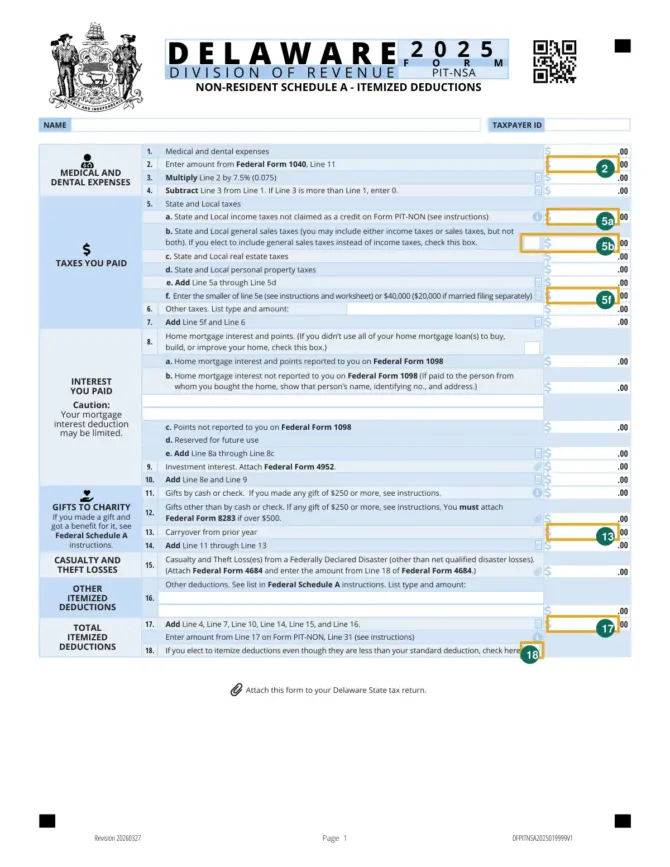
| PIT-NSA line | Entry | Point for a PIT-NON filer |
|---|---|---|
| 1 | Medical and dental costs after insurance and other reimbursements | Your full-year amount |
| 2, 3, 4 | Federal adjusted gross income, 7.5% of it, and the excess of line 1 over line 3 | Form 1040 line 11 (shown as 11a and repeated as 11b on the 2025 form) |
| 5a | Non-Delaware state and local income taxes not used for a credit on the PIT-NON | No Delaware tax at all; nothing that produced the line 45 credit |
| 5b | General sales taxes, with a checkbox | Only when 5a stays empty |
| 5c, 5d, 5e | Real estate taxes, personal property taxes, total of 5a to 5d | 5e may instead come from the PIT-NSW worksheet |
| 5f | Smaller of 5e or $40,000 ($20,000 married filing separately) | PIT-NSW when income is above $500,000 ($250,000) or foreign exclusions apply |
| 6, 7 | Other taxes by type; 5f plus 6 | Motor vehicle title fees, realty transfer tax and transfer fees do not qualify |
| 8a to 8e, 9, 10 | Mortgage interest and points, investment interest, subtotal | Form 1098 figures; Form 4952 attached for line 9 |
| 11 to 14 | Gifts by cash or check, other gifts, prior-year carryover, total | Form 8283 attached when noncash gifts are over $500 |
| 15, 16 | Disaster casualty and theft losses; other deductions with a description | Line 18 of Form 4684, attached; federal Schedule A list for line 16 |
| 17 | Lines 4, 7, 10, 14, 15 and 16 added | Copied to PIT-NON line 31 |
| 18 | Box for itemizing although the standard deduction is larger | An election, no amount |
Lines 1 to 4: medical expenses over 7.5%
The PIT-NSA section of the PIT-NON instructions allows medical and dental expenses paid, after reimbursement, to the extent they exceed 7.5% of adjusted gross income, and the printed line 3 uses the same 7.5% (0.075). Line 2 is labeled “Federal Form 1040, Line 11”. The 2025 Form 1040 shows adjusted gross income on line 11a at the bottom of page 1 and carries the same amount to line 11b at the top of page 2. If line 3 is larger than line 1, line 4 is zero.
Lines 5a to 7: which taxes a nonresident can list
Line 5a is where a nonresident’s home-state income tax usually shows up. The instructions allow non-Delaware state or local income taxes that are not claimed as a credit on the PIT-NON, and they exclude two things: any Delaware tax paid, credited or not, and tax that generated the credit for taxes paid to another state on PIT-NON line 45. That credit is labeled “Part-year Residents Only” in both the form and its instructions. A full-year nonresident therefore has no line 45 credit to protect, while a part-year resident who claims it must leave the credited tax off line 5a. The instructions’ third worked example fits the first case: Pennsylvania income tax with no line 45 credit is counted in full on line 5f.
Income taxes and general sales taxes are alternatives. Checking the box on line 5b and entering sales tax means nothing goes on 5a. Real estate taxes (5c) and personal property taxes (5d) can be added under either choice, and line 5e totals 5a through 5d.
Line 5f applies the cap for 2025. Federal Form 1040 line 11b of $500,000 or less ($250,000 for married filing separately), with no federal Form 2555, no Form 4563 and no excluded Puerto Rico income, lets you enter the smaller of line 5e or $40,000 ($20,000 married filing separately). Above those figures, or with any of those exclusions, you complete Form PIT-NSW, the State and Local Tax Deduction Worksheet (revision 20260424). PIT-NSW adds the excluded amounts to line 11b, subtracts $500,000 ($250,000), takes 30% of the excess off $40,000, never lets the limit fall under $10,000, and halves it for married filing separately. Married people filing separately or combined separate may split real estate taxes between their returns as they choose. Taxes paid in a trade or business or an income-producing activity are not limited and are not entered on PIT-NSA at all.
The worksheet’s first question uses a different threshold from the schedule. PIT-NSW line 1 asks whether PIT-NSA line 5e is more than $10,000 ($5,000 if married filing separately); PIT-NSA line 5f and the 2025 PIT-NON instructions (revised 03/27/26) use $40,000 ($20,000), and a “Yes” on that same worksheet line 1 enters $40,000 as the starting limit. The two printed documents do not say which threshold controls a line 5e between $10,000 and $40,000. Personal Income Tax Assistance at the Division of Revenue takes that question at (302) 577-8200 or DOR_PublicService@delaware.gov.
Line 6 is for other deductible taxes, with the type written next to the amount; line 7 is 5f plus 6.
Lines 8 to 16: interest, charity, disaster losses and other items
Line 8 carries a checkbox for mortgage loans not used entirely to buy, build or improve your home, beside the form’s caution that the mortgage interest deduction may be limited. Enter Form 1098 interest and points on 8a, interest not on a 1098 on 8b (with the name, identifying number and address of the seller if you paid the person you bought the home from), and points missing from a 1098 on 8c. Line 8d is reserved for future use. Line 8e totals 8a to 8c, line 9 is investment interest backed by Form 4952, and line 10 adds 8e and 9.
Gifts to charity follow the federal limits. Cash and check gifts go on line 11, noncash gifts on line 12 and a carryover from an earlier year on line 13, with line 14 as the total. Lines 11 and 12 flag any gift of $250 or more, and the side panel flags gifts you received a benefit for; both cases are handled under the federal Schedule A instructions. Driving for a charity is not entered on PIT-NSA; it has its own PIT-NON line.
Line 15 takes casualty and theft losses only from a federally declared disaster (other than net qualified disaster losses), copied from line 18 of Form 4684. Line 16 is for the other deductions listed in the federal Schedule A instructions, with a description on the lines provided.
Lines 17 and 18
Line 17 adds lines 4, 7, 10, 14, 15 and 16, and the form prints the instruction to enter that amount on PIT-NON line 31. The instructions add that the amount on line 31 is subject to certain adjustments, which are the Section D lines described below. Line 18 is a single box: check it if you elect to itemize even though your itemized deductions are less than your standard deduction.
From PIT-NSA line 17 to PIT-NON line 39
Section D of the 2025 PIT-NON turns the schedule total into the Delaware itemized deduction:
| PIT-NON line | What is entered |
|---|---|
| 31 | PIT-NSA line 17 |
| 32 | Foreign taxes actually paid and included on line 8 of federal Form 1116, if you elected the federal foreign tax credit; accrued but unpaid tax is not allowed |
| 33 | Charitable mileage: miles driven for a charity from January 1 to December 31, 2025, times $0.26 |
| 34 | Dues paid to stay in an active labor union, up to $500, if not already in the federal itemized total and not used for benefits, lobbying or political activity, or legal costs and fines |
| 35 | Total of lines 31 to 34 |
| 36 | The land-gift contribution and Neighborhood Assistance investment claimed as a PIT-CRS credit, with Form BUS-NAC or BUS-LHR and the approval letter attached |
| 37 | Line 35 minus line 36, carried to line 39 |
On page 2, check box b on line 39 (“Delaware itemized deductions”) and enter the line 37 amount. The instructions remind you to compare line 39 with the standard deduction and the additional standard deductions before settling on itemizing.
Filing status 3 on the PIT-NON is married filing separate forms, and line 31 carries a note to see the instructions in that case. Each spouse reports the deductions that belong to him or her. Deductions you cannot assign to one spouse are divided by each spouse’s share of joint income. If one spouse earned 55% of the household income and shared deductions come to $20,000, that spouse’s line 31 takes $11,000 and the other spouse’s $9,000. The PIT-NON instructions also say separate filers mail their returns in separate envelopes.
What slows down a PIT-NON with PIT-NSA
The first page of the 2025 PIT-NON instructions lists the items the Division reviews by hand, and the attachment list on page 3 adds the rest:
- The Division reviews returns with significant itemized deductions and may request supporting documentation.
- PIT-NSA is item 5 on the list of documents to attach, and a missing required attachment may delay processing.
- Delaware income tax entered on line 5a, or other-state tax already behind a PIT-NON line 45 credit.
- Motor vehicle title fees, realty transfer tax or transfer fees listed as other taxes on line 6.
- A paper copy sent after the return was filed electronically, or duplicate copies of a spouse’s return.
Download, due date and mailing addresses for PIT-NSA
The Division of Revenue’s 2025-2026 personal income tax forms page lists the Delaware Individual Non-Resident Schedule A Form (PIT-NSA) as a fillable PDF, next to the PIT-NSW worksheet. The schedule’s instructions are not a separate file; they sit on pages 11 and 12 of the 2025 PIT-NON instructions and point to the federal Schedule A instructions for anything they leave out.
Attach PIT-NSA to the PIT-NON together with pages 1 and 2 of your federal Form 1040, its schedules, and any of Forms 4952, 8283 and 4684 the lines call for. The Division asks for electronic filing for the fastest refund. A paper return is mailed to the address that matches its result:
| Paper PIT-NON | Address |
|---|---|
| Balance due, payment enclosed | State of Delaware, Division of Revenue, P.O. Box 508, Wilmington, DE 19899-0508 |
| Refund due | State of Delaware, Division of Revenue, P.O. Box 8710, Wilmington, DE 19899-8710 |
| Zero due or no payment | State of Delaware, Division of Revenue, P.O. Box 8711, Wilmington, DE 19899-8711 |
Calendar-year 2025 returns were due by April 30, 2026; a PIT-EXT filed by that date moved the filing deadline to October 15, 2026, but not the payment of tax. To correct a 2025 return already filed, the instructions say to use Form PIT-NON again and attach any federal adjustments; a change to your federal return that affects Delaware tax must be reported within 90 days of the final federal determination.
Questions about Delaware PIT-NSA
Can a nonresident deduct the income tax paid to their home state?
Line 5a takes non-Delaware state and local income tax that was not used for a credit on the PIT-NON. The line 45 credit is for part-year residents only, so a full-year nonresident’s home-state tax goes on line 5a, subject to the line 5f cap.
Do I enter only the Delaware share of my deductions?
Each line takes the full amount. The PIT-NON subtracts the deduction from full-year Delaware adjusted gross income and then multiplies the tax by the proration decimal on line 43.
Is PIT-NSA the same as the resident PIT-RSA?
Residents filing PIT-RES itemize on Form PIT-RSA. PIT-NSA is the nonresident version, and its total goes to PIT-NON line 31.
Official sources
- Delaware Division of Revenue, Form PIT-NSA, Non-Resident Schedule A, Itemized Deductions, 2025, revision 20260327
- Delaware Division of Revenue, 2025 Individual Income Tax Return, Non-Resident Instructions (PIT-NON), revised 03/27/26, pages 1 to 3, 8 and 9 (Sections D and E) and 11 to 12 (PIT-NSA)
- Delaware Division of Revenue, Form PIT-NSW, State and Local Tax Deduction Worksheet, 2025, revision 20260424
- Delaware Division of Revenue, Form PIT-NON, Non-Resident Individual Income Tax Return, 2025, revision 20260414
- Delaware Division of Revenue, Personal Income Tax Forms Current Year (2025-2026)
- Delaware Division of Revenue, Contact Information
- Internal Revenue Service, Form 1040, U.S. Individual Income Tax Return, 2025, lines 11a and 11b