Form PIT-RSA is the Delaware resident Schedule A, the one-page sheet where you list itemized deductions for a 2025 Delaware return filed on Form PIT-RES. Its total goes to line 13 of the PIT-RES, and the schedule has to be attached to the return. The current file is the 2025 PIT-RSA, revision 20260414, on the Division of Revenue’s forms page. Its instructions send you to the federal Schedule A instructions for anything they do not cover, and the form adds Delaware features of its own: a column split for married couples filing combined separate returns, a 2025 cap of $40,000 on state and local taxes, and a checkbox for itemizing even when the Delaware standard deduction would be larger.
Who attaches PIT-RSA to a Delaware return
Full-year residents file the PIT-RES. Part-year residents may file either the PIT-RES or the nonresident PIT-NON, whichever works out better for them, so a part-year resident uses PIT-RSA only when the PIT-RES is the return being filed. Nonresidents itemize on a separate schedule, Form PIT-NSA, whose line 17 goes to line 31 of the PIT-NON.
You do not have to have itemized on your federal return. The PIT-RES instructions say that someone who took the standard deduction on the federal Form 1040 may still elect to itemize for Delaware by completing and attaching PIT-RSA. The comparison point is the Delaware standard deduction on PIT-RES line 20: $3,250 for filing statuses 1, 3 and 5, $6,500 for status 2 (married filing jointly), and $3,250 in each column for status 4.
Three rules apply once you itemize:
- If one spouse takes the standard deduction, the other spouse must take it too.
- The additional standard deduction for people 65 or older or blind ($2,500 per box checked on the 2025 PIT-RES) is not allowed once you itemize, and the “65 or over” box is left unchecked.
- All federal limitations apply when the Delaware itemized deductions are calculated, so a deduction capped or disallowed on the federal Schedule A is treated the same way here.
How to fill out PIT-RSA line by line
The schedule has 18 numbered lines in seven labeled groups, a name and taxpayer ID row at the top, and no signature. Dollar boxes end in a printed “.00”; the PIT-RES instructions round every amount to the nearest whole dollar, 50 cents and up rounding up. The image below marks the lines discussed in this section; the numbers match the line numbers printed on the form.
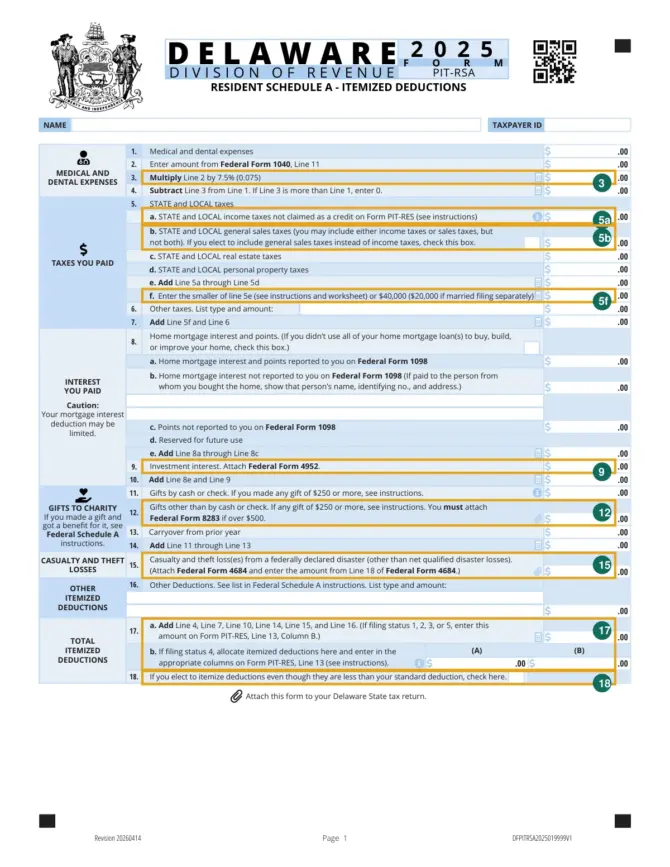
| Line | What the form asks for | Where the number comes from |
|---|---|---|
| 1 to 4 | Medical and dental expenses above 7.5% of line 2 | Your receipts after insurance reimbursements; line 2 is federal adjusted gross income |
| 5a | State and local income taxes not claimed as a credit on PIT-RES | Income taxes paid to other states or localities, never Delaware tax |
| 5b | General sales taxes, with a box to check if you choose them | Only if line 5a is left empty |
| 5c, 5d | Real estate taxes and personal property taxes | Real estate and personal property taxes you paid |
| 5e, 5f | Total of 5a to 5d, then the capped amount | Smaller of 5e or $40,000 ($20,000 married filing separately), or Form PIT-RSW |
| 6, 7 | Other taxes by type and amount; 5f plus 6 | Not motor vehicle title fees or realty transfer tax |
| 8a to 8e | Home mortgage interest and points | Federal Form 1098; for interest paid to the seller, the seller’s name, ID number and address |
| 9, 10 | Investment interest; 8e plus 9 | Federal Form 4952, attached |
| 11 to 14 | Gifts to charity by cash or check, other gifts, carryover, total | Amounts given; federal Form 8283 attached if noncash gifts exceed $500 |
| 15 | Casualty and theft losses from a federally declared disaster | Line 18 of federal Form 4684, attached |
| 16 | Other deductions, with type and amount | The list in the federal Schedule A instructions |
| 17a, 17b | Total itemized deductions, split by spouse for status 4 | Lines 4, 7, 10, 14, 15 and 16 |
| 18 | Checkbox to itemize even though the standard deduction is larger | Your own election |
Medical and dental expenses, lines 1 to 4
Line 1 is your total medical and dental expenses after reducing them by insurance payments, other reimbursements and any amount used for the organ or marrow donation credit. Line 2 asks for “Federal Form 1040, Line 11”. On the 2025 federal Form 1040, adjusted gross income is line 11a on page 1 and is repeated as line 11b at the top of page 2, so either line gives the same figure. Line 3 is line 2 times 7.5%, and line 4 is line 1 minus line 3, or zero if line 3 is larger.
The 2025 resident instructions (revised 03/26/26) are not consistent on the percentage. The opening paragraph of the “Medical and Dental Expenses” section says expenses are deductible to the extent they exceed 10% of adjusted gross income. The line 3 instruction on the same page and the printed line 3 of the PIT-RSA both say to multiply by 7.5% (0.075). If your medical deduction depends on which figure applies, Personal Income Tax Assistance at the Division of Revenue answers at (302) 577-8200 or DOR_PublicService@delaware.gov.
State and local taxes, lines 5a to 7
Line 5a is for income taxes paid to another state or a locality that you have not used for a credit on the PIT-RES. Delaware tax paid never goes here, whether or not it was claimed as a credit, and neither do taxes that produced the credit for taxes paid to another state on PIT-RES line 28. If you worked in Pennsylvania, paid Pennsylvania income tax and claimed the line 28 credit for it, that tax stays off line 5a. You may deduct income taxes or general sales taxes, not both: choosing sales taxes means checking the box on line 5b and leaving 5a empty.
Line 5f applies the cap. The instructions describe it as the federal limit: $40,000 for single, head of household and joint filers, $20,000 for married people filing separately or combined separate. Couples in either separate status may divide real estate taxes between their two returns as they see fit. Taxes paid in a trade or business or an income-producing activity are not limited and do not belong on PIT-RSA at all.
Whether you can simply take the smaller of line 5e or the cap depends on income. If federal Form 1040 line 11b is $500,000 or less ($250,000 married filing separately) and you did not file federal Form 2555 or 4563 or exclude income from Puerto Rico, enter the smaller of 5e or $40,000 ($20,000). Otherwise the instructions send you to the State and Local Tax Deduction Worksheet, Form PIT-RSW (revision 20260424). That worksheet adds the foreign and Puerto Rico exclusions back to line 11b, compares the result with $500,000 ($250,000), reduces $40,000 by 30% of the excess but keeps the limit at $10,000 or more, and halves the limit for married filing separately.
One label on that worksheet differs from the schedule. PIT-RSW line 1 asks whether PIT-RSA line 5e is more than $10,000 ($5,000 if married filing separately), while PIT-RSA line 5f, its instructions and the worksheet’s own “Yes” answer use $40,000. A filer whose line 5e falls between those figures and whose income is under the threshold is sent to the worksheet by its line 1, and its line 6 “No” path then enters $40,000 as the limit. For questions about the worksheet, use the Personal Income Tax Assistance number above.
Line 6 takes other deductible taxes, with the type written in. The PIT-RES instructions rule out motor vehicle title fees, realty transfer tax and transfer fees. Line 7 adds 5f and 6.
Interest, gifts, losses and other deductions, lines 8 to 16
Line 8 has a box to check if not all of your home mortgage loans were used to buy, build or improve your home; the form’s caution beside it says the mortgage interest deduction may be limited. Line 8a is interest and points reported on federal Form 1098, 8b is interest not reported on a 1098 (with the seller’s name, identifying number and address if you paid the person you bought the home from), and 8c is points not on a 1098. Line 8d is reserved, and 8e adds 8a through 8c. Line 9 is investment interest, with federal Form 4952 attached, and line 10 adds 8e and 9.
Charitable gifts are split by how you gave: cash or check on line 11, property and other noncash gifts on line 12, and a carryover from an earlier year on line 13. A gift of $250 or more sends you to the federal Schedule A instructions, and noncash gifts over $500 require federal Form 8283. Line 14 is the total of 11 through 13. Mileage driven for a charity is not entered here; it goes on PIT-RES line 15.
Line 15 is limited to casualty and theft losses from a federally declared disaster, other than net qualified disaster losses. Enter the amount from line 18 of federal Form 4684 and attach the 4684. Line 16 covers other deductions from the list in the federal Schedule A instructions, with a written description in the two lines above the amount.
Totals and the election box, lines 17 and 18
Line 17a adds lines 4, 7, 10, 14, 15 and 16. For filing statuses 1, 2, 3 and 5 that amount goes to PIT-RES line 13, column B. Under filing status 4, married filing combined separate, line 17b splits the total between column A (the spouse) and column B. Deductions you can trace to one spouse go to that spouse. When they cannot be traced, the instructions prorate by each spouse’s share of the couple’s income: with $18,000 of itemized deductions and one spouse earning 70% of the household income, that spouse’s column gets $12,600 and the other column $5,400.
Line 18 is a checkbox for electing to itemize even though your itemized deductions are less than your standard deduction. The instructions attach no further condition to it.
Carrying the total to PIT-RES lines 13 to 20
PIT-RSA ends at line 17, but Section C of the PIT-RES adds further items before the amount reaches the tax calculation:
- Line 14: foreign taxes actually paid, if you elected the foreign tax credit on your federal return (accrued but unpaid foreign tax does not count).
- Line 15: charitable mileage for 2025, miles driven for a charity times $0.26.
- Line 16: union dues, the smaller of $500 or the amount paid to stay in an active labor organization, if not already in your federal itemized deductions and not used for benefits, lobbying, political activity or legal costs.
- Line 18: the charitable contribution for land gifts claimed as a PIT-CRS credit is subtracted, with Form BUS-LHR or BUS-NAC and the approval letter attached.
Line 19 is the net itemized deduction. On page 2, check the box on line 20b and enter line 19 on line 20: in column B for statuses 1, 2, 3 and 5, or in both columns for status 4.
What delays a return that includes PIT-RSA
The checklist on page 1 of the 2025 resident instructions and the attachment list on page 3 name several points the Division reviews by hand:
- A combined separate return (status 4) whose column A and column B on PIT-RSA do not add up to the totals claimed on the return.
- Significant itemized deductions: the Division reviews these returns and may ask for supporting documentation.
- A missing PIT-RSA. It is item 6 on the list of documents to attach, and the instructions say a missing attachment may delay processing.
- Delaware income tax on line 5a, or other-state tax already used for the PIT-RES line 28 credit.
- Motor vehicle title fees, realty transfer tax or transfer fees entered as “other taxes” on line 6.
Where to get the 2025 PIT-RSA and where it goes
The 2025 Form PIT-RSA is listed on the Division’s personal income tax forms page for 2025-2026 as the Delaware Individual Resident Schedule A Form, next to the Schedule A Worksheet (PIT-RSW). The fillable PDF has Reset and Prepare For Print buttons. There are no separate PIT-RSA instructions; they are on page 12 of the 2025 PIT-RES resident instructions, which refer you to the federal Schedule A instructions for anything not covered.
PIT-RSA is never filed alone. Attach it to the PIT-RES, together with pages 1 and 2 of your federal Form 1040 and the federal forms the lines call for (4952, 8283, 4684). An electronically filed return needs no paper copy. A paper return goes to one of three addresses, depending on the result:
| Paper PIT-RES result | Mailing address |
|---|---|
| Balance due, payment enclosed (line 46) | State of Delaware, Division of Revenue, P.O. Box 508, Wilmington, DE 19899-0508 |
| Refund due (line 47) | State of Delaware, Division of Revenue, P.O. Box 8710, Wilmington, DE 19899-8710 |
| Zero due or no payment | State of Delaware, Division of Revenue, P.O. Box 8711, Wilmington, DE 19899-8711 |
Calendar-year 2025 returns were due on or before April 30, 2026, or October 15, 2026 with an automatic extension; both dates have passed as of this check. A filed 2025 return is corrected on the PIT-RES itself with the “Amended Return” box checked, generally within three years after the original due date or two years after the tax was paid, whichever is later. Amended returns go to P.O. Box 8711, Wilmington, DE 19899-8711.
Questions about PIT-RSA
Can I itemize in Delaware if I took the standard deduction on my federal return?
The 2025 PIT-RES instructions allow it: complete PIT-RSA, attach it, and check the box on PIT-RES line 20b. Your spouse cannot then take the Delaware standard deduction.
Does the $40,000 SALT cap apply to my Delaware itemized deductions?
PIT-RSA line 5f caps state and local taxes at $40,000, or $20,000 for married filing separately or combined separate. Above $500,000 of federal income ($250,000 separately), Form PIT-RSW lowers that cap, though not below $10,000.
Which Schedule A does a nonresident use?
Nonresidents filing PIT-NON use Form PIT-NSA, the Non-Resident Schedule A, and carry its line 17 to PIT-NON line 31.
Official sources
- Delaware Division of Revenue, Form PIT-RSA, Resident Schedule A, Itemized Deductions, 2025, revision 20260414
- Delaware Division of Revenue, 2025 Individual Income Tax Return, Resident Instructions (PIT-RES), revised 03/26/26, page 12 (PIT-RSA) and pages 7 to 8 (Section C)
- Delaware Division of Revenue, Form PIT-RSW, State and Local Tax Deduction Worksheet, 2025, revision 20260424
- Delaware Division of Revenue, Form PIT-RES, Resident Individual Income Tax Return, 2025
- Delaware Division of Revenue, Form PIT-NSA, Non-Resident Schedule A, 2025
- Delaware Division of Revenue, Personal Income Tax Forms Current Year (2025-2026)
- Delaware Division of Revenue, Contact Information
- Internal Revenue Service, Form 1040, U.S. Individual Income Tax Return, 2025, lines 11a and 11b