Form SCT-EXT asks the Delaware Division of Revenue for more time to file the S corporation return, Form SCT-RTN, and carries the personal income tax that the S corporation pays on behalf of its nonresident shareholders. This guide covers the 2025 form, revision 20250605, used for calendar year 2025 and for fiscal years ending in 2026.
Who files SCT-EXT and when a federal extension is enough
Every S corporation with income from Delaware sources files SCT-RTN by the 15th day of the third month after its tax year closes. The 2025 SCT-RTN instructions give two ways to get more time. A request to the IRS for an automatic six-month extension also extends the Delaware filing date by six months; a copy of that federal extension goes with the final Delaware return. SCT-EXT is the Delaware request made with payment: it is filed by the original due date, and the estimated personal income tax owed for nonresident shareholders is sent with it.
The payment comes from § 1158(a) of Title 30 of the Delaware Code. It requires the S corporation to pay, for each nonresident shareholder, tax at the highest personal income tax rate on that shareholder’s share of distributive income apportioned to Delaware. If every shareholder is a Delaware resident, SCT-RTN tells filers to stop after its line 6; on SCT-EXT, line 2a is then 0% and lines 2b, 3b and 4 come to zero.
Qualified S corporations are exempt from the Delaware corporation income tax under § 1902(b)(9) of Title 30. The Division’s forms page lists the corporate income tax forms, including Delaware CIT-EST (the corporate tentative return) and CIT-EXT, apart from the forms for S corporations.
How to fill out the SCT-EXT worksheet and payment boxes
The header takes the nine-digit taxpayer ID (the fillable PDF rejects any other length), the corporation’s name, street address, city, two-letter state code and ZIP code. Choose the calendar or fiscal year ending date from the list in box A of the marked image; the PDF then fills in “Due on or before” and “Extension to” for that year end. Tick the request-for-change box only if you are also filing SCT-REQ, the S-Corp Request For Change. Box B holds the two payment amounts, C covers worksheet lines 1 to 4, D covers lines 5 to 7, and S is the signature block.
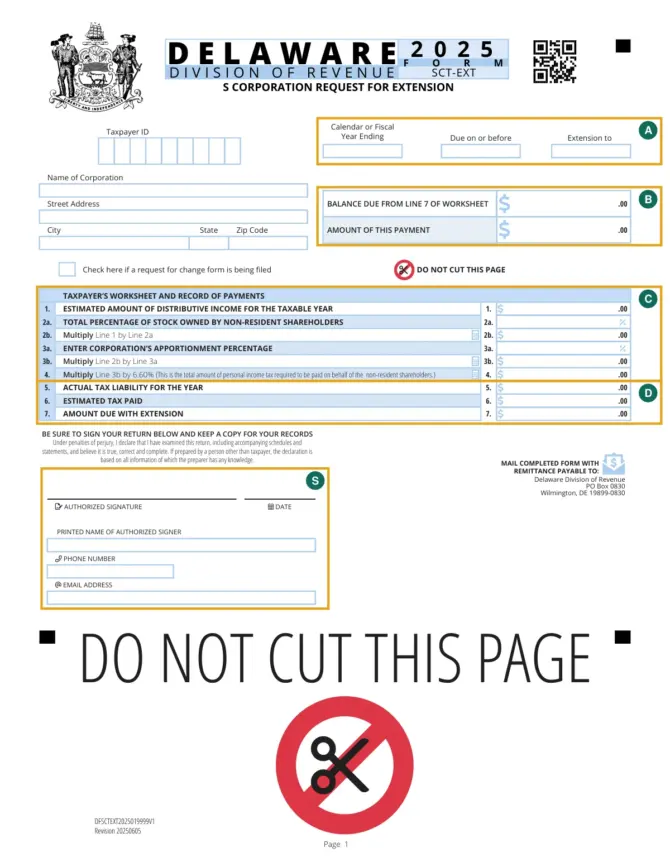
| Line or box | What to enter | Where the figure comes from |
|---|---|---|
| Line 1 | Estimated distributive income for the taxable year | The corporation’s estimate for the year. SCT-RTN builds distributive income from federal Form 1120S Schedule K amounts with Delaware additions and subtractions. |
| Line 2a | Total percentage of stock owned by nonresident shareholders | Shareholder records. The PDF accepts 0 to 100. For shareholders who were not Delaware residents for the whole year, the SCT-RTN instructions say to contact the Division. |
| Line 2b | Line 1 multiplied by line 2a | Calculated by the PDF |
| Line 3a | The corporation’s apportionment percentage | SCT-RTN Schedule 1D, line 8: the average of the property, wage and gross receipts factors the corporation has |
| Line 3b | Line 2b multiplied by line 3a | Calculated by the PDF |
| Line 4 | Line 3b multiplied by 6.60% | Calculated by the PDF; the form calls this the total personal income tax required on behalf of nonresident shareholders |
| Line 5 | Actual tax liability for the year | No formula printed (see below) |
| Line 6 | Estimated tax paid | The year’s SCT-TAX estimated payments, the same payments SCT-RTN line 9 picks up |
| Line 7 | Amount due with extension | No formula printed; copy the result to “Balance due from line 7 of worksheet” |
| Amount of this payment | The amount you are actually sending | Your remittance |
| Signature block | Authorized signature, date, printed name of the authorized signer, phone number and email address | The signer declares under penalties of perjury that the return is true, correct and complete |
As an illustration, $400,000 of estimated distributive income with 25% nonresident ownership gives $100,000 on line 2b. A 40% apportionment percentage brings line 3b to $40,000, and line 4 is $2,640.
Lines 5, 6 and 7 have no printed arithmetic, and the fillable PDF calculates only lines 2b, 3b and 4. The 2025 SCT-RTN instructions do not explain these three lines; they say that the estimated personal income tax required on behalf of nonresident shareholders must be remitted with the request for extension. Before paying a line 7 amount you worked out yourself, ask the Division how line 5 relates to line 4. Its Wilmington office is at (302) 577-8205, Dover at (302) 744-1085 and Georgetown at (302) 856-5358; the toll-free number for callers in Delaware is 1-(800) 292-7826.
SCT-EXT due dates for calendar 2025 and fiscal 2026 years
SCT-EXT is due on or before the original due date of SCT-RTN. For calendar year 2025 the form shows March 16, 2026 as the due date and September 15, 2026 as the extended date. Both had passed by October 31, 2026, when this guide was checked, and the instructions accept the request only on or before the original due date.
The year-end list in the PDF runs from January 31 to November 30, 2026 for fiscal years. These four still had a future due date at this review:
| Fiscal year ending | Due on or before | Extension to |
|---|---|---|
| August 31, 2026 | November 16, 2026 | May 17, 2027 |
| September 30, 2026 | December 15, 2026 | June 15, 2027 |
| October 31, 2026 | January 15, 2027 | July 15, 2027 |
| November 30, 2026 | February 15, 2027 | August 16, 2027 |
A timely SCT-EXT extends the time to file the return, but the tax is still due by the original date. The SCT-RTN instructions set a late-filing penalty of 5% per month, up to 50% of the tax due, plus interest of 1/2% per month from the original due date. Not paying the tax shown on a timely return adds a penalty of 1% per month, up to 25%.
Time beyond the automatic six months is requested by letter on or before the return’s due date, and the Division’s approval letter is attached to the final return. Under § 511 of Title 30, the Director may require a bond of up to twice the tax when granting an extension.
On SCT-RTN itself, tick the Extension Attached box when an approved federal or Delaware extension applies, and include the SCT-EXT payment on line 9 with the estimated tax paid. If payments exceed the line 8 tax, the S corporation gets no refund: the excess is included proportionally in the estimated tax the nonresident shareholders claim on their Delaware nonresident returns.
Where to mail SCT-EXT and the payment
Make the remittance payable to the Delaware Division of Revenue and mail the completed form to Delaware Division of Revenue, PO Box 0830, Wilmington, DE 19899-0830. The page is printed with “Do not cut this page”, so send the whole sheet. The fillable PDF has a “Prepare For Print” button, and the form asks you to keep a copy.
The PDF is on the Division’s Business Tax Forms page under “Calendar Year 2025 and Fiscal Year Ending 2026”, with the 2024 version listed separately for calendar 2024 and fiscal years ending in 2025. SCT-VCH on the same page is the electronic filer S corporation payment voucher, a different form.
Official PDF: Form SCT-EXT — Official PDF (revenuefiles.delaware.gov)