Form WTH-EXM is the certificate a military spouse working in Delaware gives an employer to stop Delaware income tax being withheld from wages. It replaced the form once called W-4DE; the current version is revision 20250804, with general instructions revised September 24, 2025. The form rests on the Servicemembers Civil Relief Act as amended by the Military Spouses Residency Relief Act (P.L. 111-97).
Who can give an employer WTH-EXM
The employee answers four yes-or-no questions on the form, and the exemption applies only when all four answers are yes:
- My spouse is a military servicemember.
- I am not a military servicemember.
- My servicemember spouse has current military orders assigning him or her to a military location near Delaware.
- My domicile is a state other than Delaware.
“Near Delaware” has a limit in the instructions: the assignment location on the spouse’s Leave and Earning Statement must be in Delaware, Pennsylvania, New Jersey or Maryland. The two also live together, since the form asks for the street address where you both currently reside.
For example, an employee whose home state is Texas moves with a spouse whose orders assign them to a station in Delaware, then takes a job with a Delaware employer. The 2025 instructions for Delaware’s nonresident return, PIT-NON, say that all income of a non-military spouse is taxed in the state of their legal residence, and in their example a spouse with Delaware wages who keeps a legal residence outside Delaware does not need to file a Delaware return. The same page tells military spouses claiming the withholding exemption to complete WTH-EXM and give it to their employer.
A servicemember cannot use WTH-EXM for their own pay; the second question rules that out. Delaware’s treatment of military pay is set out separately under “Members of Armed Forces” in the PIT-NON instructions.
Filling out WTH-EXM, from names to the start date
The form says that, apart from the signatures, everything is printed. The numbers below match the marked image.
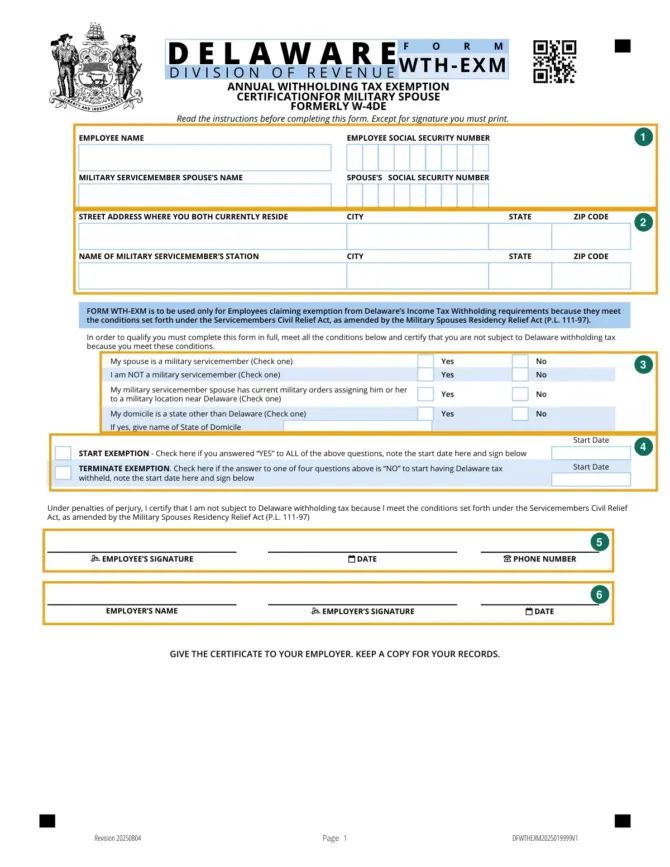
| Part | What to enter | Notes from the form and instructions |
|---|---|---|
| 1. Names and Social Security numbers | Employee name and SSN; military servicemember spouse’s name and SSN | Both SSNs go in nine-digit boxes. |
| 2. Addresses | Street address, city, state and ZIP where you both live now; name, city, state and ZIP of the servicemember’s station | The employer compares the station with the assignment location on the spouse’s Leave and Earning Statement. |
| 3. Four questions | Yes or No to each; if your domicile is outside Delaware, the name of that state | All four must be yes to claim the exemption. |
| 4. Start or terminate exemption | Tick Start exemption and give the start date, or tick Terminate exemption and give the date Delaware withholding should begin | The PDF takes dates as mm-dd-yyyy. |
| 5. Employee signature | Signature, date and phone number | Signed under penalties of perjury, certifying that you are not subject to Delaware withholding under the two federal acts. |
| 6. Employer section | Employer’s name, employer’s signature and date | Completed by a representative responsible for personnel matters, after the document checks described below. |
The form’s last line reads “Give the certificate to your employer. Keep a copy for your records.”
Proving a domicile outside Delaware
The fourth question is the one the instructions spend most of their space on. To claim a domicile in a state other than the one where you live now, you must have proof that you meet one or more of their criteria, and a state where you were never domiciled cannot be claimed “merely by making an election”. The instructions describe domicile as the place of permanent residence you intend to return to; a person has only one at a time, and changing it normally takes at least six months of residence in the new state.
The criteria they list include homestead status and the location of your permanent home and mailing address, where your bank accounts are, the state where prior resident tax returns were filed, where you are registered to vote, your driver’s license and vehicle registration state, where professional licenses are kept, and where you qualify for in-state tuition. No single factor decides it; all are weighed together, and the instructions say charitable giving plays no part.
What the employer checks and keeps
The instructions place these duties on the employer:
- See the original of the spouse’s latest Leave and Earning Statement, keep a copy in the personnel file, and confirm that its assignment location matches the station on WTH-EXM and lies in Delaware, Pennsylvania, New Jersey or Maryland.
- See the original of the employee’s current military ID showing the employee as a current military spouse, and keep a copy. These IDs are reissued every four years, so an ID dated more than four years before the day it is shown cannot be accepted.
- Keep the certificate with the employee’s personnel records.
- Have a personnel representative sign the employer section.
An employer that has only a federal Form W-4, or a WTH-EXM that is not fully completed and signed by the employee, stays liable for Delaware tax it failed to withhold. If the employer believes the exemption was claimed improperly, the instructions tell it to contact the Division of Revenue at P.O. Box 8995, Wilmington, Delaware 19801-8995, or (302) 577-8200.
When the exemption starts and when it stops
The exemption runs from the start date written beside the Start exemption box. If any of the four answers later becomes no, for example because the employee’s domicile becomes Delaware, the form tells the employee to tick Terminate exemption, enter the date Delaware withholding should begin and sign, then give it to the employer.
The form’s own title calls it an annual certification, and the PIT-NON instructions use the same name, but neither the form nor its instructions gives a date for renewing it. Employees and employers who need to know whether a new certificate is required each calendar year can ask the Division at (302) 577-8200.
Getting the official WTH-EXM PDF
The fillable PDF and its one-page instructions are listed together under the withholding forms on the Division of Revenue’s Business Tax Forms page, as “WTH-EXM- Withholding Exemption Certificate for Military Spouse” and “WTH-EXMi”. The certificate goes to the employer; neither the form nor the instructions gives a Division address for sending it.
Official PDF: Form WTH-EXM — Official PDF (revenuefiles.delaware.gov)
Questions about WTH-EXM
Is WTH-EXM the same form as the old W-4DE?
Both the form and the instructions are printed “Formerly W-4DE”; the Division now lists it under the code WTH-EXM.
Can a spouse whose home state is Delaware use WTH-EXM?
The fourth question requires a domicile in a state other than Delaware, so a spouse domiciled in Delaware answers no and does not qualify.
Delaware sources used
- Form WTH-EXM, Annual Withholding Tax Exemption Certification for Military Spouse (revision 20250804)
- Form WTH-EXM general instructions for completion (revised 09/24/25)
- Form PIT-NON instructions, 2025, Members of Armed Forces and Military Spouses
- Business Tax Forms 2025-2026, Delaware Division of Revenue