Form SCT-TAX is the paper declaration and payment coupon a Delaware S corporation uses to prepay personal income tax for its nonresident shareholders during the year. The form discussed here is the 2026 SCT-TAX, revision 20250605, whose year-end list runs from December 31, 2026 to November 30, 2027. The Division of Revenue’s 2024 edition carried the note “Formerly 1100P”, the older name of the same coupon.
Which S corporations file SCT-TAX
Section 1158(a) of Title 30 of the Delaware Code makes an S corporation pay, for each nonresident shareholder, tax at the highest personal income tax rate on that shareholder’s share of distributive income apportioned to Delaware. The 2025 SCT-RTN instructions turn that into an estimated tax: every S corporation with Delaware-source income must make estimated payments on behalf of its nonresident shareholders, declare its estimated liability, and prepay it in four installments.
A few points from the same instructions decide whether you need the coupon at all:
- The declaration is due even when the estimated liability is zero and nothing is paid. If the liability stays at zero, the remaining vouchers are not required.
- No estimated tax is filed or paid when the S corporation’s taxable period is shorter than 92 calendar days (House Bill No. 257, signed July 23, 1997).
- Qualified S corporations are exempt from Delaware corporation income tax under § 1902(b)(9), so SCT-TAX carries only the shareholders’ personal income tax. A C corporation pays its own tax on the corporate forms; after e-filing, its check goes with Delaware CIT-VCH.
One point the instructions leave open is an S corporation whose shareholders all live in Delaware. They say both that every S corporation with Delaware income makes estimated payments for its nonresident shareholders and that “every S Corporation with non-resident shareholders” declares and prepays. They do not say separately whether an all-resident S corporation files a zero SCT-TAX. The Division’s offices can answer that: Wilmington (302) 577-8205, Dover (302) 744-1085, Georgetown (302) 856-5358, or 1-(800) 292-7826 toll-free from inside Delaware.
How to fill out SCT-TAX, from the header to line 6
The header (A in the marked image) takes the nine-digit taxpayer ID, the calendar or fiscal year ending date and the quarter, 1 to 4. The fillable PDF rejects a taxpayer ID of any other length, and once a year end and a quarter are chosen it fills in “Due on or before” by itself. Below the header go the corporation’s name, street address, city, two-letter state code and ZIP code. Tick the request-for-change box only if you are also sending SCT-REQ, the S-Corp Request For Change.
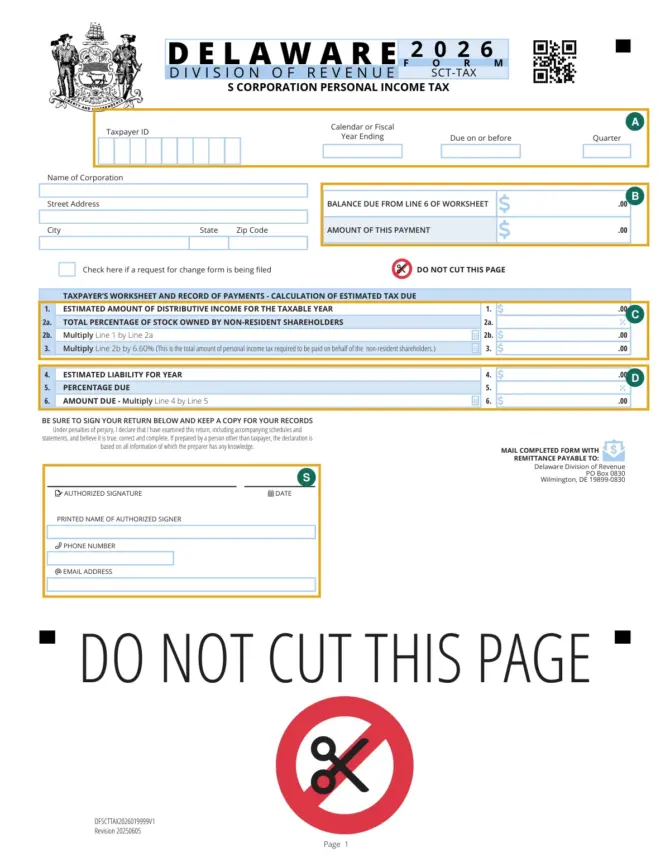
Box B holds two amounts: the balance due carried from worksheet line 6, and the amount of this payment. C marks worksheet lines 1 to 3, D lines 4 to 6, and S the signature block.
| Line | What goes in | Where the figure comes from |
|---|---|---|
| 1 | Estimated distributive income for the taxable year | The corporation’s own estimate. The instructions describe it as distributive income apportioned to Delaware; the form has no separate apportionment line. |
| 2a | Total percentage of stock owned by nonresident shareholders | Shareholder records; the PDF accepts 0 to 100. For shareholders who were not Delaware residents all year, the SCT-RTN instructions say to contact the Division. |
| 2b | Line 1 times line 2a | Calculated by the PDF |
| 3 | Line 2b times 6.60% | Calculated by the PDF; the form calls it the total personal income tax to be paid for the nonresident shareholders |
| 4 | Estimated liability for the year | No formula printed and not calculated by the PDF. The instructions call the 6.60% figure the estimated tax liability, which on this form is line 3. |
| 5 | Percentage due | The installment share for this quarter (next section); the PDF accepts 0 to 100 |
| 6 | Amount due: line 4 times line 5 | Calculated by the PDF; copy it to “Balance due from line 6 of worksheet” |
| Signature block | Authorized signature, date, printed name of the authorized signer, phone number and email address | Signed under penalties of perjury |
Take an S corporation that expects $300,000 of distributive income apportioned to Delaware, with 40% of its stock held by nonresidents. Line 2b is $120,000 and line 3 is $7,920. Paid on the regular schedule, the first coupon is 50% of that, $3,960; the second and third are $1,584 each and the fourth is $792.
The form does not print which percentage belongs on line 5 for each quarter, and it does not say whether line 4 should simply repeat line 3. The table follows the instructions’ wording; if your figures do not fit that reading, check with the Division before sending the payment.
How much each installment covers
The 2025 SCT-RTN instructions set two schedules, both counted from the start of the S corporation’s taxable year:
| Installment | Due on the 15th day of | Regular schedule | Small corporation |
|---|---|---|---|
| 1 (with the declaration) | 4th month | 50% | 25% |
| 2 | 6th month | 20% | 25% |
| 3 | 9th month | 20% | 25% |
| 4 | 12th month | 10% | 25% |
A “small corporation” in those instructions is one, S corporations under § 1158 included, whose aggregate gross receipts from sales of tangible personal property and gross income from other sources, inside and outside Delaware, did not exceed $26,071,000 in any 2 of the 3 taxable years before the year being estimated. The figures are the same ones used for the Schedule 1-D ratio on SCT-RTN.
SCT-TAX due dates for 2026 and fiscal years ending in 2027
These are the dates the 2026 PDF fills in for each year end and quarter. Some fall on the 16th or 17th where the 15th is a weekend or holiday.
| Year ending | Quarter 1 | Quarter 2 | Quarter 3 | Quarter 4 |
|---|---|---|---|---|
| December 31, 2026 | April 15, 2026 | June 15, 2026 | September 15, 2026 | December 15, 2026 |
| January 31, 2027 | May 15, 2026 | July 15, 2026 | October 15, 2026 | January 15, 2027 |
| February 28, 2027 | June 15, 2026 | August 17, 2026 | November 16, 2026 | February 16, 2027 |
| March 31, 2027 | July 15, 2026 | September 15, 2026 | December 15, 2026 | March 15, 2027 |
| April 30, 2027 | August 17, 2026 | October 15, 2026 | January 15, 2027 | April 15, 2027 |
| May 31, 2027 | September 15, 2026 | November 16, 2026 | February 16, 2027 | May 17, 2027 |
| June 30, 2027 | October 15, 2026 | December 15, 2026 | March 15, 2027 | June 15, 2027 |
| July 31, 2027 | November 16, 2026 | January 15, 2027 | April 15, 2027 | July 15, 2027 |
| August 31, 2027 | December 15, 2026 | February 16, 2027 | May 17, 2027 | August 16, 2027 |
| September 30, 2027 | January 15, 2027 | March 15, 2027 | June 15, 2027 | September 15, 2027 |
| October 31, 2027 | February 16, 2027 | April 15, 2027 | July 15, 2027 | October 15, 2027 |
| November 30, 2027 | March 15, 2027 | May 17, 2027 | August 16, 2027 | November 15, 2027 |
Fiscal years that end during 2026 began in 2025 and belong to the previous edition. On the Division’s Business Tax Forms page, checked November 1, 2026, the link under “Calendar Year 2025 and Fiscal Year Ending 2026” opened this same 2026 file, while the 2024 edition is listed under 2024. A corporation with a fiscal year ending in 2026 that still owes a 2026 installment should ask the Division which coupon to use.
Missing a declaration or paying late or short brings a penalty of 1.5% per month on the underpayment, from the installment’s due date to the date paid. The instructions waive it when the estimated tax paid on time equals or exceeds 80% of the current year’s liability, or 100% of the liability for the first preceding taxable year.
Mailing SCT-TAX and the payment
Make the remittance payable to the Delaware Division of Revenue and mail the completed form to Delaware Division of Revenue, PO Box 0830, Wilmington, DE 19899-0830. The page is printed with “Do not cut this page”, so the whole sheet goes in the envelope; the form also asks you to keep a copy. The PDF has a “Prepare For Print” button that readies it for printing.
The current file is listed first under “For S Corporations” on the Division’s Business Tax Forms page. The same page lists SCT-VCH, the electronic filer S corporation payment voucher, which is a different form. The top of that page points filers to the Delaware Taxpayer Portal for online filing without listing which S corporation forms it takes.
Official PDF: Form SCT-TAX — Official PDF (revenuefiles.delaware.gov)
After the year ends: SCT-RTN line 9
The installments are claimed on the annual S Corporation Reconciliation and Shareholders Information Return, SCT-RTN, due on the 15th day of the third month after the year closes. Its line 9 takes the estimated tax paid on SCT-TAX plus any payment sent with an extension request. If payments exceed the line 8 tax, Delaware does not refund the S corporation: the overpayment is included proportionally in the estimated tax the nonresident shareholders claim on their Delaware nonresident returns.
A corporation that needs more time to file SCT-RTN uses SCT-EXT, which extends the filing date but not the date the tax is due.