Form PRT-RTN is the Delaware Partnership Return. It reports how much of a partnership’s federal Schedule K income and deductions comes from Delaware sources, so that each partner can pay Delaware personal income tax on the right amount. The partnership itself owes no Delaware income tax and the form has no tax line. This guide follows the 2025 form, Revision 20251105, and the 2025 instructions revised 05/27/25, both listed under Partnership on the Division of Revenue’s Business Tax Forms 2025-2026 page.
Who has to file a Delaware partnership return
The test in the instructions covers any business treated as a partnership for federal purposes that has income or loss, of any amount, derived from or connected with a Delaware source. With no Delaware-source income or loss, no return is required. Delaware sources include income from real or tangible personal property located in the state, intangibles used in a business carried on in Delaware, and any trade, business, profession or occupation conducted there.
The tax falls on the partners. A nonresident partner of a partnership with Delaware-source income files Form PIT-NON, or is included in a composite return, and reports the Delaware share. A resident partner files Form PIT-RES and reports their share of partnership income or loss.
Take, as an example, an LLC taxed as a partnership that runs a shop in Wilmington and has two members living in Pennsylvania. It files PRT-RTN, answers Yes to the first question in block B and No to the second, completes Schedule 2 if it also earns income outside Delaware, and prepares a Delaware K-1 (Form PRT-PSI) for each member.
The header and questions A to D
Fiscal-year partnerships enter the beginning and ending dates; the name, street address and taxpayer ID follow. In Nature of Business, the instructions ask for the business code number from item C on page 1 of federal Form 1065, not a description.
Block A has three check boxes: Amended Return, Partnership Dissolved or Inactive, and Change of Address. When the address has changed, also check Location, Mailing or Billing to show which one. Block B asks two yes-or-no questions: whether the partnership had income derived from or connected with Delaware sources, and whether it had Delaware resident partners, followed by the number of resident partners. Block C asks for the total number of partners and D for the year the partnership was formed. The late-filing penalty described further down is also counted per partner.
Schedule 1 on page 1, lines 1 to 20
Every partnership that has to file completes Schedule 1. Most lines name the federal Form 1065 Schedule K line they come from, so the federal return should be finished first.
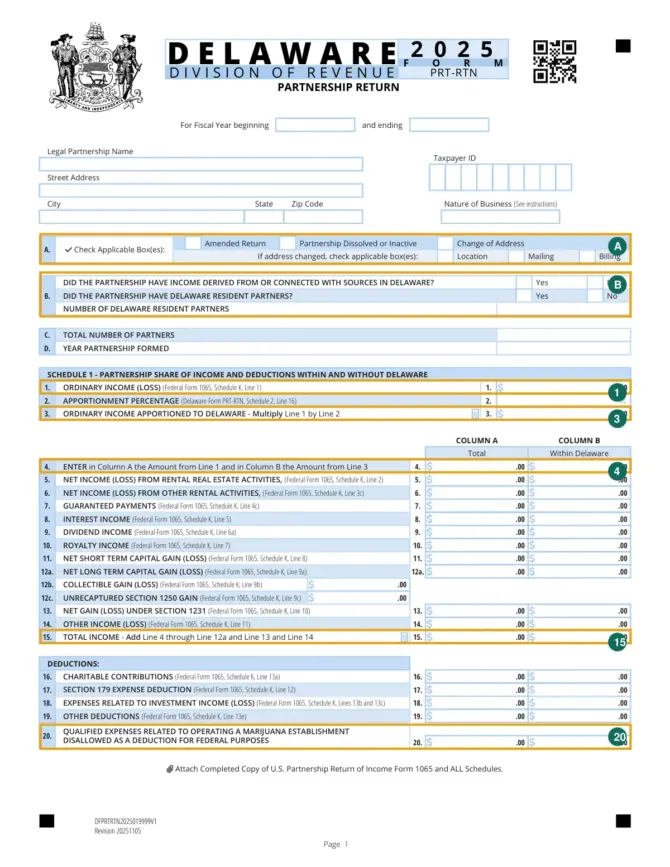
| Line | Entry | Source on the federal return or this form |
|---|---|---|
| 1 | Ordinary income (loss) | Schedule K, line 1 |
| 2 | Apportionment percentage | PRT-RTN Schedule 2, line 16 |
| 3 | Ordinary income apportioned to Delaware | Line 1 times line 2 |
| 4 | Ordinary income in both columns | Column A takes line 1, Column B takes line 3 |
| 5, 6 | Rental real estate; other rental activities | Schedule K, lines 2 and 3c |
| 7, 8, 9, 10 | Guaranteed payments; interest; dividends; royalties | Schedule K, lines 4c, 5, 6a and 7 |
| 11, 12a | Net short-term and net long-term capital gain (loss) | Schedule K, lines 8 and 9a |
| 12b, 12c | Collectibles gain; unrecaptured section 1250 gain | Schedule K, lines 9b and 9c, in a single box each |
| 13, 14 | Section 1231 gain (loss); other income (loss) | Schedule K, lines 10 and 11 |
| 15 | Total income | Lines 4 through 12a, plus 13 and 14 |
| 16, 17 | Charitable contributions; section 179 deduction | Schedule K, lines 13a and 12 |
| 18, 19 | Investment expenses; other deductions | Schedule K, lines 13b and 13c; line 13e |
| 20 | Marijuana establishment expenses | Ordinary and necessary expenses disallowed federally under IRC § 280E |
From line 4 down, Schedule 1 has two columns: Column A is the total and Column B is the part within Delaware. Line 15 adds 12a but not 12b or 12c, which keep only one box and no Delaware column. Line 20 is open only to a partnership operating a marijuana establishment under Chapter 13 of Title 4 or Chapter 49A of Title 16.
Line 3 normally uses the Schedule 2 percentage when the partnership did business in Delaware and at least one other state. The exception is a partnership whose records allow complete separate accounting of its Delaware income and deductions. A partnership doing business only in Delaware skips Schedule 2, and its two columns are the same. An explanatory statement is attached for any item allocated in whole or part outside Delaware, and for a multistate partnership that does not fill Column B with the apportionment percentage.
For lines 5 through 14, Delaware-source items include income from an activity carried on or tangible property located in Delaware. Taxable dividends and net gains or losses on intangible property also count as Delaware items when Delaware is the place from which the partnership’s business is directed or managed and the property is used in that business.
Schedule 2: the three-factor percentage on page 2
Schedule 2 is required when the partnership has income or loss from Delaware and another state and at least one partner who is not a Delaware resident. Watch the column labels: on page 2, Column A is Delaware sourced and Column B is total sourced, the reverse of Schedule 1.
| Section and lines | What to enter |
|---|---|
| A, lines 1 to 7: property | Original cost of real and tangible property owned at the beginning and end of the year (line 1); rented property at eight times annual rent (line 2); line 3 adds them. Line 4 removes property whose income was reported on Schedule 1, lines 5 to 14. Line 5 is net values, line 6 combines beginning and end, and line 7 divides by 2. |
| B, line 8: wages | Pay to employees and officers working in Delaware (Column A) and to all employees and officers wherever they work (Column B). |
| C, lines 9 to 11: receipts | Sales of tangible property physically delivered to a buyer or agent in Delaware, excluding goods given to the US mail or a carrier for shipment out of the state (line 9); other gross income from activity in Delaware not already on Schedule 1, lines 5 to 14 (line 10); line 11 is the total. |
| D, lines 12a to 16: percentage | Each factor is Column A over Column B: property on 12c, wages on 13c, receipts on 14c. Line 15 adds them. Line 16 divides by 3, by 2 when only two factors exist, or takes line 15 as is when there is one. |
Percentages are carried to at least six decimal places and not rounded up. Property owned by the US government but used by the partnership is left out. A partnership that is itself a partner in an active partnership includes its share of that partnership’s property, wages and receipts.
With made-up figures: a partnership has 20% of its average property, 30% of its payroll and 25% of its receipts in Delaware. Line 15 is 75.000000% and line 16 is 25.000000%. If line 1 ordinary income is $300,000, line 3 is $75,000, and line 4 shows $300,000 in Column A and $75,000 in Column B.
Schedule K-1 for each partner (Form PRT-PSI)
The partnership prepares a Delaware Schedule K-1, published as Form PRT-PSI, for every person who was a partner at any time in the year. An individual partner is identified by SSN or ITIN, any other partner by EIN. The partner type takes one of 14 codes, among them 01 individual, 04 domestic corporation, 08 trust and 13 limited liability company. The instructions tie Column B of the Delaware K-1 to two different figures: for a Delaware resident, the total of lines 1 through 11 of the federal K-1; for a nonresident, Column B (within Delaware) of PRT-RTN Schedule 1, lines 4 through 14.
What goes in with PRT-RTN
- A complete copy of federal Form 1065 as filed with the IRS, with its schedules (see the note on K-1s below).
- Form BUS-CRS when the partnership passes through a Delaware business tax credit.
- The explanatory statement for items allocated outside Delaware or for a Column B not based on the apportionment percentage.
- A photocopy of the approved federal extension, when the return is filed under it.
- For an amended return, the federal audit report or the amended Form 1065 with all supporting schedules.
The two 2025 documents differ on federal K-1s. Page 1 of PRT-RTN (Revision 20251105) says to attach Form 1065 and all schedules, while the instructions (revised 05/27/25) ask for all schedules other than Schedule K-1. A partnership that wants to know whether to include the federal K-1s can ask the Division’s New Castle County office at (302) 577-8200 before mailing.
Due date, extension and the per-partner penalty
The return is due by the 15th day of the third month after the tax period ends, March 15 for calendar-year partnerships. For calendar 2025, the Division’s PRT-EXT form prints March 16, 2026 as the due date and September 15, 2026 as the extended date.
The instructions describe one way to get more time: submit a copy of the federal extension application by the return’s due date, then attach a photocopy of the approved federal extension when filing. The approved federal extension moves the Delaware due date to the federal extended date. The forms page also lists Form PRT-EXT, mailed to PO Box 0830, which the instructions do not mention; a partnership planning to rely on PRT-EXT without a federal extension can confirm the effect with the Division at the numbers below.
Failing to file, or leaving out information the return asks for, costs $25 for each month the failure continues, multiplied by the number of people who were partners during any part of the year, for at most 5 months. A partnership with six partners that files two months late owes $300. The instructions also point to separate penalties for a false or fraudulent return and say that copying figures from the federal return is no defense against them.
Amended returns after a federal change
Changes to income, deductions or credits are made on an amended PRT-RTN with the Amended Return box in block A checked. The same amended return is filed after the partnership is notified of the results of a federal audit, with a copy of the audit and/or the amended Form 1065 and its supporting schedules attached.
Where to get PRT-RTN and where to mail it
The fillable 2025 PDF, its instructions, PRT-PSI, PRT-EXT and PRT-VCH are all in the Partnership section of the Business Tax Forms 2025-2026 page, which suggests downloading the PDF before filling it in and also offers the Delaware Taxpayer Portal. A partner signs page 2 and adds a phone number and email; a paid preparer completes the preparer block with an EIN, SSN or PTIN. Mail the return to:
Delaware Division of Revenue
PO Box 8703
Wilmington, DE 19899-8703
PRT-VCH, the Electronic Filer Partnership Payment Voucher, uses a different address, PO Box 830, Wilmington, DE 19899-0830; its corporate counterpart is Delaware Form CIT-VCH. The instructions list three offices: New Castle County (302) 577-8200, Kent County (302) 744-1085 and Sussex County (302) 856-5358, with 1-800-292-7826 toll-free from inside Delaware.
Official PDF: Form PRT-RTN — Official PDF (revenuefiles.delaware.gov)
Questions about Delaware PRT-RTN
Does a partnership pay tax with PRT-RTN?
The instructions state that a partnership, as such, is not subject to Delaware tax. The partners pay personal income tax on their shares through PIT-RES, PIT-NON or a composite return.
Does a partnership with only Delaware residents complete Schedule 2?
Schedule 2 is required only when there is Delaware and out-of-state income and at least one nonresident partner. Schedule 1 is still completed by every partnership that files.
Is PRT-RTN due on the same day as federal Form 1065?
The Delaware due date is the 15th day of the third month after the period ends, March 15 for a calendar year. An approved federal extension carries the Delaware return to the federal extended date.
Official sources
- Form PRT-RTN 2025, Partnership Return (Revision 20251105)
- Form PRT-RTN 2025 instructions (revised 05/27/25)
- Form PRT-PSI 2025, Schedule K-1 Partner’s Share of Income (Revision 20250730)
- Form PRT-EXT 2025, Partnership Request for Extension (Revision 20250729)
- Form PRT-VCH 2025, Electronic Filer Partnership Payment Voucher (Revision 20250730)
- Business Tax Forms 2025-2026, Delaware Division of Revenue