Delaware Form REW-EST records the estimated income tax connected with a real estate conveyance. The form says it must be completed for all conveyances and presented at recording. A qualifying Part 5 exemption or installment-method entry can mean no payment is due at that time.
Who completes REW-EST at a property transfer?
The Division of Revenue’s current personal income tax forms page links to the REW-EST PDF marked Revision 20240830. Its title is Real Estate Tax Return, Declaration of Estimated Income Tax. The same listing supplies instructions revised July 31, 2024 and a REW-SCH schedule marked Revision 20250729. The directory years in the download addresses are not the revision dates printed on those documents.
The REW-EST instructions describe the estimated payment imposed on nonresident sellers under Title 30, sections 1126, 1606 and 1909. The form’s broader completion requirement and its resident exemption box explain why being a resident does not remove the need to address the form at recording. The transferor or seller bears the estimated tax.
Identifying the property and sellers in Parts 1 to 4
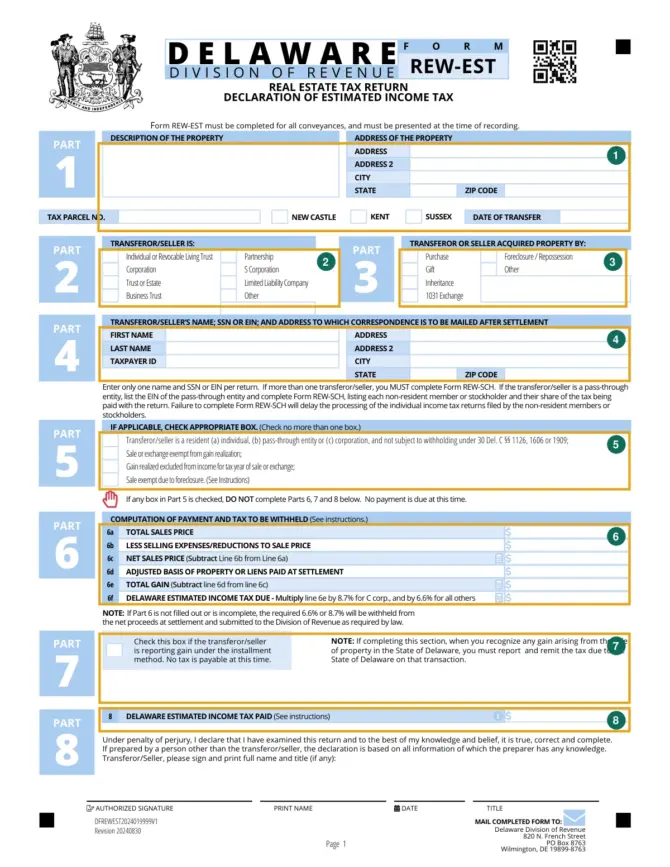
The outlines numbered 1 through 4 identify the property, seller classification, acquisition method and taxpayer details on the official form. Gather the property and settlement records before entering them.
| Part | Entries |
|---|---|
| 1: property | Describe the property or transfer issues. Enter its street address, second address line, city, state, ZIP code, tax parcel number and transfer date. Select New Castle, Kent or Sussex County. |
| 2: seller type | Select the seller’s classification: individual or revocable living trust, corporation, trust or estate, business trust, partnership, S corporation, limited liability company, or other. The instructions give a government agency or nonprofit corporation as examples of Other. |
| 3: acquisition | Indicate purchase, gift, inheritance, 1031 exchange, foreclosure/repossession or other, according to how the seller acquired the property. |
| 4: seller | Enter the seller’s name and SSN or EIN. Use the address where correspondence should go after settlement, including both address lines and city, state and ZIP code. |
Enter only one name and SSN or EIN per return. If there is more than one seller, the current form requires REW-SCH. A pass-through seller enters its own EIN and completes REW-SCH for each nonresident member or stockholder and their share of the tax. The instructions warn that omitting this schedule delays processing of those owners’ individual returns.
On REW-SCH, identify the taxpayer at the top, then supply the listed parties’ taxpayer IDs, names, addresses and estimated tax paid. Its total must match REW-EST line 8.
Part 5 exemptions and the installment-method box
Part 5 permits no more than one exemption box. Its alternatives are a resident individual, pass-through entity or corporation not subject to withholding under the cited sections; a sale or exchange exempt from gain realization; gain excluded from income for the year of sale or exchange; or an exempt foreclosure. The instructions identify the foreclosure provision as 30 Del. C. § 1126(b)(3a)(3).
If an applicable Part 5 box is checked, stop the calculation: do not complete Parts 6, 7 or 8, and no payment is due at that time. The seller still completes the required identification and signed declaration.
Part 7 is the separate installment-method branch. Check it when the seller reports gain under that method. No current payment is due under this branch, but Delaware tax must be reported and remitted when gain from the Delaware property is recognized for federal tax purposes. The instruction for Part 8 expressly excludes a payment when Part 7 is completed.
Calculating Parts 6 and 8, including the line 6d discrepancy
For a transaction requiring the calculation, Part 6 runs from the sale price to estimated tax. The numbered outlines 6 and 8 locate the calculation and payment areas.
| Line | Calculation or entry |
|---|---|
| 6a | Total sales price. |
| 6b | Selling expenses or reductions to the sale price. |
| 6c | Net sales price: subtract 6b from 6a. |
| 6d | The form says “adjusted basis of property or liens paid at settlement.” The instructions describe adjusted basis alone; see the discrepancy below. |
| 6e | Total gain: subtract 6d from 6c. |
| 6f | Multiply 6e by 8.7% for a C corporation or 6.6% for all other taxpayers. |
| 8 | Enter the estimated tax from 6f unless Part 7 applies. Part 5 exemptions stop before this section. |
The official sources differ on line 6d. REW-EST Revision 20240830 includes liens paid at settlement in the printed label. The instructions revised July 31, 2024, Part 6, direct the seller to enter adjusted basis: original purchase price, nondeductible closing costs and improvements, reduced by depreciation previously taken. They do not explain when a lien amount can replace adjusted basis. Confirm the treatment with the Division of Revenue at (302) 577-8200 before choosing between those amounts; paying off a mortgage can produce a different number from the basis calculation.
The form also warns that an incomplete or missing Part 6 causes 6.6% or 8.7% to be withheld from net proceeds at settlement. That printed fallback uses net proceeds, while the completed calculation applies the relevant percentage to line 6e gain. Check the completed Part 6 before settlement.
Official PDF, signature and conflicting delivery directions
Download the official REW-EST PDF. The seller signs the declaration under penalty of perjury, prints their full name and title, if any, and dates it. The declaration covers the preparer’s knowledge when someone other than the seller prepares the return.
The delivery directions conflict. The July 31, 2024 instructions, final paragraph, say the signed form and tax must accompany the deed to the Recorder’s Office before the deed can be recorded. REW-EST Revision 20240830 also says it must be presented at recording, but its bottom-right “Mail completed form to” block gives Delaware Division of Revenue, 820 N. French Street, PO Box 8763, Wilmington, DE 19899-8763.
Confirm the required handling with the Division of Revenue at (302) 577-8200 and the Recorder’s Office handling the conveyance before sending the completed original or payment. These sources do not explain how the form’s mailing block fits the deed-recording instruction. The transaction’s recording requirement is not an annual income tax return deadline.