Delaware requires a separate SCT-SSR for every resident and nonresident shareholder of an S corporation. Give one copy to the shareholder and attach another to the corporation’s reconciliation return. The shareholder also attaches a copy to the Delaware personal income tax return. A federal Schedule K-1 cannot replace this Delaware statement.
Who prepares SCT-SSR for 2025
The form is headed “S Corporation Shareholder’s Information Return”, followed by “Shareholder’s Share of Income, Deductions & Credits”. This guide uses the 2025 form, revision 20250716, and its instructions revised May 15, 2025. Delaware’s business-forms page lists this form for the current filing set. The main SCT-RTN instructions cover calendar 2025 and fiscal years beginning in 2025 and ending in 2026.
Start with the corporation’s federal return and Schedule K-1, Delaware SCT-SSA, SCT-RTN and approved BUS-CRS credit schedule. The SCT-SSR instructions allocate the listed income, deductions and state adjustments by the shareholder’s stock-ownership percentage. The separate nonresident estimated-payment calculation on line 26 uses the proportion of all nonresident ownership.
Filling out the shareholder statement
Enter fiscal-year beginning and ending dates when applicable; the shareholder’s and corporation’s taxpayer IDs, names and full street addresses; the shareholder’s percentage of stock owned; and the resident or nonresident box. Column A is labelled Resident and column B Non-Resident.
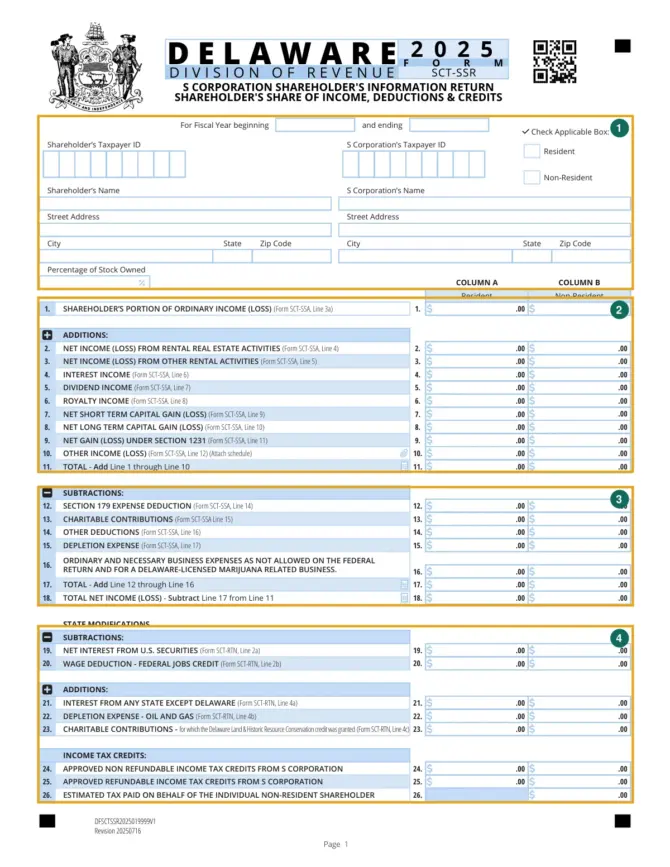
| SCT-SSR line | Item to report | Printed source or calculation |
|---|---|---|
| 1 | Ordinary income or loss | SCT-SSA 3a, allocated to the shareholder |
| 2–3 | Rental real estate and other rental income or loss | SCT-SSA 4 and 5 |
| 4–6 | Interest, dividends and royalties | SCT-SSA 6, 7 and 8 |
| 7–10 | Short-term capital result, long-term capital result, section 1231 result, other income or loss | SCT-SSA 9–12; attach a schedule for other income or loss |
| 11 | Total income | Add lines 1–10 |
| 12–15 | Section 179 expense, charitable contributions, other deductions and depletion | SCT-SSA 14–17 |
| 16 | Ordinary and necessary business expenses disallowed federally for a Delaware-licensed marijuana-related business | The field appears on the July 2025 form; see the instruction gap below |
| 17–18 | Total deductions and net income or loss | Add lines 12–16; subtract line 17 from line 11 |
| 19–20 | US-security interest and wage deduction for federal jobs credit | SCT-RTN 2a and 2b, multiplied by ownership |
| 21–23 | Other-state interest, oil-and-gas depletion, conservation-credit charitable contributions | SCT-RTN 4a–4c, multiplied by ownership |
| 24–25 | Approved nonrefundable and refundable credits | BUS-CRS approved credit amounts |
| 26 | Estimated tax paid for this individual nonresident shareholder | The separate ownership fraction described below |
The May instructions say column A amounts must match the federal Schedule K-1. Their next sentence refers to taking the nonresident’s proportion from SCT-SSR column B itself, without supplying an independent allocation base in that sentence. The form and the opening instruction instead identify SCT-SSA and SCT-RTN source lines. If the column allocation is uncertain for your facts, ask the Division of Revenue at (302) 577-8205 before entering an assumed amount.
There is also a version gap at line 16: the July 16, 2025 form includes the marijuana-business expense field, but the May 15, 2025 SCT-SSR instructions do not give it a separate calculation. This guide does not infer which expenses qualify or an allocation rule for that new field. Obtain the Division’s guidance for that entry at the same number.
Moving the state adjustments to a personal return
The SCT-SSR instructions give the following destination lines for the 2025 personal returns. Apply the shareholder’s ownership percentage to each underlying SCT-RTN adjustment before transferring it.
| SCT-SSR | PIT-RES resident return | PIT-NON nonresident return |
|---|---|---|
| 19, US-security interest | 5 | 22 |
| 20, wage deduction | 7 | 25 |
| 21, other-state interest | 2 | 18 |
| 22, oil-and-gas depletion | 3 | 19 |
| 23, conservation-credit contribution | 18 | 36 |
For lines 24 and 25, use the approved nonrefundable and refundable credits identified in the BUS-CRS schedule. The form keeps them separate. Do not combine them into a single credit entry.
Line 26: allocating the nonresident payments
The instructions start with the total of SCT-RTN lines 9, 10 and 14, including tax actually paid on line 14. Multiply that total by this shareholder’s stock percentage divided by the stock percentage owned by all nonresident shareholders. The second sentence of the instruction specifies tax paid on line 14; do not treat an unpaid balance as a payment merely because it appears there.
For example, when a shareholder owns 20% of all stock and all nonresidents together own 50%, the fraction is 20/50, or 40%. Apply that fraction to the eligible payment total. This is an illustration of the printed fraction, not a replacement calculation for the corporation’s underlying liability. The SCT-RTN instructions say an overpayment for nonresidents passes proportionally to their personal returns rather than being refunded to the corporation.
When and where the copies are filed
Attach the corporate copy to SCT-RTN and provide the shareholder copy for attachment to the Delaware personal return. There is no separate signature field or independent payment voucher on the one-page SCT-SSR. Complete the signatures and payment requirements of the returns to which it is attached.
The SCT-RTN instructions set the corporate filing date at the fifteenth day of the third month after the tax year closes. An automatic six-month federal extension also extends Delaware filing, with a copy attached to the final return. Extending filing does not extend payment. Delaware’s business-forms page directs online filing through the Delaware Taxpayer Portal. For paper filing, use the delivery instructions for the actual accompanying return; SCT-SSR is an attachment, not a separately addressed submission.
The related Delaware CIT-VCH is a corporate electronic-filer payment voucher. It does not replace the shareholder allocation statement. Obtain professional advice for changing stock ownership, disputed sourcing or credits requiring approval.
Official PDF: Form SCT-SSR — Official PDF (revenuefiles.delaware.gov)