Form SCT-RTN is the S Corporation Reconciliation and Shareholders Information Return that Delaware’s Division of Revenue expects once a year from every S corporation with Delaware-source income. It takes the corporation’s federal ordinary income, apportions it to Delaware, adds the state modifications and then computes the personal income tax the corporation pays on behalf of its nonresident shareholders at 6.60%. The corporation itself owes no Delaware corporate income tax: § 1902(b)(9) of Title 30 exempts S corporations with a valid federal election, and the instructions say that exemption is claimed by completing SCT-RTN and attaching federal Form 1120S. This guide uses the 2025 form, Revision 20250605, with the instructions revised 11/03/25. They cover calendar year 2025 and fiscal years that begin in 2025 and end in 2026, and the Division’s Business Tax Forms 2025-2026 page lists this edition for S corporations.
Which S corporations file SCT-RTN for 2025
The filing rule in the instructions is short: every S corporation deriving income from sources within Delaware files the return. A parent S corporation that has elected to treat a wholly owned subsidiary doing business in Delaware as a qualified subchapter S subsidiary (QSSS) reports that subsidiary’s income, deductions and apportionment factors on its own SCT-RTN. Delaware does not permit consolidated returns and does not accept combined, unitary or water’s-edge reporting, so each S corporation files separately.
The return follows the corporation’s federal income year. A short period return is required when the accounting period changes, when the corporation did not exist for the whole year and when the S election changes. If a short period federal return is due, a short Delaware return is due for the same period.
Nonresident shareholders still report their share of income on Delaware personal returns. A composite return, Form CMP-TAX, can be filed in place of their individual nonresident returns when every included shareholder was a nonresident for the full year, had no other Delaware-source income (a spouse’s income counts too) and has the same tax year end.
The order to work through the package
The numbers in this package run from back to front. Schedule 1 on page 2 of SCT-RTN produces the apportionment percentage. That percentage goes on line 2 of Form SCT-SSA (Delaware Schedule A), which converts the Form 1120S Schedule K items into Delaware total net income in two columns. Column B of SCT-SSA then becomes line 1 on page 1 of SCT-RTN. Form SCT-SSR (Delaware Schedule A1) comes last and splits the results by shareholder.
Before starting, pull together the federal Form 1120S with Schedule K and all K-1s, the original cost of property owned at the start and end of the year, annual rent paid, payroll split between Delaware and elsewhere, pay to general executive officers, sales delivered in Delaware, the SCT-TAX payments made during the year and any approved credit amounts on Form BUS-CRS.
Schedule 1 on page 2: the apportionment percentage
Each part of Schedule 1 has a column for amounts within Delaware and a column for amounts within and without Delaware. A corporation that is a general or limited partner in an active partnership includes its share of that partnership’s property, wages and receipts in the matching factor.
| Part of Schedule 1 | Lines | What to enter |
|---|---|---|
| 1A, real and tangible personal property | 1 to 6 | Line 1: original cost of property owned at the beginning and end of the year. Line 2: rented property valued at eight times the annual rental. Line 3 adds them. Line 4 removes property whose income is separately allocated on SCT-SSA lines 4 to 14, property under construction and property not used in the business. Line 5 is line 3 less line 4; line 6 averages the beginning and end totals (add, then divide by 2). |
| 1B, wages, salaries and other compensation | 1 to 3 | Line 1: pay to all employees. Line 2: pay to general executive officers, meaning the officers of record in the state of incorporation. Line 3 is line 1 less line 2. |
| 1C, gross receipts subject to apportionment | 1 to 3 | Line 1: receipts from sales of tangible personal property; the Delaware column takes only goods physically delivered to a buyer or agent in Delaware, not goods handed to the US Mail or a carrier for delivery outside the state. Line 2: other gross income not directly allocated, with a statement listing the items. Line 3 adds lines 1 and 2. |
| 1D, determination of the percentage | 1 to 8 | Lines 1 and 2 give the property ratio, lines 3 and 4 the wage ratio, lines 5 and 6 the receipts ratio. Line 7 totals the ratios; line 8 is the apportionment percentage. |
For lines 7 and 8 the instructions ask for each percentage carried to at least six decimal places, without rounding. The total is divided by the number of factors actually present: three when the corporation has property, payroll and sales, two when one factor is missing, one when only a single factor exists. A corporation with property and sales but no salaries averages the two. The line 8 result goes on SCT-SSA line 2.
The Schedule 1C instructions add that a business selling tangible personal property or providing services in Delaware is liable for a Delaware business license and gross receipts tax on those receipts. That tax has its own returns; it is not computed on SCT-RTN.
Page 1 header and check boxes
Fiscal-year filers enter the beginning and ending dates as MM/DD/YYYY; calendar-year filers leave them blank. The name block takes the corporate headquarters address, a Delaware address only if it differs, and the taxpayer ID, which is the federal employer identification number issued on Form SS-4. Below that come the state and date of incorporation, a short phrase for the nature of business and, only if the corporation stopped operating during the tax year or on its last day, the date it went out of business.
The boxes on the right have specific meanings in the instructions. Initial Return marks the corporation’s first SCT-RTN. Change of Address is for an address different from last year’s filing. Amended Return changes a return already filed. Extension Attached means the corporation has an approved federal or Delaware extension. Small Corporation refers to the standard in § 1905(5) of Title 30, and ESOP is for an S corporation wholly owned by an employee stock ownership trust.
Lines 1 to 14 on page 1
Page 1 turns total net income into the tax owed for nonresident shareholders. The marked lines on the image below are the ones that carry numbers in from other forms or decide whether the rest of the page applies.
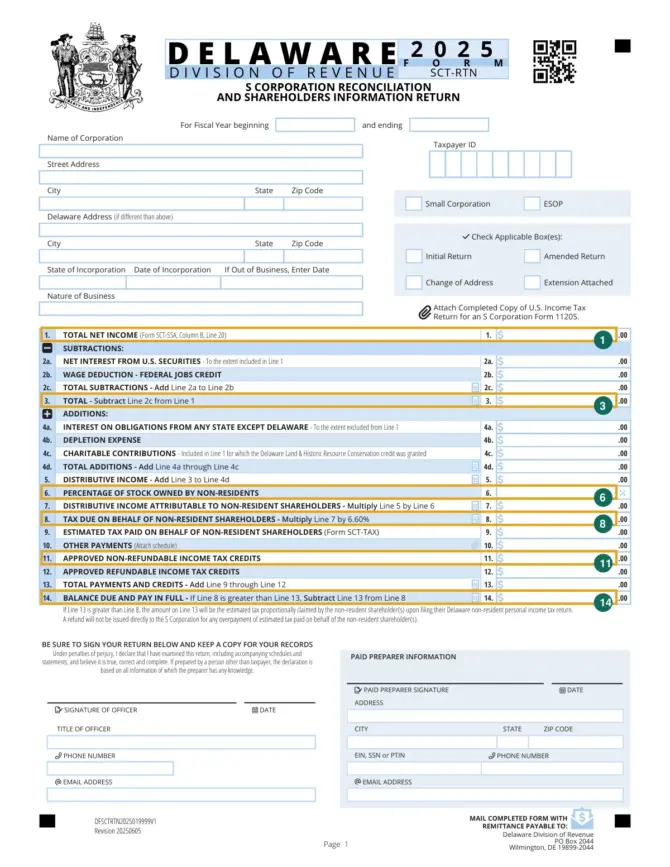
| Line | Entry | Where the figure comes from |
|---|---|---|
| 1 | Total net income | Form SCT-SSA, Column B (see the note on line numbers below) |
| 2a | Net interest from US securities | Interest on bonds or securities of the United States and its instrumentalities, less related expenses, to the extent it is in line 1 |
| 2b | Wage deduction, federal jobs credit | Wages disallowed federally under IRC § 280C(a); attach federal Form 5884 |
| 2c, 3 | Total subtractions, then line 1 less line 2c | Arithmetic |
| 4a | Interest on obligations of other states | Interest from any state or political subdivision except Delaware, to the extent it is not already in line 1 |
| 4b | Depletion expense | Federally allowable depletion in excess of cost depletion |
| 4c | Charitable contributions | Contributions included in line 1 for which the Delaware Land and Historic Resource Conservation credit was granted |
| 4d, 5 | Total additions; distributive income | Line 5 is line 3 plus line 4d |
| 6 | Percentage of stock owned by nonresidents | Shareholder records; stop after this line if every shareholder is a Delaware resident |
| 7, 8 | Nonresident distributive income; tax due | Line 5 times line 6; then line 7 times 6.60% |
| 9 | Estimated tax paid for nonresident shareholders | Form SCT-TAX payments for the year, plus any payment sent with an extension request |
| 10 | Other payments | Payments not on line 9, with an attached explanation |
| 11, 12 | Approved nonrefundable and refundable credits | Form BUS-CRS amounts multiplied by the nonresident percentage on line 6 |
| 13, 14 | Total payments and credits; balance due | Lines 9 to 12 added; line 14 is line 8 less line 13 when line 8 is larger |
A worked example with made-up figures: distributive income on line 5 is $240,000 and nonresidents own 40% of the stock. Line 7 is $96,000 and line 8 is $6,336 (6.60% of $96,000). If the corporation paid $5,000 through SCT-TAX and has no credits, line 13 is $5,000 and line 14 shows a $1,336 balance to pay with the return.
When line 13 is larger than line 8, nothing comes back to the corporation. The form and the instructions both say the amount on line 13 is claimed proportionally by the nonresident shareholders as estimated tax on their own Delaware nonresident returns, and the S corporation gets no refund of the overpayment. The shareholder-level split is reported on SCT-SSR.
Line 6 has one gap the instructions leave to the Division: if any shareholder was not a Delaware resident for the entire year, the instructions say to contact the Division of Revenue for specific instructions instead of giving a rule. Schedule A1 (SCT-SSR) is still completed for every shareholder, resident or not.
Lines 11 and 12 draw on Delaware’s nine income tax credits: Economic Development, Green Industries, Research and Development, Land and Historic Resource Conservation, Historic Preservation and Repair, Neighborhood Assistance, New Economy Jobs, the employer credit for hiring individuals with disabilities and the automatic external defibrillator credit. Some need approval from another Delaware agency first, so only amounts approved on BUS-CRS belong here. The instructions note that the Commitment to Innovation Act (Senate Bill 200) made the research and development credit refundable, which puts it on line 12.
Line 1: line 19 or line 20 of SCT-SSA
The 2025 documents point to two different lines. The printed label on SCT-RTN line 1 reads “Form SCT-SSA, Column B, Line 20”, the 2025 SCT-SSA (Revision 20250618) tells filers to carry its Column B line 20 to SCT-RTN line 1, and the Schedule A part of the instructions says the same. The separate line 1 paragraph of the SCT-RTN instructions (revised 11/03/25) names Schedule A, Column B, line 19. On the 2025 SCT-SSA, line 19 is the total of the subtractions and line 20 is total net income. If your return depends on which line the Division expects, ask the Wilmington office at (302) 577-8205 before filing.
What to attach to SCT-RTN
- A complete copy of federal Form 1120S for the year, with all schedules and exhibits, including Schedule K and the K-1s.
- Form SCT-SSA (Delaware Schedule A), the reconciliation that produces line 1.
- Form SCT-SSR (Delaware Schedule A1) for every resident and nonresident shareholder; give each shareholder a copy as well.
- Federal Form 5884 when line 2b is used.
- A schedule explaining line 10 payments, and a statement listing the other income on Schedule 1C, line 2.
- A copy of the federal extension, or the Division’s approval letter for an extension beyond six months, when the Extension Attached box is checked.
Due date, extensions and penalties
SCT-RTN is due on or before the fifteenth day of the third month after the tax year closes. A dissolving corporation’s short period return has the same deadline counted from the end of the short period.
An automatic six-month federal extension extends the Delaware due date by six months as well; a copy of it goes with the return. A corporation without a federal extension uses Form SCT-EXT, filed with payment by the original due date. Note that SCT-EXT has its own mailing address, Delaware Division of Revenue, PO Box 0830, Wilmington, DE 19899-0830, which is not the box for the return. An extension gives more time to file only: the tax owed for nonresident shareholders must be paid with the extension request. More time beyond six months can be asked for by letter before the due date, and under § 511 of Title 30 the Director may require a bond of up to twice the tax. Delaware C corporations use a different request, Form CIT-EXT.
A late return is charged 5% per month of the tax due, up to 50%, plus interest of 1/2% per month from the original due date. A timely return with tax left unpaid adds a separate 1% per month penalty, capped at 25%.
The payments on line 9 come from the estimated tax system. A corporation with nonresident shareholders files Form SCT-TAX by the fifteenth day of the fourth month of its tax year, even if the estimate is zero, and pays 50% of the estimated tax then, 20% by the fifteenth day of the sixth month, 20% by the fifteenth day of the ninth month and 10% by the fifteenth day of the twelfth month. A small corporation, one whose gross receipts and other gross income did not exceed $26,071,000 in any 2 of the 3 preceding tax years, pays four equal 25% installments on the same dates. Underpaid or late estimates draw a 1.5% monthly penalty unless timely payments reached 80% of this year’s liability or 100% of last year’s. No estimates are required when the tax period is shorter than 92 days.
What delays or changes an SCT-RTN
- Blank lines or schedules. The instructions require all lines and schedules to be completed and say that failing to do so will delay processing.
- Sending federal K-1s in place of SCT-SSR. The instructions say a federal Schedule K-1 cannot be used in lieu of the Delaware schedule, and one SCT-SSR is filed for each shareholder.
- Rounding the factor percentages on Schedule 1D. They are carried to at least six decimal places and not rounded.
- Taking a net operating loss deduction. An S corporation cannot adjust its income for a net operating loss carryback or carryforward; the instructions cite Delaware Tax Ruling 78-3.
- Holding the payment until the extended due date. The extension covers filing only, and the 1% monthly failure-to-pay penalty applies to unpaid tax.
Amended returns and IRS changes
An S corporation that files an amended federal return has 90 days to file an amended SCT-RTN, checking the Amended Return box and attaching a copy of the amended federal return. When the IRS changes or corrects the corporation’s net income, or redetermines its tax, the Division of Revenue must be told within 90 days after the IRS’s final determination.
Getting the 2025 SCT-RTN and where to mail it
The fillable PDF, its instructions, SCT-SSA, SCT-SSR and SCT-EXT are all on the Division’s Business Tax Forms 2025-2026 page, which advises downloading a PDF before completing it. The same page also invites businesses to file online through the Delaware Taxpayer Portal and lists Form SCT-VCH, titled Electronic Filer S Corporation Payment Voucher, which is mailed with a payment to the same box as the return.
The paper return is signed by an officer, with the officer’s title, phone number and email address; a paid preparer completes the preparer block with an EIN, SSN or PTIN. Mail the completed form with any payment, made payable to the Delaware Division of Revenue, to:
Delaware Division of Revenue
PO Box 2044
Wilmington, DE 19899-2044
Questions go to the Division’s public service offices: Wilmington (302) 577-8205, Dover (302) 744-1085 and Georgetown (302) 856-5358. The toll-free number 1-(800) 292-7826 works only from within Delaware.
Official PDF: Form SCT-RTN — Official PDF (revenuefiles.delaware.gov)
Questions about Delaware SCT-RTN
Does an S corporation file SCT-RTN when all its shareholders live in Delaware?
It does, because the filing rule covers every S corporation with Delaware-source income. The instructions tell such a corporation to stop after line 6, and SCT-SSR is still prepared for each shareholder.
Can resident shareholders use the corporation’s net operating loss?
Resident shareholders get the benefit of their share of an S corporation loss on their Delaware personal returns. Nonresident shareholders may carry forward losses that came from a Delaware S corporation for tax years beginning on or after January 1, 1992, but only when the same carryover exists on their federal return for that year.
Which form does the shareholder attach to a personal return?
Each resident or nonresident shareholder attaches the copy of Delaware Schedule A1 (SCT-SSR) to the Delaware personal income tax return.
Official sources
- Form SCT-RTN 2025, S Corporation Reconciliation and Shareholders Information Return (Revision 20250605)
- Form SCT-RTN 2025 instructions (revised 11/03/25)
- Form SCT-SSA 2025, Reconciliation of Ordinary Income to Total Net Income (Revision 20250618)
- Form SCT-SSR 2025, S Corporation Shareholder’s Information Return (Revision 20250716)
- Form SCT-EXT 2025, S Corporation Request for Extension
- Form SCT-VCH 2025, Electronic Filer S Corporation Payment Voucher
- Business Tax Forms 2025-2026, Delaware Division of Revenue