A partnership, an LLC taxed as a partnership or an S corporation with owners who live outside Delaware can report and pay Delaware personal income tax for some of them on a single return, Form CMP-TAX. Each owner who joins the composite filing skips the individual nonresident return, the PIT-NON. The 2025 form (revision 20250728) is one page with 11 numbered lines: the owners’ Delaware-source income goes on line 1 and is taxed at a flat .0660 on line 2. Older Delaware forms lists show the same return as Form 200C, “Delaware Composite Return”.
Which owners can be included on CMP-TAX
The CMP-TAX instructions (revised 05/27/25) let the entity include qualifying nonresident partners, members or shareholders only when every one of these holds:
- the person was a nonresident of Delaware for the full taxable year, so someone who moved in or out during the year cannot be included;
- the person, and the person’s spouse, had no income from Delaware sources other than the distributive share from this entity;
- everyone on the return has the same tax year for income tax purposes.
Grantor trusts may also be included. Joining is the individual’s choice: a qualifying partner who stays out files a PIT-NON instead, and a partner who is included must not file a PIT-NON reporting the same income. The 2025 PRT-RTN instructions say the same from the partnership side: a nonresident partner with Delaware-source income files either PIT-NON or a composite return.
Two conditions apply to everyone included. No net operating losses are allowed on the composite return, and any refund or overpayment is paid to the organization, which has to pass it on to the members.
For S corporations, the SCT-RTN instructions (revised 11/03/25) repeat the three conditions and add that an S corporation with one or more nonresident shareholders is required to make estimated personal income tax payments on their behalf.
Before you start: Form CMP-SCH and the K-1s
The figures on CMP-TAX come from a companion page, Form CMP-SCH (Composite Personal Income Tax Schedule, revision 20250728). It has one row per included owner with five columns: taxpayer ID, name, income, estimated tax paid and percentage of ownership. Its two totals carry over directly: total income goes to line 1 of CMP-TAX and total estimated tax paid goes to line 5.
Delaware also wants a Schedule K-1 for every nonresident shareholder and partner on the composite return. Entities with a large number of owners may file a schedule built from the information on the A-1 schedules, in place of one A-1 per person. Gather as well any PIT-CRS credit form and any REW-EST real estate returns before filling in the lines below.
Filling in CMP-TAX line by line
The top of the form asks for the fiscal year beginning and ending dates, the business name and address, a Delaware address if it is different, the state and date of incorporation, the nonresident partners or shareholders, the nature of business and the employer identification number. Three boxes on the right mark the return as initial, final or amended. The marked copy below shows the lines that take the most work.
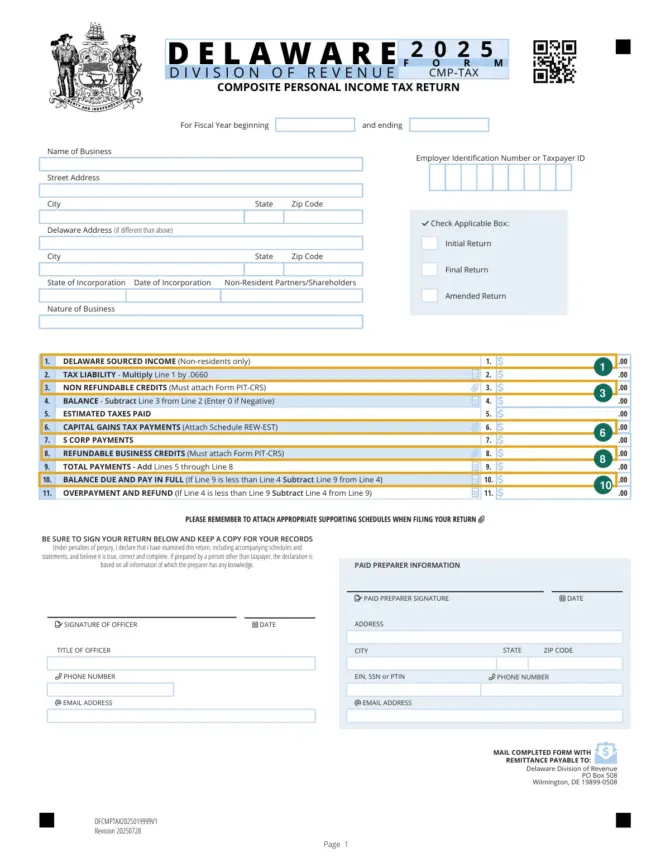
| Line | What the form asks for | Where the number comes from |
|---|---|---|
| 1 | Delaware sourced income (nonresidents only) | Total income column of CMP-SCH |
| 2 | Tax liability: line 1 multiplied by .0660 | Calculation on the form |
| 3 | Nonrefundable credits | Form PIT-CRS, which must be attached |
| 4 | Balance: line 2 minus line 3, zero if negative | Calculation on the form |
| 5 | Estimated taxes paid | Total estimated tax paid on CMP-SCH |
| 6 | Capital gains tax payments | REW-EST payments made for included owners; attach the REW-EST copy |
| 7 | S corp payments | Payments made by the S corporation |
| 8 | Refundable business credits | Form PIT-CRS, which must be attached |
| 9 | Total payments: lines 5 through 8 | Calculation on the form |
| 10 | Balance due, when line 9 is less than line 4 | Line 4 minus line 9, paid in full with the return |
| 11 | Overpayment and refund, when line 4 is less than line 9 | Line 9 minus line 4; the refund is paid to the organization |
Lines 1 and 2
Line 1 is labeled “Non-residents only”, which matches the full-year nonresident condition. There is no rate table and no deduction or exemption line on the composite form: the tax on line 2 is line 1 times .0660. With three included partners whose CMP-SCH income figures are $48,000, $31,500 and $20,500, line 1 is $100,000 and line 2 is $6,600. These numbers are only an illustration for this guide.
Lines 3 and 8: credits
Both credit lines carry the printed note “Must attach Form PIT-CRS”. Nonrefundable credits on line 3 can only bring the balance on line 4 down to zero. Refundable business credits on line 8 count as a payment and can produce an overpayment on line 11.
Lines 5 to 7: payments already made
Line 5 is the CMP-SCH estimated tax total. The instructions split estimated payments by entity type: partnerships pay composite estimates with CMP-EST coupons, while an S corporation’s estimated payments must be made with its own SCT-TAX coupons or with SCT-RTN, not through the composite return filing. Line 7 is labeled “S Corp payments”; neither the form nor the instructions explain it further. Line 6 is for real estate withholding: if REW-EST payments were declared and paid for any owner on the return, a copy of Form REW-EST must be attached.
Lines 9 to 11
Add lines 5 to 8 on line 9 and compare with line 4. In the example above, $5,000 of estimated tax on line 5 and nothing on lines 6 to 8 leaves a balance due of $1,600 on line 10. Only one of lines 10 and 11 is filled in.
Signature block
The return is signed by a partner or a corporate officer who is authorized to sign the partnership return or the S corporation income tax return. The officer adds title, date, phone number and email address. A paid preparer completes the separate block with signature, date, address, EIN, SSN or PTIN, phone and email.
When the 2025 composite return is due
CMP-TAX is due on the 30th day of the fourth month after the close of the taxable year of the shareholders or partners on the return. The 2025 extension form, CMP-EXT, gives April 30, 2026 as its filing date and requests an automatic extension to October 15, 2026. Both dates had passed when this guide was checked on November 1, 2026.
Two routes extend the filing date. A federal extension of time to file is accepted as a valid extension for CMP-TAX. Partnerships can also file Delaware’s own CMP-EXT, which has five lines: expected total tax, estimated payments including prior-year overpayments credited, other payments and credits, their total, and the balance to pay in full with the form. CMP-EXT goes to PO Box 830, Wilmington, DE 19899-0830.
For the next year, the 2026 CMP-EST voucher shows April 30, 2026 for the first quarter. The Division’s forms page asks composite filers to make their estimated payments with CMP-EST and not with the individual PIT-EST voucher.
What goes in the envelope with CMP-TAX
- CMP-TAX, signed by the authorized partner or officer
- CMP-SCH with every included owner, totals matching lines 1 and 5
- A Schedule K-1 for each nonresident shareholder or partner on the return (or the consolidated schedule for a large group)
- PIT-CRS, if line 3 or line 8 has an amount
- A copy of each REW-EST, if line 6 has an amount
- Payment of the line 10 balance, payable to the Delaware Division of Revenue
The bottom of the form also reminds you to attach the supporting schedules and keep a copy. To correct a composite return later, the entity files an amended composite return; the instructions allow no other way to change it, and the form has an “Amended Return” box for that.
Getting the 2025 form and where to mail it
The fillable 2025 CMP-TAX, its instructions, CMP-SCH, CMP-EXT, CMP-EST and CMP-VCH are listed under “Composite Forms” on the Division of Revenue’s Personal Income Tax Forms Current Year (2025-2026) page. The completed return and any payment go to:
Delaware Division of Revenue
PO Box 508
Wilmington, DE 19899-0508
CMP-VCH, the composite electronic filer payment voucher, is a separate page for sending a payment by check or money order payable to “Delaware Division of Revenue” to PO Box 830, Wilmington, DE 19899-0830. The voucher says not to send cash.
The Division lists Personal Income Tax Assistance at (302) 577-8200 and DOR_PublicService@delaware.gov. The CMP-TAX instructions also give the Carvel State Office Building, 9th and French Streets, first floor, Wilmington, DE 19801. Delaware corporate income tax payments use a separate voucher, described in our guide to Delaware Form CIT-VCH.
Official PDF: Form CMP-TAX — Official PDF (revenuefiles.delaware.gov)
Questions about the Delaware composite return
Is CMP-TAX the same return as Delaware Form 200-C?
The Division’s 2019-2020 forms list shows “Form 200C Delaware Composite Return” with separate 200Ci instructions. The current list shows “Form CMP-TAX Delaware Composite Return” in the same role, and the 2025 form is the one to use for 2025.
Can a partner who moved out of Delaware during 2025 be included?
The instructions require each person on the composite return to be a nonresident for the full taxable year. A part-year resident files an individual Delaware return.
Who gets the refund on line 11?
The instructions say any refund or overpayment on a composite return is paid to the organization, which distributes it to the members.
Can a partner with Delaware rental income still join?
The instructions exclude anyone who has Delaware-source income, including a spouse’s, other than the distributive share from the entity. That partner files a PIT-NON.
Official sources
- Form CMP-TAX, Composite Personal Income Tax Return, 2025 (Revision 20250728)
- Form CMP-TAX instructions, 2025 (revised 05/27/25)
- Form CMP-SCH, Composite Personal Income Tax Schedule, 2025 (Revision 20250728)
- Form CMP-EXT, Application for Automatic Extension of Time to File Delaware Composite Income Tax Return, 2025 (Revision 20250728)
- Form CMP-VCH, Electronic Filer Payment Voucher, 2025 (Revision 20251016)
- Form CMP-EST, Declaration of Estimated Income Tax, 2026 (Revision 20250728)
- Form SCT-RTN instructions, 2025 (revised 11/03/25)
- Form PRT-RTN instructions, 2025 (revised 05/27/25)
- Personal Income Tax Forms Current Year (2025-2026), Delaware Division of Revenue
- 2019-2020 Personal Income Tax Forms, Delaware Division of Revenue
- Contact Information, Delaware Division of Revenue