Delaware Form FID-BEN reports a beneficiary’s share of an estate or trust’s income, Delaware adjustments, credits and payments. The fiduciary completes a separate FID-BEN for each beneficiary, attaches it to Form FID-TAX and provides a copy to that beneficiary.
Who prepares FID-BEN, and which year applies?
The current Delaware form list supplies the 2025 FID-BEN, Revision 20250808, as the fiduciary Schedule K-1. Use it for the corresponding 2025 fiduciary reporting period; the top has beginning and ending dates for a fiscal year. The beneficiary uses the information on their own return.
Start with the estate or trust’s federal distributable net income and Delaware FID-TAX schedules. The FID-TAX instructions allocate Delaware modifications using each recipient’s share of distributable net income. Cash paid out during the year is not the allocation formula. Schedule B also addresses income accumulated by the fiduciary and the specified S corporation income; use its instructions for those calculations.
How to complete the identification and income entries
Enter the estate or trust name and the percentage of distributive share. Mark amended or final FID-BEN when applicable and identify resident or nonresident status. Complete the separate taxpayer-ID fields and FEIN/SSN selections. Enter the beneficiary’s name and full address in the left-hand block, and the fiduciary’s name and full address in the right-hand block, including city, state and ZIP code.
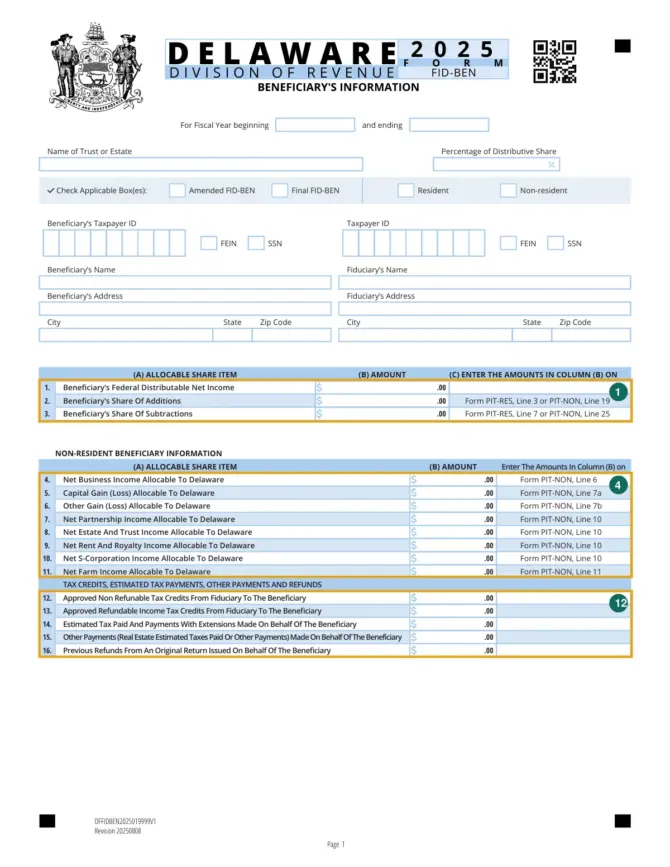
| FID-BEN entry | Amount to report | Printed recipient-return destination |
|---|---|---|
| 1 | Beneficiary’s federal distributable net income, using the fiduciary computation. | No destination is printed in column C for this row. |
| 2 | Beneficiary’s share of additions. | PIT-RES line 3 or PIT-NON line 19. |
| 3 | Beneficiary’s share of subtractions. | PIT-RES line 7 or PIT-NON line 25. |
| 4 | Net business income allocable to Delaware. | PIT-NON line 6. |
| 5 and 6 | Delaware-allocable capital gain or loss, then other gain or loss. | PIT-NON lines 7a and 7b, respectively. |
| 7 through 10 | Delaware-allocable net partnership, estate and trust, rent and royalty, and S corporation income in their separate rows. | PIT-NON line 10. |
| 11 | Net farm income allocable to Delaware. | PIT-NON line 11. |
| 12 and 13 | Approved nonrefundable credits and approved refundable income tax credits, respectively. | Column C is blank; use the recipient’s return instructions. |
| 14 through 16 | Estimated tax and extension payments; other payments, including real-estate estimated tax; previous refunds, all made or issued on behalf of the beneficiary. | Column C is blank; reconcile with the recipient’s return instructions. |
What belongs in the nonresident section?
Complete lines 4 through 11 for a nonresident beneficiary’s income from Delaware sources. The 2025 FID-TAX instructions specifically exclude the beneficiary’s share of passive portfolio income from publicly traded securities, C corporation dividends and intangible investment assets not used in a business carried on in Delaware. A Delaware fiduciary address does not make every investment receipt Delaware-source income.
For example, keep a beneficiary’s share of rent from Delaware property in the rent-and-royalty row, separate from portfolio dividends. The fiduciary’s underlying schedules must establish the amounts; FID-BEN has no calculation that turns the estate’s entire income into Delaware-source income.
Official PDF, beneficiary copy and filing with FID-TAX
Get the 2025 FID-BEN PDF. It has no separate signature or payment section. Attach each completed beneficiary schedule to the fiduciary return and give each beneficiary a copy, as directed on page 3 of the FID-TAX instructions.
Those instructions give April 30 following year-end for calendar-year fiduciary returns and the last day of the fourth month after year-end for fiscal-year returns. They direct mailed returns to Delaware Division of Revenue, P.O. Box 2044, Wilmington, DE 19899-2044. These are the underlying FID-TAX arrangements; FID-BEN does not provide a separate filing deadline or an independent payment demand.
Where the beneficiary’s return requires information beyond a printed column-C reference, use that return’s instructions or ask Delaware Revenue at 302-577-8200. Do not assign a return line to one of the blank destination cells by copying the row above it.