Schedule D (Form 1120-S) is where an S corporation totals its capital gains and losses for the year and, if it was once a C corporation or took over assets from one, works out the built-in gains tax. Parts I and II produce a net short-term and a net long-term figure that flow to Schedule K and from there to each shareholder’s K-1. Part III, on page 2, produces a tax the corporation itself pays on Form 1120-S, page 1, line 23b. The current schedule is the 2025 version (footer “Created 2/14/25”), and its instructions are dated November 20, 2025.
Who files Schedule D (Form 1120-S) and what goes on it
The schedule is attached to Form 1120-S. The instructions list what goes on it:
- the overall gain or loss from transactions listed on Form 8949
- certain transactions that do not have to be listed on Form 8949
- capital gains from installment sales on Form 6252 and capital gains and losses from like-kind exchanges on Form 8824
- gains on distributions of appreciated capital assets to shareholders
- capital gain distributions
- the tax on built-in gains, in Part III
Business property does not start here. Sales, exchanges and distributions of real property used in the business and of depreciable or amortizable property, involuntary conversions other than casualty or theft, and the deferral of a qualified section 1231 gain invested in a qualified opportunity fund (QOF) go on Form 4797. Casualties and thefts go on Form 4684, and section 1256 contracts and straddles on Form 6781. A disposal of a digital asset held as a capital asset, whether by sale, trade, exchange, payment or other transfer, is figured on Form 8949 and reported on Schedule D; digital assets received for services or held for sale to customers are reported like other income of that kind.
A corporation that deferred a capital gain by investing in a QOF files its return with Schedule D, Form 8949 and Form 8997 attached, and keeps filing Form 8997 every year until it disposes of the investment.
What changed on the 2025 Schedule D (Form 1120-S)
The What’s New section of the 2025 instructions has two entries. Codes G, H, I, J, K and L were added to lines 1b, 2, 3, 8b, 9 and 10 so that digital asset transactions can be carried from Form 8949, with Form 1099-DA, Digital Asset Proceeds From Broker Transactions, named as the related broker form. Separately, a taxpayer that elected to defer gains invested in a QOF meeting the 7-year holding period threshold may be eligible for a basis adjustment, with Form 8997 and its instructions given as the place to look.
How to fill out Parts I and II, line by line
Every page of Form 8949 the corporation needs is completed before lines 1b, 2, 3, 8b, 9 or 10 of Schedule D. Short-term items, generally held one year or less, go in Part I and long-term items in Part II. The lines with four money columns use (d) proceeds, (e) cost or other basis, (g) adjustments carried from Form 8949, and (h) gain or loss; negative amounts are entered in parentheses. The markers on the image match the first column of the table.
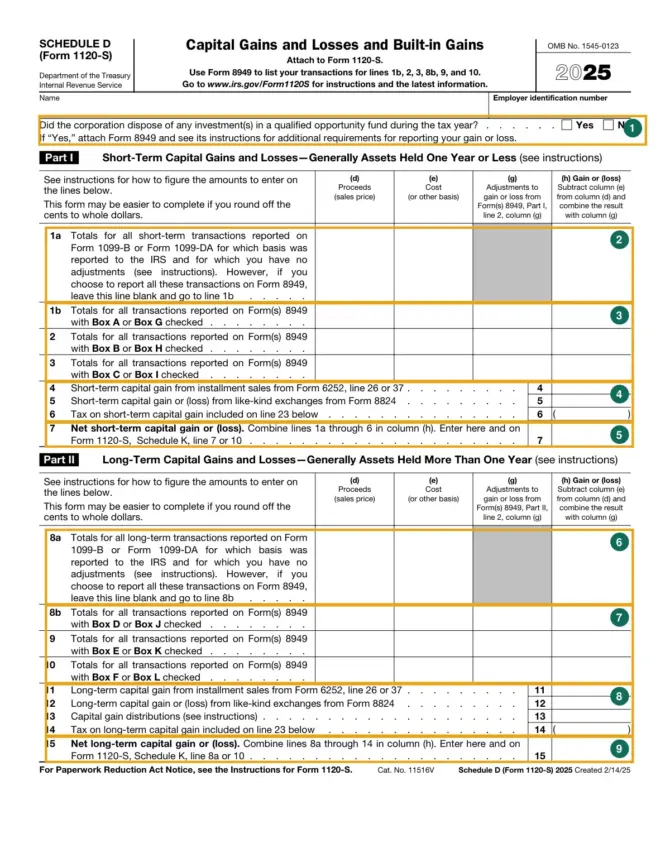
| Marker | Line | Entry | Where it comes from or goes |
|---|---|---|---|
| 1 | QOF question | Yes if the corporation disposed of any QOF investment during the year | A Yes means Form 8949 is attached, with its extra reporting rules |
| 2 | 1a | Short-term broker totals with basis reported to the IRS and no adjustments | Form 1099-B or Form 1099-DA; column (g) is shaded |
| 3 | 1b, 2, 3 | Short-term totals by Form 8949 box | 1b: Box A or G; 2: Box B or H; 3: Box C or I |
| 4 | 4, 5, 6 | Installment sale gain, like-kind exchange gain or loss, and the built-in gains tax on short-term gain shown as a loss | Form 6252, line 26 or 37; Form 8824; Part III, line 23 |
| 5 | 7 | Net short-term capital gain or loss, lines 1a to 6 in column (h) | Form 1120-S, Schedule K, line 7 or 10 |
| 6 | 8a | Long-term broker totals with basis reported and no adjustments | Form 1099-B or Form 1099-DA |
| 7 | 8b, 9, 10 | Long-term totals by Form 8949 box | 8b: Box D or J; 9: Box E or K; 10: Box F or L |
| 8 | 11 to 14 | Long-term installment and like-kind amounts, capital gain distributions, and the built-in gains tax on long-term gain shown as a loss | Form 6252; Form 8824; distributions paid to the corporation; Part III, line 23 |
| 9 | 15 | Net long-term capital gain or loss, lines 8a to 14 in column (h) | Form 1120-S, Schedule K, line 8a or 10 |
Above Part I the schedule asks only for the corporation’s name and employer identification number. Cents may be rounded to whole dollars, but then every amount is rounded: under 50 cents is dropped and 50 to 99 cents goes up to the next dollar. When several amounts are added for one line, the cents are kept in the addition and only the total is rounded.
Lines 1a and 8a: broker totals that skip Form 8949
Aggregate totals can go straight on line 1a or line 8a, except for sales of collectibles, only when all of these hold: the Form 1099-B or Form 1099-DA shows that basis was reported to the IRS and shows no adjustment in box 1f or 1g of Form 1099-B (box 1h or 1i of Form 1099-DA); the Ordinary checkbox (box 2 of Form 1099-B, box 6 of Form 1099-DA) is not checked; the QOF checkbox (box 3 of Form 1099-B, box 3b of Form 1099-DA) is not checked; and nothing about the basis, the type of gain or loss, or the gain or loss itself needs adjusting. Transactions put on these lines are left off Form 8949, and no explanatory statement is attached.
A broker form without reported basis, or with a basis the corporation knows is wrong, sends the transaction to Form 8949. With our own figures: two long-term stock sales, both on a Form 1099-B with basis reported and nothing to adjust, sold for $18,500 and $7,300 with bases of $11,200 and $9,100. Line 8a shows $25,800 in column (d), $20,300 in column (e) and $5,500 in column (h).
Lines 1b to 3 and 8b to 10: Form 8949 totals
Each of these lines takes the totals of the Form 8949 pages with the matching box checked. Column (h) is column (d) minus column (e), combined with the adjustment in column (g). Say the Form 8949 pages with Box E checked total $40,000 of proceeds and $43,500 of basis, with a $1,200 positive adjustment in column (g) for a disallowed wash sale loss. Line 9, column (h), is ($2,300).
The column (g) adjustments come from the codes entered in column (f) of Form 8949. The Schedule D instructions mention several: W for a wash sale, with the nondeductible loss as a positive number; R for gain postponed by rolling over qualified small business stock; and X for excluded gain on District of Columbia Enterprise Zone or qualified community assets, with the excluded amount as a negative number.
Lines 7 and 15: what goes to Schedule K
Line 7 is carried to Form 1120-S, Schedule K, line 7 and line 15 to Schedule K, line 8a, to the extent the gain or loss is portfolio income. A gain or loss from disposing of nondepreciable personal property used in a trade or business may not be portfolio income; it goes on Schedule K, line 10, and on each shareholder’s K-1 in box 10 with code ZZ. Collectibles (28%) gain or loss is figured from the line 15 amount and reported on Schedule K, line 8b. The instructions define collectibles as works of art, rugs, antiques, metals such as gold, silver and platinum bullion, gems, stamps, coins, alcoholic beverages and certain other tangible property.
Part III: when the built-in gains tax applies
Section 1374 taxes built-in gains of two kinds of S corporation: one that was a C corporation before electing S status, and one that acquired an asset whose basis is figured by reference to its basis, or the basis of other property, in the hands of a C corporation (a transferred-basis acquisition). The tax can apply when the corporation has net recognized built-in gain during the 5-year recognition period. That period starts on the first day of the first S corporation year for assets held while it was a C corporation, and on the acquisition date for a transferred-basis asset.
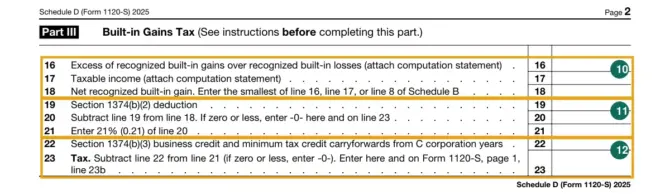
| Marker | Lines | What the instructions require |
|---|---|---|
| 10 | 16, 17, 18 | Line 16: taxable income counting only recognized built-in gains and losses, with an attachment that lists capital and ordinary amounts separately. Line 17: taxable income figured on Form 1120, lines 1 to 28, with that computation attached. Line 18: the smallest of line 16, line 17 or Form 1120-S, Schedule B, line 8. |
| 11 | 19, 20, 21 | Line 19: the section 1374(b)(2) deduction, generally NOL and capital loss carryforwards from C corporation years or from a transferred-basis acquisition. Line 20: line 18 minus line 19, zero or more. Line 21: 21% of line 20. |
| 12 | 22, 23 | Line 22: section 1374(b)(3) business credit and minimum tax credit carryforwards from C corporation years. Line 23: line 21 minus line 22, carried to Form 1120-S, page 1, line 23b. |
Schedule B, line 8, of Form 1120-S is the corporation’s net unrealized built-in gain reduced by net recognized built-in gain from prior years. A worked example with our own figures: line 16 is $90,000, line 17 is $70,000 and Schedule B, line 8, is $150,000, so line 18 is $70,000. A $10,000 NOL carryforward from the C corporation years on line 19 leaves $60,000 on line 20, line 21 is $12,600, and with no C-year credits line 23 is $12,600. If the C corporation returns behind that carryforward are no longer at hand, a copy of a filed return can be ordered with Form 4506.
In the example, line 16 exceeds line 17 by $20,000. For a corporation that made its S election after March 30, 1988, that excess is treated as recognized built-in gain in the next tax year of the recognition period. A corporation with both kinds of assets figures the tax separately for the assets held when its S election took effect and for each group of transferred-basis acquisitions, and it does not use Schedule B, line 8, for those groups. Certain dispositions of timber, coal or domestic iron ore under section 631 are not subject to the tax, and the refundable AMT credit provisions do not apply to S corporations.
The tax on line 23 is treated as a loss of the corporation in the same year, split in proportion among the net recognized built-in gains that produced it. The part tied to short-term capital gain goes on Schedule D, line 6, the part tied to long-term capital gain on line 14, and the part tied to ordinary income is deducted as taxes on Form 1120-S, line 12. The built-in gains tax also counts toward estimated tax: installments are generally required when it, the excess net passive income tax and the investment credit recapture tax add up to $500 or more. For 2026, a calendar-year corporation’s installments are due April 15, June 15, September 15 and December 15.
Transactions the instructions single out
- Installment sales: a sale with a payment due in a later year is generally reported on Form 6252 unless the corporation elects out, which it does by reporting the full gain for the year of sale on a timely return. Stock or securities traded on an established securities market cannot use the installment method.
- Distributions of appreciated property: gain, but not loss, is generally recognized on a nonliquidating distribution to the extent fair market value exceeds adjusted basis (section 311).
- Related persons: no loss is allowed on a sale or exchange between the corporation and certain related persons, except in distributions in complete liquidation (section 267).
- Qualified small business stock: gain rolled over under section 1045, and any gain that could qualify for the rollover at the shareholder level, is separately stated on Schedule K, line 10; gain that could qualify for the section 1202 exclusion is reported on Form 8949 and on Schedule K, line 10.
- Applicable partnership interests: the long-term holding period is more than 3 years, and gains and losses held 3 years or less are treated as short term (section 1061).
- Traders in securities that made the mark-to-market election report each transaction in Part II of Form 4797, not on Form 8949.
Where to get the 2025 schedule and how it is filed
The official 2025 Schedule D (Form 1120-S) is a two-page PDF: Parts I and II on page 1 and Part III on page 2. It has no filing address or signature of its own and is attached to Form 1120-S. A calendar-year S corporation’s 2025 Form 1120-S was due March 16, 2026, because March 15 fell on a Sunday; otherwise the return is generally due by the 15th day of the 3rd month after the tax year ends.
The IRS’s About Form 1120-S page lists Schedule D with its instructions among the Form 1120-S schedules. Its recent developments concern Schedules K-2 and K-3 and Form 7203, not Schedule D.