Nebraska Form 422 asks the county board of equalization to review a property’s valuation or an applicable assessment penalty. File it with the county clerk where the property is located, using a separate protest for each parcel. The requested value, property description and reasons are required entries.
The Department of Revenue’s June 1, 2026 valuation-protest release continues to direct owners to Form 422 or 422A. The statewide Form 422 PDF is marked 96-199-2000 Rev. 2-2022 and contains its instructions on page 2. Check whether your county requires its own version, including an electronic form.
Who can file a property valuation protest?
The form’s instructions identify the property owner as the filer and require authorization when someone protests on the owner’s behalf. Complete the owner-or-authorized-person yes/no question and supply the authorization where applicable. The instructions also describe a clerk’s duty to send the owner a copy when the filer is neither the owner nor an authorized representative; that provision does not remove the form’s authorization requirement for a representative.
For real property, the department’s information guide describes a protest concerning market valuation or unequal valuation compared with similar properties. It recommends checking the property record, dimensions, building age and condition, comparable assessments and recent sales, and discussing unresolved issues with the assessor.
How to complete the taxpayer portion of Form 422
Identify the county and the parcel, then set out both the protested and requested values. Use the space for reasons or attach additional pages.
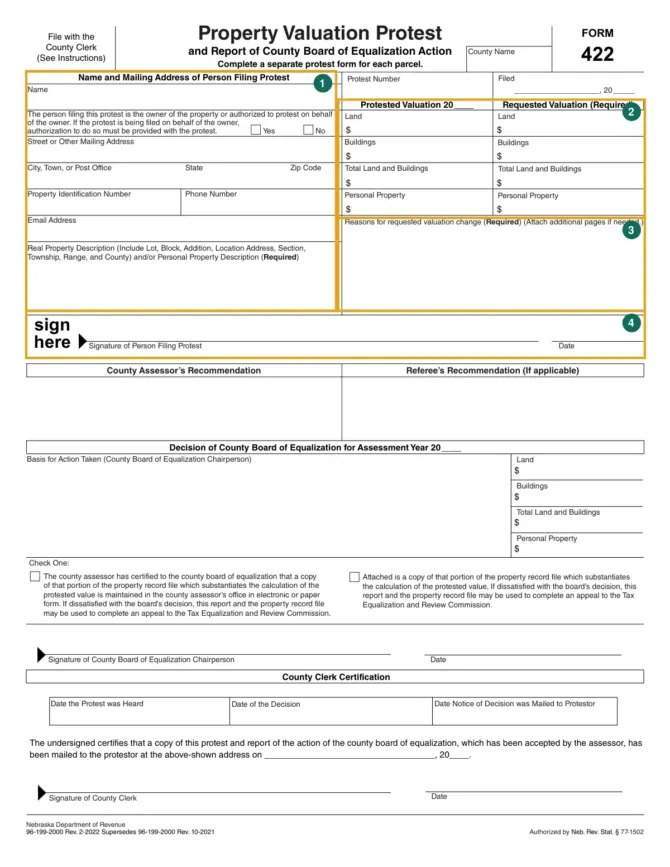
| Form area | Entry | Record or instruction |
|---|---|---|
| County and filer | County name, filer name and mailing address, including city, state and ZIP code; answer the ownership/authorization question. | The county where the property is located and any representative authorization. |
| Parcel and contact details | Property identification number, phone number and email address. | The assessment record and the filer’s contact information. |
| Protested and requested valuations | Assessment year and the applicable land, building, total land/building and personal-property amounts in the two columns. | The assessed values and the values you request. |
| Property description | For real property, identify the lot, block, addition, location address, section, township, range and county as applicable. For personal property, describe the property protested. | Information adequate to identify the property. |
| Reasons and attachments | Explain why the assessment should change. Attach further explanation or evidence when needed. | The factual valuation or equalization issue. |
| Filer’s signature | Sign and date the protest, in writing or electronically as allowed by the instructions. | The person filing the protest. |
The protest-number and filed-date areas record the protest’s administration. Follow the county clerk’s directions for those areas. The lower assessor recommendation, referee recommendation, board decision and clerk certification sections record official action; do not enter a proposed result in the board’s decision section.
What evidence supports the requested value?
The information guide lists recent sales of the property or comparable properties, a recent appraisal, photographs showing building condition as of January 1, income and expenses for income-producing property, and Farm Service Agency maps or other agricultural-acreage records. Choose evidence relevant to the reason you state.
The owner bears the burden of showing the assessment is incorrect. The guide warns that a protest can result in an increased valuation if the board finds the assessor undervalued the property.
When must Form 422 be filed?
Ordinary annual real-property protests are filed between June 1 and June 30. The June 1, 2026 DOR release identified June 30, 2026 as that year’s deadline. The form’s page 2 distinguishes the following situations; a notice-based protest can have a different deadline from the annual process.
| Protest described in the form instructions | Printed filing rule |
|---|---|
| County assessor’s annual real-property valuation | After completion of the assessment roll and on or before June 30. |
| County board valuation-change notice received between June 1 and July 25 for undervalued, overvalued or omitted real property | Within 30 days after the notice is mailed. |
| County board omitted-property valuation/penalty notice received during January 1 through December 31 for unreported real property or a clerical error | Within 30 days after mailing. |
| Real-property exemption-denial valuation notice received after June 1 | Within 30 days after mailing. |
| Personal-property valuation filed with the assessor between January 1 and May 1 | On or before June 30. |
| Personal-property additional assessment, failure-to-file notice or penalty | Within 30 days after mailing. |
The form may also be used for an applicable agricultural or horticultural special-valuation protest. A deadline falling on a weekend or holiday moves to the next business day. For U.S. mail, the postmark controls; registered or certified mailing uses the registration or certification date. The 2026 DOR release also permits email filing with the county clerk and says an email sent before midnight on the due date should be timely. Confirm the clerk’s receiving details before filing.
County recommendations, decision and later appeal
The assessor and any referee enter their recommendations. The board records the assessment year, its basis for action and the decided values. Its chair signs and dates the decision, and the form records whether the relevant property-record material is attached or retained in the assessor’s office. The clerk records the hearing, decision and notice-mailing dates and signs the mailing certification.
The form says ordinary annual real- and personal-property protest decisions are notified by August 2, and other protest decisions within seven days after the board’s decision. It warns that the clerk’s notice period does not extend the appeal deadline.
The Commission’s current appeal guidance describes the ordinary August 24 deadline and conditional September 10 extension. For section 77-1504 notices received between June 1 and August 10, it describes October 15, or October 30 where the hearing deadline has been extended. That notice range differs from the June 1-to-July 25 range printed in the February 2022 Form 422 instructions. Other real-property taxable-value decisions generally use 30 days after the board decision, while taxable-status and other decisions have specific statutory rules. Ask the clerk which procedure applies; TERC lists 402-471-2842 for further information. A later Commission appeal uses its own appeal form and required documents, not another submission of Form 422.
Official PDF and where to deliver the protest
Download Form 422 and its two-page instructions. Deliver the completed, signed protest and supporting attachments to the county clerk in the county where the property is located. Use the department’s county-contact directory linked from its valuation-protest guidance to locate the correct office.
Page 2 warns that failure to identify the property adequately, state a reason or provide a requested valuation results in dismissal. The form is a county protest, so the state Property Assessment Division’s general mailing address is not a substitute destination.