Form 458 Schedule I is the income statement attached to the Nebraska Homestead Exemption Application. It adds up the household income of the applicant, the spouse and any other owner who lives in the home, and that total decides how much of the homestead exemption is granted. The 2026 Schedule I (Form No. 96-296-2009 Rev. 1-2026) reports income from January 1 through December 31, 2025 and is filed with Form 458 at the county assessor’s office after February 1 and on or before June 30, 2026. As of November 1, 2026, the Department of Revenue’s homestead exemption page still links this 2026 version.
Who files Schedule I
Applicants in homestead categories 1 (age 65 or older), 2 (veterans totally disabled by a non-service-connected accident or illness), 3 (qualifying physical disabilities) and 6 (developmental disability) must file it. Categories 4V, 4S, 5 and 7, the veteran and surviving spouse categories based on VA compensation, do not file it; for them there is no income limit.
How many statements a household sends depends on who owns and lives in the home:
- If the applicant filed, or would have filed, as married for 2025, the statement includes the income of both the applicant and the spouse.
- Every other owner who occupied the homestead during any part of 2025 reports income on a separate Schedule I. The top note on the form says not to mix an owner-occupant’s income into the applicant’s statement.
- A brother, sister or parent who is on the deed and lives in the home is a “closely related” owner. Their income counts in the household income, they complete their own Schedule I, and the applicant uses the Married or Living with Closely Related Relatives status on Form 458.
The first box on the form (marker A on the image) says whose statement it is: the applicant filing single, the applicant and spouse filing jointly, the applicant married filing separately, the spouse married filing separately, or another owner-occupant. Check only one.
Part I or Part II
The schedule has two income sections and you complete only one of them. If you filed a 2025 federal income tax return, complete Part I, which starts from federal adjusted gross income. If you did not file a 2025 federal return, complete Part II and Worksheet A on the back, which build the total from each type of income. Social Security retirement income counts in either case, whether or not a return was filed.
How to fill out Schedule I, Part I
Part I takes most of its numbers from the 2025 federal Form 1040 and the Nebraska Form 1040N.
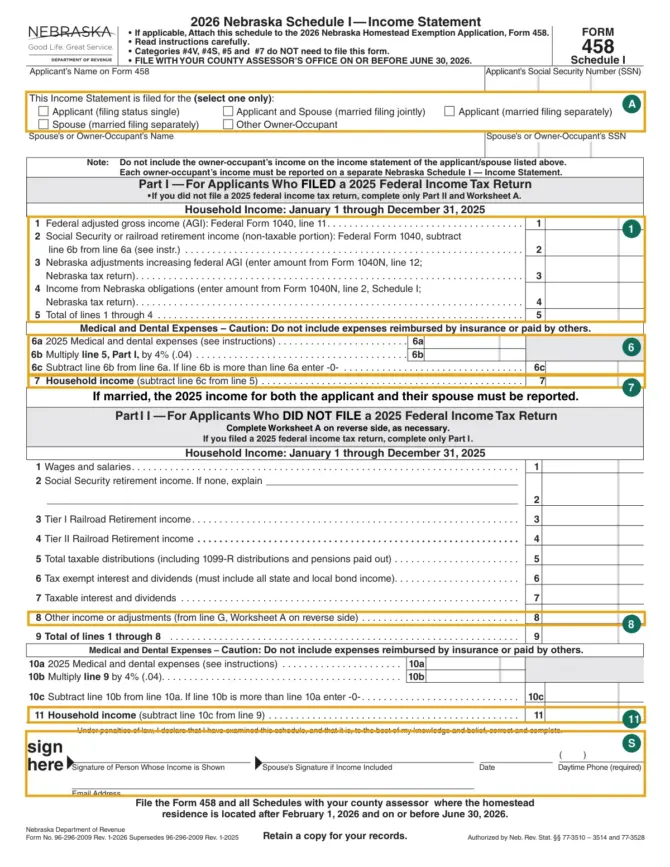
| Line | What it asks | Where the number comes from |
|---|---|---|
| 1 | Federal adjusted gross income | Form 1040, line 11, for tax year 2025 |
| 2 | Non-taxable Social Security or railroad retirement income | Form 1040 line 6a minus line 6b; do not subtract Medicare premiums or other adjustments |
| 3 | Nebraska adjustments increasing federal AGI | Form 1040N, line 12, not reduced; amounts on line 13 of Form 1040N are not allowed |
| 4 | Income from Nebraska obligations | Form 1040N Schedule I, line 2 |
| 5 | Total | Lines 1 through 4 |
| 6a | 2025 medical and dental expenses | Out-of-pocket amounts paid in 2025 (see the medical section below) |
| 6b | 4% of line 5 | Line 5 times 0.04 |
| 6c | Deductible medical expenses | Line 6a minus line 6b; zero if line 6b is larger |
| 7 | Household income | Line 5 minus line 6c |
Here is how the arithmetic runs for a single applicant age 66 with a 2025 federal AGI of $21,000 and Social Security of $18,000, of which $3,000 was taxable. Line 2 is $15,000 ($18,000 minus $3,000), and with nothing on lines 3 and 4, line 5 is $36,000. She paid $2,400 in Medicare Part B premiums and prescriptions. Line 6b is $1,440 (4% of $36,000), so line 6c is $960 and line 7 is $35,040. In the single column for age 65 and over, that falls in the 100% relief bracket of the 2026 table.
Part II and Worksheet A, for applicants with no 2025 return
| Line | What it asks | Where the number comes from |
|---|---|---|
| 1 | Wages and salaries | Wages, fees, commissions, tips and bonuses received in 2025, even without a W-2 (W-2 box 1 if there is one) |
| 2 | Social Security retirement income | SSA-1099 box 5, without subtracting Medicare premiums; if none, explain why on the line |
| 3 | Tier I railroad retirement | RRB-1099 box 5 |
| 4 | Tier II railroad retirement | RRB-1099-R box 7 |
| 5 | Taxable distributions and pensions | Form 1099-R box 2a; not a qualified IRA rollover |
| 6 | Tax-exempt interest and dividends | 1099-INT box 8, 1099-OID box 11, 1099-DIV box 12, including Nebraska and out-of-state municipal bond income and exempt-interest dividends from mutual funds |
| 7 | Taxable interest and dividends | 1099-INT boxes 1 and 3, 1099-OID boxes 1 and 2, 1099-DIV boxes 1a and 2a |
| 8 | Other income or adjustments | Line G of Worksheet A |
| 9 | Total | Lines 1 through 8 |
| 10a to 10c | Medical and dental expenses | Same method as lines 6a to 6c, using 4% of line 9 |
| 11 | Household income | Line 9 minus line 10c |
Line 6 leaves out interest earned inside an IRA and excludable interest on Series EE bonds (federal Form 8815). Worksheet A collects what the lines above do not: line A net business, rental or farm income or loss (Schedules C, E and F), line B capital gain or loss (Schedule D, Forms 1099-B, 1099-S, 1099-DIV), line C other gains or losses (Form 4797), line D unemployment compensation from 1099-G box 1, line E other income from 1099-MISC, 1099-NEC and taxable state refunds minus adjustments such as IRA deductions, student loan interest, self-employment tax and alimony paid, and line F the early withdrawal penalty from 1099-INT box 2. Line G is A through E minus F and goes to Part II line 8.
Income that stays off Schedule I
The specific instructions list six kinds of payments that are not reported anywhere on the statement: VA disability compensation, Supplemental Security Disability Income (SSDI), workers’ compensation, child support, Aid to Dependent Children and Nebraska Department of Health and Human Services aid. Social Security disability benefits of an applicant or spouse under full retirement age (generally 66 or 67) are also left out, except any part already in federal AGI. Once those benefits convert to retirement benefits at full retirement age, they are reported.
Medical and dental expenses on lines 6a and 10a
Lines 6a and 10a take all medical expenses paid during 2025 for the applicant, spouse or owner-occupant, whenever the care was received, that would in general qualify for the federal itemized deduction on Schedule A line 1. Treatment for a dependent who is not an owner-occupant does not count. Only the part you paid yourself goes in: nothing reimbursed by insurance and nothing paid directly to the provider by another person or a government unit.
- Counted: doctors, dentists, chiropractors, nurses and other licensed practitioners; hospitals and licensed nursing care facilities; medical equipment, hearing aids, glasses, contact lenses and dentures; prescription medicine and insulin; premiums for Medicare Part B, Part D, Medicare supplements and other supplemental or nursing care coverage, including Part B withheld from Social Security.
- Not counted: over-the-counter medicine even when a doctor recommends it; funeral, burial or cremation costs; Medicare Part A withheld from wages; employer-sponsored health plans and flexible spending accounts; self-employed health insurance that already reduced income; the medical part of car insurance; life or income protection policies.
Only the amount above 4% of the line 5 (or line 9) total reduces household income, which is what lines 6b and 6c work out.
From household income to the percentage of relief
Line 7 or line 11 is compared with the 2026 Household Income Table on the homestead exemption page. The table is based on 2025 income and the Department marks it “subject to change.” It has one pair of columns for applicants over age 65 and another for disabled veterans and disabled individuals; within each pair, the filing status from item 11 of Form 458 picks the column.
| Relief | Over 65, single | Over 65, married or closely related | Disabled, single | Disabled, married or closely related |
|---|---|---|---|---|
| 100% | $0 to $37,000.99 | $0 to $43,400.99 | $0 to $41,600.99 | $0 to $47,700.99 |
| 90% | $37,001 to $38,900.99 | $43,401 to $45,800.99 | $41,601 to $43,600.99 | $47,701 to $50,000.99 |
| 80% | $38,901 to $40,800.99 | $45,801 to $48,100.99 | $43,601 to $45,500.99 | $50,001 to $52,400.99 |
| 70% | $40,801 to $42,700.99 | $48,101 to $50,400.99 | $45,501 to $47,400.99 | $52,401 to $54,700.99 |
| 60% | $42,701 to $44,700.99 | $50,401 to $52,800.99 | $47,401 to $49,300.99 | $54,701 to $57,000.99 |
| 50% | $44,701 to $46,600.99 | $52,801 to $55,100.99 | $49,301 to $51,300.99 | $57,001 to $59,400.99 |
| 40% | $46,601 to $48,500.99 | $55,101 to $57,500.99 | $51,301 to $53,200.99 | $59,401 to $61,700.99 |
| 30% | $48,501 to $50,400.99 | $57,501 to $59,800.99 | $53,201 to $55,100.99 | $61,701 to $64,100.99 |
| 20% | $50,401 to $52,400.99 | $59,801 to $62,100.99 | $55,101 to $57,000.99 | $64,101 to $66,400.99 |
| 10% | $52,401 to $54,300.99 | $62,101 to $64,500.99 | $57,001 to $59,000.99 | $66,401 to $68,700.99 |
| 0% | $54,301 and over | $64,501 and over | $59,001 and over | $68,701 and over |
Income above the limit means a partial approval or a full denial for that application year; a new application can be filed the next year. The Department sends its income-based letters of partial approval or denial in mid-October. The home’s value is a separate test applied by the county, so the percentage here can still be reduced on Form 458R if the home is above the county maximum.
Where to file Schedule I and the October 15 exception
Download the 2026 Schedule I from the Department’s homestead exemption page, where it is listed as “Form 458, Schedule I – Income Statement and Instructions.” Sign it (the spouse signs too when the spouse’s income is included), add the date and a daytime phone number, which is required, and attach it to the 2026 Form 458. Both go to the county assessor of the county where the home is located by June 30, 2026. There is one later date: an applicant with an approved federal income tax extension files Form 458 and any certificates by June 30 and can submit Schedule I by the October 15 extension due date. Keep a copy; the form asks you to.
When Schedule I leads to a denial or a new tax bill
- No Schedule I in category 1, 2, 3 or 6: the Form 458 instructions call this a waiver of the homestead exemption.
- Schedule I filed after October 15 under a federal extension: the Information Guide says the application will be rejected.
- Income that does not match tax returns. The Department reviews Schedule I against the applicant’s income tax returns and can confirm reported income within three years of the application year. If a discrepancy would reduce the exemption, the applicant is notified and can dispute it; once final, the county treasurer issues a corrected tax statement.
Errors work the other way too. An applicant who finds a mistake in reported income or medical expenses must notify the Department within three years after December 31 of the application year and amend any income tax return that contains the item. If an exemption is then approved on the amended income, the county treasurer refunds the tax paid.
Questions about the Nebraska homestead income statement
I don’t file income taxes. Do I still need Schedule I?
If you are in category 1, 2, 3 or 6, yes: fill in Part II and Worksheet A instead of Part I. Line 2 of Part II asks you to explain on the form if you had no Social Security retirement income.
Does a 100% disabled veteran file Schedule I?
Not under category 4V, nor under 4S, 5 or 7. Those categories have no income limit. A veteran filing under category 2 (non-service-connected disability) does file it.
Where do Medicare premiums go?
Part B, Part D and Medicare supplement premiums go on line 6a or 10a as medical expenses, including Part B withheld from Social Security. They are not subtracted from Social Security on line 2.
My sister co-owns the house and lives with me. Does her income count?
A sister on the deed who lives in the home is closely related, so her income is part of household income. She completes her own Schedule I, and you file Form 458 with the Married or Living with Closely Related Relatives status, which uses the higher income limits.
Official sources
- Nebraska Department of Revenue, 2026 Form 458 Schedule I, Income Statement and Instructions, Form No. 96-296-2009 Rev. 1-2026
- Nebraska Department of Revenue, 2026 Form 458, Nebraska Homestead Exemption Application, Form No. 96-295-2009 Rev. 1-2026
- Nebraska Department of Revenue, Property Assessment Division, Nebraska Homestead Exemption
- Nebraska Department of Revenue, 2026 Household Income Table
- Nebraska Department of Revenue, Nebraska Homestead Exemption Information Guide, February 19, 2026 (96-299-2009 Rev. 2-2026)