Form 458 is the Nebraska Homestead Exemption Application. A homeowner who is 65 or older, a qualifying veteran or surviving spouse, or a person with a qualifying disability files it with the county assessor to have part or all of the property tax on the home paid by the State. When an exemption is granted, the State pays the tax directly to the county treasurer; with a partial exemption, the owner pays the rest. The current form is the 2026 Form 458, for filing after February 1 and on or before June 30, 2026. As of November 1, 2026, the Department of Revenue’s homestead exemption page still links this 2026 form, and it is also the form used for the late 2026 filings described below.
Who can file Form 458
The applicant must be an owner-occupant of the home on January 1, 2026, and keep both ownership and occupancy from January 1 through August 15, 2026. If either lapses during that period, the exemption is disallowed for the whole year. The instructions count as owners the owner of record (or the surviving spouse in the spouse’s year of death), a buyer in possession under a land contract, a joint tenant or tenant in common, a holder of a life estate, and the beneficiary of a trust that owns the home and gives the beneficiary the right to occupy it. The exemption is open to U.S. citizens and qualified aliens. A home held only in the name of a corporation, partnership or LLC does not qualify, and the homestead itself is the residence or mobile home plus no more than one acre of land around it.
Being away from the home for health reasons or a legal duty does not by that fact disqualify the applicant, as long as there is an intention to return. The Information Guide gives a nursing or assisted-living stay as an example and names the signs it looks at: furnishings left in place and a home that has not been sold, leased or rented.
The eight categories in Part C
Every applicant picks one category. Income and home value limits apply only to categories 1, 2, 3 and 6.
| Category | Who it covers | Schedule I | Certification |
|---|---|---|---|
| 1 | Age 65 or older before January 1, 2026 | Yes | None |
| 2 | Wartime veterans totally disabled by a non-service-connected accident or illness | Yes | Form 458B or VA certification (timing differs between documents, see below) |
| 3 | Permanent loss of mobility without a mechanical aid or prosthesis, amputation of both arms above the elbow, or over 75% partial disability of both arms | Yes | Form 458B, first year and on request |
| 4V | Veterans with a 100% service-connected permanent disability, or an Individual Unemployability rating, certified on or before January 1, 2026 | No | VA certification |
| 4S | Unremarried surviving spouses (or remarried after age 57) drawing VA compensation after a qualifying veteran’s or service member’s death | No | VA certification |
| 5 | Paraplegic or multiple amputee veterans whose home was substantially paid for by the VA, and their unremarried surviving spouses | No | VA certification, every application year |
| 6 | Developmental disability certified by the Nebraska Department of Health and Human Services on or before January 1, 2026 | Yes | Form 458B signed by DHHS, first year and on request |
| 7 | Veterans with a 100% service-connected temporary disability certified on or before January 1, 2026, and their surviving spouses | No | VA certification |
A footnote on categories 2, 4S and 7 requires the veteran to have been discharged with an honorable or general (under honorable conditions) characterization. Part C warns past applicants that categories may carry a new number, so a preprinted form from the county is worth reading closely: the instructions ask recipients to check every preprinted entry, correct it legibly, answer each question and sign.
When Form 458 is due, and late filing
The filing window for 2026 ran from February 2 through June 30, 2026, and the form says most categories must file every year. Missing the deadline is a waiver of the exemption for that year. Nebraska’s homestead law allows three routes after June 30:
- A written request to the county board where the home is located, which may extend the deadline to July 20 by majority vote. An applicant who got an extension the year before cannot get one again.
- A surviving spouse whose husband or wife died during the application year can file late with a copy of the death certificate, by June 30 of the following year.
- An applicant whose medical condition prevented timely filing can attach Form 458L, Physician’s Certification for Late Homestead Exemption Filing, also by June 30 of the following year.
For the 2026 application, the second and third routes end on June 30, 2027. Form 458L must have box 1 (inpatient care) or box 2 (a period of incapacity) checked, with start and end dates filled in by a physician, physician assistant or APRN, and the applicant must sign it as well. Separately, Schedule I alone may come in late when the applicant has an approved federal income tax extension: Form 458 and any certificates still go in by June 30, and Schedule I by the October 15 extension date, or the application is rejected.
How to fill out Form 458, Part A and Part B
Page 1 holds Part A (items 1 to 15) and Part B. The markers on the image match the item numbers in the table.
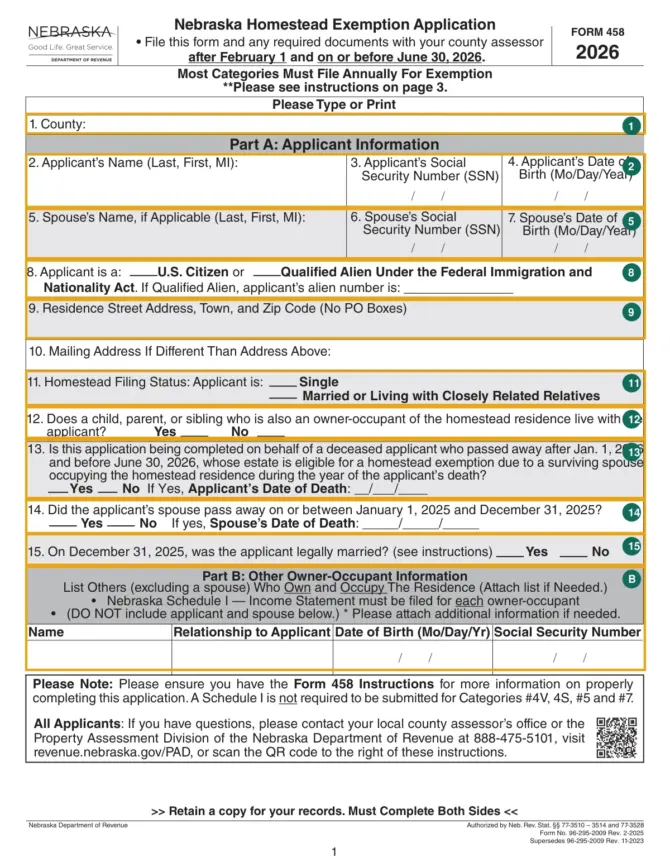
| Item | What the form asks | What to enter |
|---|---|---|
| 1 | County | The county where the homestead is located |
| 2 to 4 | Applicant’s name, SSN, date of birth | Last name, first name, middle initial; the applicant’s Social Security number and birth date |
| 5 to 7 | Spouse’s name, SSN, date of birth | Only if there is a spouse |
| 8 | Citizenship | U.S. citizen or qualified alien; a qualified alien adds the alien number |
| 9 | Residence address | Street address, town and ZIP code of the home being exempted; no PO box |
| 10 | Mailing address | Only if mail about the application should go somewhere else |
| 11 | Homestead filing status | Single, or Married or Living with Closely Related Relatives (see below) |
| 12 | Co-owner child, parent or sibling living there | Yes if a co-owner who is your child, parent or sibling lives with you; a remainder interest after a life estate does not make someone a co-owner |
| 13 | Deceased applicant | Yes only if the applicant died after January 1, 2026 and on or before June 30, 2026 before filing, with the date of death |
| 14 | Spouse died in 2025 | Yes and the date if the spouse died between January 1 and December 31, 2025 |
| 15 | Legally married on December 31, 2025 | No if unmarried or legally separated under a divorce or separate maintenance decree on that date |
| Part B | Other owner-occupants | Name, relationship, birth date and SSN of each co-owner (not a spouse) who lives in the home; blank if there is none |
Item 11 decides which column of the income table applies. The Information Guide ties it to the 2025 federal return: Single for a single or head of household filer, Married for a joint or separate married filer (or a widow or widower filing a joint return for the year of the spouse’s death), and Closely Related for a single filer who lives with a brother, sister or parent who also owns and occupies the home. One point in the 2026 instructions does not match the form. The item 11 instruction says the status is Married or Living with Closely Related Relatives when the applicant answered yes to question 13, 14, 15 or 16 in Part A, yet Part A on the 2026 form (Rev. 2-2025 on page 1) ends at question 15. The instructions do not say which question 16 means. If your answer to item 11 depends on it, ask your county assessor or the Property Assessment Division at 888-475-5101 before filing.
Part B is skipped by categories 4V, 4S, 5 and 7. For everyone else, each person listed there files a separate Schedule I, and that income is counted in the applicant’s household income.
Part C, Part D and the signature on page 2
Part C is the category list in the table above: check one box. Category 2 also asks for the veteran’s service begin and end dates.
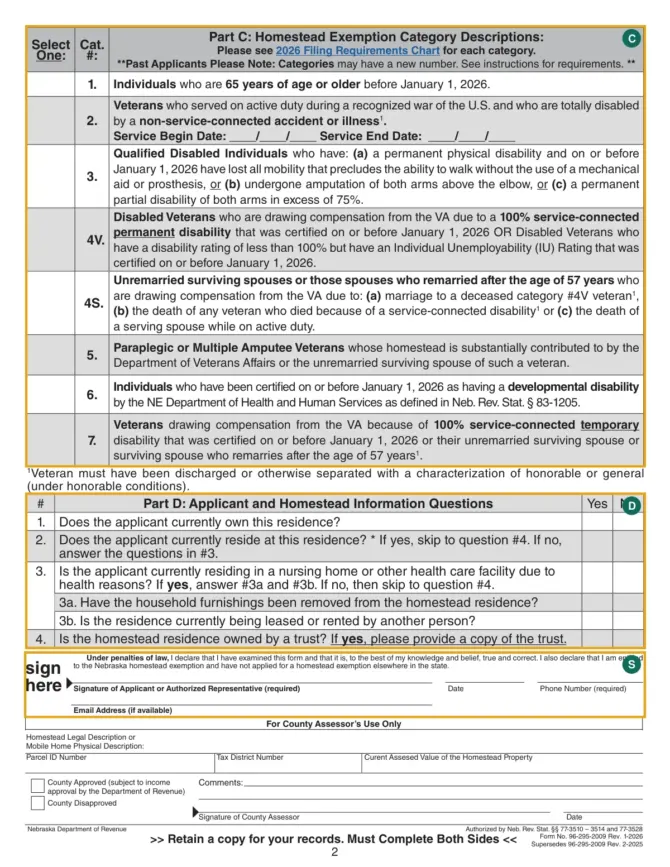
Part D has four yes or no questions about the home. Question 1 asks whether the applicant owns it now, as sole owner, joint tenant with right of survivorship, tenant in common or life estate holder. If the answer to question 2 (living there now) is yes, skip to question 4. If not, question 3 asks about a nursing home or other health care facility, and 3a and 3b ask whether the furnishings were removed and whether someone else is leasing or renting the home. Question 4 asks whether a trust owns the home, for example a title reading “John Doe Revocable Trust”; a yes needs a copy of the trust or the parts that show the occupancy rights required by Neb. Rev. Stat. § 77-3503.
The applicant or an authorized representative signs under penalties of law, declaring that no homestead exemption was applied for elsewhere in Nebraska. The phone number is required and an email address is optional. The block at the bottom is for the county assessor.
What goes in with Form 458
- Form 458 Schedule I, Income Statement, for categories 1, 2, 3 and 6: one for the applicant (covering the spouse if married) and one for each other owner-occupant.
- Form 458B, Certification of Disability for Homestead Exemption, for categories 2 (or a VA certification instead), 3 and 6. The disability must have occurred on or before January 1 of the application year.
- A VA certification for categories 4V, 4S, 5 and 7; category 5 sends one every year.
- A copy of the trust if Part D question 4 is yes.
- For a late filing, the spouse’s death certificate or Form 458L.
Filing years that differ between Department documents
The Department’s own documents do not agree on how often some of these are due. Three of them are in play: the chart on page 3 of the 2026 Form 458 (Rev. 1-2026), the Homestead Exemption Information Guide dated February 19, 2026 (Rev. 2-2026), and the 2026 Homestead Category Requirement Table linked from the homestead exemption page.
| Category and item | Form 458 chart, page 3 | Information Guide | 2026 Category Requirement Table |
|---|---|---|---|
| 4V, Form 458 | First application and years ending in 0 or 5 | First application and years ending in 0 or 5 | Not annual; first application and the year after a late application |
| 4S, Form 458 | Every year | Every year | Not annual; first application and the year after a late application |
| 4V and 4S, VA certification | First application and years ending in 0 or 5 | First application and years ending in 0 or 5 | First application or a late application |
| 7, VA certification | First application and years ending in 0 or 5 | First application and years ending in 0 or 5 | Every application year |
| 2, Form 458B or VA certification | First application and on request | First year and years ending in 0 or 5 | First application or on request |
None of the three says which one governs. If you are in one of these categories, confirm the filing years with your county assessor or the Property Assessment Division at 888-475-5101 before deciding to skip a form. On one point the Information Guide and the Category Requirement Table agree: a change in status means a new Form 458 with a new certification, and the Guide adds that a first-time category 4V applicant files that year.
Where to file Form 458 and what happens next
The completed 2026 Form 458 and its attachments go to the county assessor of the county where the home is located, not to the Department of Revenue. Assessor addresses and phone numbers are on the Department’s County Assessors and Parcel Search page. The fillable PDF has Reset and Print buttons, and both pages say to keep a copy.
The Information Guide lays out the rest of the year. Prior-year applicants receive a preprinted application from the county assessor in February. Assessors forward approved applications to the Department by August 1. In mid-October the Department sends letters of partial approval or denial based on income, and in October and November the county assessor may send Form 458R, Notice of Reduction/Rejection, when the home’s value is over the county maximum. The exempt amount drops by 10% for each $2,500 the home’s value is above the maximum, and a home $20,000 or more over the maximum gets no exemption. The December property tax statement shows the exemption amount.
A rejection by the county assessor can be appealed to the county board of equalization within 30 days of receiving the notice. A denial from the Tax Commissioner can be challenged within 30 days with a Petition for Redetermination, Form 458P, filed with the Department. A homestead appeal cannot be used to protest the home’s valuation; that protest is due on or before June 30.
Reasons a homestead exemption is rejected or lost
- Filing after June 30 without one of the three late-filing routes: the instructions call this a waiver of the exemption.
- Leaving out Schedule I in a category that needs it, which the instructions also treat as a waiver.
- Not owning and occupying the home from January 1 through August 15. A single applicant who dies before August 16 loses the exemption for that year for the same reason.
- No Form 458B or VA certification in a year when the category requires one: the Information Guide says the applicant does not qualify that year.
- Form 458L without the practitioner’s dates and signature, or without the applicant’s signature, which the form says leads to denial.
- Title held only by a corporation, partnership or LLC.
Questions about the Nebraska homestead application
I bought a new home in Nebraska after filing. Does the exemption move with me?
It can, with Form 458T, Application for Transfer. The new home must be acquired on or after January 1, 2026 and before August 15, 2026, and you must own and occupy it by August 15. File Form 458T with the assessor of the county where the new home is located by August 15, 2026, or within 30 days of receiving a Form 458R for the original application.
Can I still file a 2026 homestead application now?
The June 30 deadline and the July 20 county board extension have passed. A 2026 application can still be filed by June 30, 2027 only by a surviving spouse whose spouse died in 2026, with the death certificate, or by an applicant with a medical condition certified on Form 458L.
What if I find a mistake in the income I reported?
The Department must be notified within three years after December 31 of the application year to have the exemption reconsidered. If the item is on your income tax return, that return must be amended too.
Two unmarried co-owners live in the house. Who files?
The Information Guide says both should file Form 458, and Schedule I if their category needs it, by June 30, so the exemption is protected if one of them dies before August 16. Only one exemption is granted per homestead; if several applications come in, the one with the highest approved exemption is used.
Official sources
- Nebraska Department of Revenue, 2026 Form 458, Nebraska Homestead Exemption Application and Instructions, Form No. 96-295-2009 Rev. 1-2026
- Nebraska Department of Revenue, 2026 Form 458 Schedule I, Income Statement, Form No. 96-296-2009 Rev. 1-2026
- Nebraska Department of Revenue, Property Assessment Division, Nebraska Homestead Exemption
- Nebraska Department of Revenue, Nebraska Homestead Exemption Information Guide, February 19, 2026 (96-299-2009 Rev. 2-2026)
- Nebraska Department of Revenue, 2026 Homestead Category Requirement Table
- Nebraska Department of Revenue, Form 458B, Certification of Disability for Homestead Exemption (96-294-2009 Rev. 8-2026)
- Nebraska Department of Revenue, 2026 Form 458T, Application for Transfer of Nebraska Homestead Exemption
- Nebraska Department of Revenue, Form 458L, Physician’s Certification for Late Homestead Exemption Filing (96-287-2009 Rev. 8-2026)
- Nebraska Department of Revenue, Property Assessment Division, County Assessors and Parcel Search