A new Nebraska business can use Form 20 to apply for the tax permits, licenses and registrations its activities require. The June 2026 application also handles a change of owners, a change of business entity or an additional tax program. Complete both sides; the last two PDF pages explain which programs need registration.
Who needs Form 20 and when to apply
File when applying for a required Nebraska tax registration or when the owners of an existing business change. A change in the federal employer identification number also requires a new Form 20 and a new Nebraska ID number. When a business is being bought or sold, the instructions separately call for Form 36, the tax-clearance or current-liabilities application.
Routine changes after applying belong on Nebraska Form 22, including addresses, filing frequency and changes in officers, members or partners. If an EIN was unavailable when you applied, supply it later on Form 22: put the EIN in box 2 and write “Not available at time of application” in box 11. Generally, obtain the EIN before applying.
Completing lines 1 to 12
Enter the business’s physical location separately from its mailing address. The physical street address must not be a PO Box. Include the legal business name, any doing-business-as name and business email.
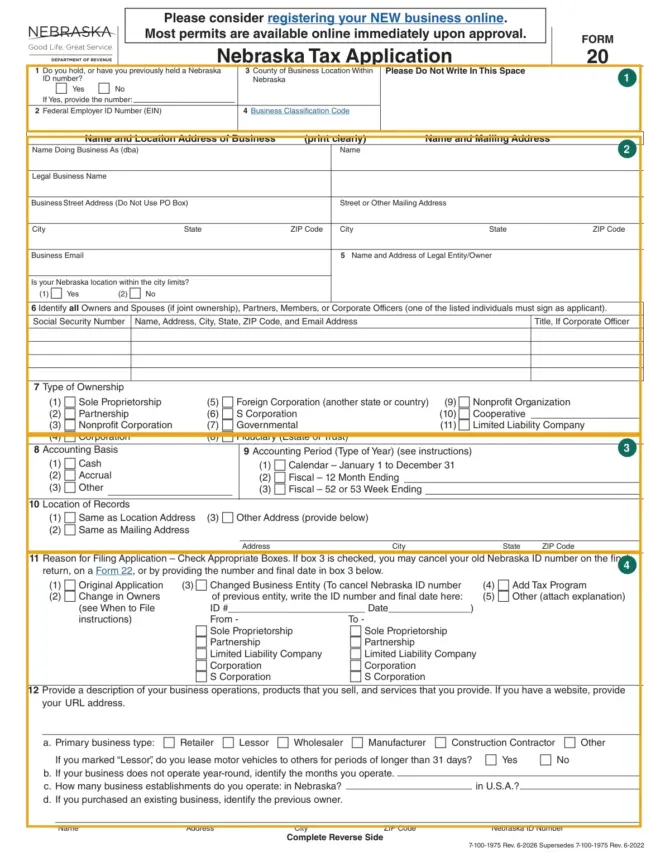
| Line | Information to supply | What to check |
|---|---|---|
| 1–4 | Any current or previous Nebraska ID; federal EIN; Nebraska county; business classification code | Answer the prior-ID question even if this application concerns a new program; indicate whether the location is inside city limits |
| 5 | Legal entity or owner’s name and full address | Keep this separate from the business location and mailing address |
| 6 | All owners and jointly owning spouses, partners, members or corporate officers | Provide each individual’s SSN, name, address and email, plus officer title when applicable |
| 7 | Ownership type | Select the printed type, including sole proprietor, partnership, corporation, S corporation, nonprofit, governmental, fiduciary, cooperative or LLC |
| 8–9 | Cash, accrual or other accounting basis; calendar, fiscal or 52/53-week year | Give the ending month or week where the selected fiscal-year entry requires it |
| 10 | Where records are kept | Select location, mailing address or give a different full address |
| 11 | Original application, ownership change, entity change, added program or other reason | For an entity change, identify the old and new types; supply old ID and final date to cancel it, or cancel on the final return or Form 22 |
| 12 | Operations, products, services and website; business type | Give seasonal operating months, Nebraska and US establishment counts and the previous owner if purchased |
Line 6’s personal identification is mandatory under the statutes cited in the instructions. One of the listed individuals must sign as applicant. For a lessor, line 12 also asks whether motor vehicles are leased for longer than 31 days. Direct-selling companies requesting a Distributor’s Agreement should request it in line 12. Construction contractors must register with the Department of Labor’s contractor database; their building-materials election determines whether they need a sales or use tax permit.
Line 13: sales tax or use tax
For a sales tax permit, enter the first-sale date and estimate annual sales and use tax liability. The printed filing choices are monthly at $3,000 or more, quarterly from $900 to $2,999 and annual below $900. A sales permit is required for each retail location making taxable sales. The guide also describes remote sellers and marketplace platforms as engaged in Nebraska business when Nebraska gross sales exceed $100,000 or transactions reach 200; include marketplace sales when applying its stated threshold.
For multiple licensed locations, choose separate returns or request combined filing with Form 11. The instructions allow a retailer with at least 80% ownership in multiple locations to apply; combined sales and use tax filers must e-file monthly through NebFile. If a paid preparer will file the sales or use tax return, attach Form 33, Power of Attorney.
Do not select the separate use-tax permit if applying for a sales permit: use tax is reported on the sales and use tax return. If a sales permit is unnecessary but a use-tax permit is needed, enter the first-purchase date and select the same annual-liability filing bands shown in the use-tax section.
Line 14: withholding and income tax programs
For withholding, give the first-wage date. Answer separately whether average monthly Nebraska withholding will exceed $500, whether annual withholding will be less than $500 and whether federal annual withholding returns have been allowed. If either question in subsection b is yes, select the quarterly or annual preference offered on the form.
Choose separate-location, consolidated or regional/district withholding returns. Say whether a payroll service will prepare them; if yes, attach Form 33. List other business operations employing Nebraska residents with their Nebraska IDs, names and location addresses, using another sheet when needed.
The instructions require registration before Nebraska withholding starts for covered employers and payments. They include employees working in Nebraska, certain nonemployee payments for Nebraska services, federally subject gambling and other payments, certain unregistered contractors, and pension or annuity payments subject to federal withholding.
Check each income-tax registration needed and give its beginning date: corporate, partnership, fiduciary or financial-institution tax. LLC filing status follows federal status; the form directs an LLC to select corporate or partnership. A corporate applicant must answer the S-corporation question. A financial institution identifies bank, savings and loan, credit union or other type.
The attached guide distinguishes Form 1120N corporations from Form 1120-SN S corporations and Form 1065N partnerships, including federally classified LLCs with Nebraska-source income. Resident estates and trusts use Form 1041N when a federal return is required, with the guide’s exception for a simple trust whose beneficiaries and income are Nebraska-based and which has no federal taxable income. Qualifying financial institutions with a permanent Nebraska business place and active deposit solicitation use Form 1120NF rather than the corporation return.
Line 15: the remaining permits and licenses
Enter the first-transaction date for each selected program. If reporting a liability before the application date, enter the earliest date for which a return is needed.
- Tire fee: retailers of new tires for the vehicles listed in the guide need one permit regardless of locations. The frequency choices are monthly for at least 3,000 taxable tires annually, quarterly for 900–2,999 and annual below 900.
- Lodging: obtain a permit for each lodging location using its actual physical address and county. Monthly filing is shown for annual taxable sales of $10,000 or more and annual below that. The guide requires both marketplace platforms and short-term-rental hosts to be licensed as described for sales and lodging.
- Litter fee: manufacturers, wholesalers and retailers with at least $100,000 annual Nebraska gross proceeds from covered products need a license for each location. Multiple locations require combined reporting and Form 11.
- Severance and conservation: the guide covers those severing Nebraska oil or gas; when sold in Nebraska, the first purchaser pays the tax.
- Prepaid wireless surcharge: register for taxable prepaid service sales, phones, phone cards and recharges. Frequency follows sales tax, including combined filing when sales returns are combined.
- Remittance transfer excise: covered Money Transmitters Act licensees and delegates register and file Form 838 quarterly through NebFile.
- Kratom product retailer excise: retail sellers register and file Form 231 monthly through NebFile.
Form 20 does not replace the separate applications for cigarette and tobacco programs (20CT), mechanical amusement devices (54), bingo/lottery/raffle/pickle-card licensing (50), or motor fuels (20MF). The guide identifies Form 50 for covered bingo and pickle-card activities, lotteries with gross proceeds exceeding $1,000 and raffles exceeding $5,000.
Signing and sending the application
Line 16 names the authorised contact with title, email and telephone. That person may receive the Nebraska ID assigned from the application. The declaration must be signed and dated by an owner, partner, member, corporate officer or a person authorised by an attached power of attorney; enter the signer’s title, email and telephone as well.
Apply online, fax the completed paper application to 402-471-5927, or mail it to Nebraska Department of Revenue, PO Box 98903, Lincoln, NE 68509-8903. The form encourages new-business online registration and says most permits are available online immediately upon approval; it does not promise immediate approval of an application. For questions, the printed contacts are 800-742-7474 in Nebraska and Iowa and 402-471-5729 elsewhere.
This application opens tax accounts. Subsequent return filing and payments follow each program’s rules; the guide says electronic payments can be available even when a program lacks electronic returns, and certain payment thresholds make electronic payment mandatory. Confirm complex entity classification or combined-return eligibility with the Department or a tax adviser.
Official PDF: Form 20 — Official PDF (revenue.nebraska.gov)