Form 1120-SN is the Nebraska return an S corporation files for a year in which it has income from Nebraska sources. The Nebraska Department of Revenue (DOR) says in its instructions that it is not just an information return: it works out the income, deductions and credits that pass through to shareholders, pays Nebraska income tax on behalf of nonresident individual shareholders, reports pass-through entity tax (PTET) and reports recapture of incentive credits. This guide follows the 2025 form (number 8-287-2025) and the 2025 S Corporation Income Tax Booklet (8-301-2025), which DOR posted in January 2026. The 2025 form covers calendar year 2025 and any fiscal year that begins in 2025.
Who has to file Form 1120-SN
Every S corporation, as defined in Internal Revenue Code § 1361, that has income from Nebraska sources must file. An S corporation that will distribute Nebraska incentive credits to its shareholders files as well. A financial institution organized as an S corporation that keeps a permanent place of business in Nebraska and actively solicits deposits from Nebraska residents files two returns: Form 1120NF and Form 1120-SN.
A qualified subchapter S subsidiary (QSSS) is handled the way it is federally. Its assets, liabilities, income, deductions and credits are treated as the parent’s, and for Nebraska purposes, nexus included, the parent and all of its QSSSs are one entity.
The Nebraska tax year has to be the same as the federal one. A corporation that changes its federal tax year changes its Nebraska year too and attaches the IRS approval to the first return showing the change. Accounting methods follow the same rule: the federal method applies, and a change needs IRS approval, with a copy attached to the first return that uses the new method. Resident and nonresident shareholders alike owe Nebraska income tax on their share of the corporation’s Nebraska-source income.
Due date and extension with Form 7004N
Form 1120-SN is due on or before the 15th day of the third month after the tax year closes. A fiscal-year corporation counts from its own year end. An extension moves only the filing date; tax not paid by the original due date carries interest. The booklet cites a statutory rate of 8% running from the original due date to the date of payment and refers to DOR’s interest rate revenue ruling for the rates that apply.
The instructions accept three ways of getting more time:
- Attach to the Nebraska return a copy of a timely federal Form 7004. A timely federal request gives an automatic Nebraska extension for the same number of months the IRS grants.
- Instead of the copy, attach a schedule giving the federal confirmation number and explaining that the electronic federal extension request was not denied.
- File Nebraska Form 7004N by the original due date when the corporation is making a tentative Nebraska payment or is not asking for a federal extension at all.
If the federal extension is not long enough, Form 7004N goes in on or before the date the federal extension runs out, with proof of the federal extension attached. No combination can take the Nebraska deadline past seven months after the original due date. A tentative payment made by check or money order is mailed with Form 7004N; when the tentative payment is made electronically, Form 7004N is attached to Form 1120-SN when the return is filed.
Nonresident shareholders: Form 12N, withholding or PTET
DOR does not allow composite returns. An S corporation with nonresident shareholders has to take one of three routes:
- get a signed and completed Form 12N from the nonresident individual shareholder;
- remit Nebraska income tax withholding on that shareholder’s share of Nebraska income with Form 1120-SN; or
- make the PTET election and pay the PTET due.
Form 12N is the Nebraska Nonresident Income Tax Agreement. By signing it the shareholder agrees to file a Nebraska Form 1040N and pay any tax due, and the corporation no longer has to withhold for that person. The 12N has to include all requested information, be signed and dated by the shareholder or an authorized representative (with a copy of the Form 33 power of attorney), and reach the corporation before Form 1120-SN is originally filed. A new one is completed every year. The booklet says all signed 12Ns are attached to Form 1120-SN; the 12N itself says that when the return is e-filed the agreement is kept in the corporation’s records. A nonresident grantor of a grantor trust counts as an individual. Form 12N is not used for a year in which the S corporation elected PTET.
For each nonresident individual without a 12N, the corporation pays 5.20% of that shareholder’s share of Nebraska-source taxable income. Nothing is withheld for shareholders that are corporations, estates or trusts (grantor trusts excepted); those owners file their own Nebraska returns. The amount paid for each shareholder is shown on that shareholder’s Nebraska Schedule K-1N, and the shareholder claims it as a credit by attaching the K-1N to Form 1040N.
A nonresident whose only connection with Nebraska is the corporation’s business does not have to file Form 1040N when the corporation withheld on all of that person’s Nebraska income, or paid PTET whose credit fully covers the person’s Nebraska tax. The nonresident may still file to claim a refund. A shareholder who signed a 12N and then does not file Form 1040N can receive an assessment based on what DOR knows, and loses any current-year Nebraska net operating or capital loss passed through from the corporation until the return for the loss year is filed.
How to fill out page 1 of Form 1120-SN
Page 1 carries the identification block, eight check boxes and lines 1 to 21. The numbers in the image were added for this guide and match the first column of the table. Amounts are whole dollars: round 50 cents or more up, anything less down, and leave the preprinted zeros in the cents column as they are.
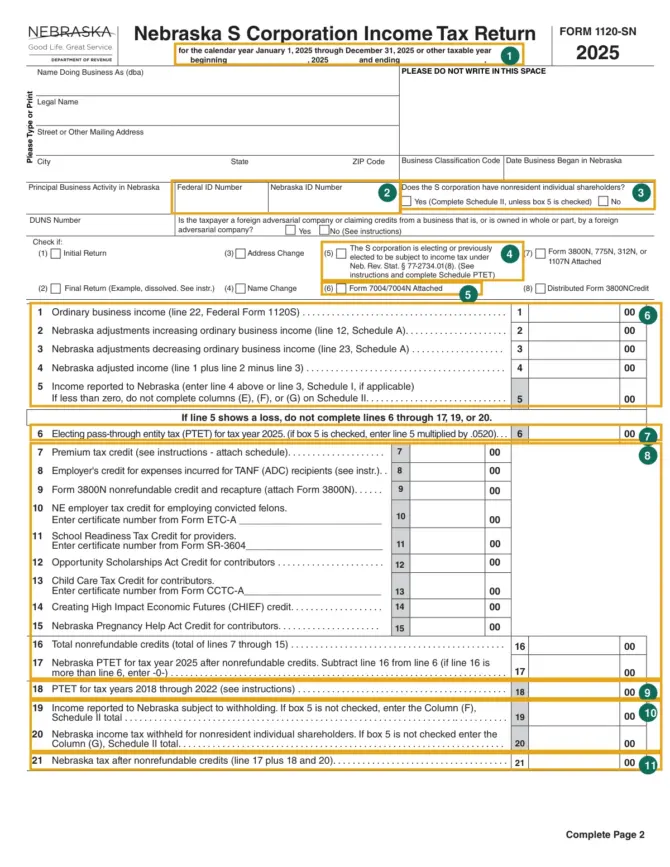
| Marker | Part of the form | What goes there |
|---|---|---|
| 1 | Tax year beginning and ending | Dates for a fiscal-year or short-period return. Calendar-year filers leave it blank. |
| 2 | Federal ID Number, Nebraska ID Number | The EIN from the IRS and the ID DOR assigned. A corporation without an S corporation income tax ID e-files with its Nebraska withholding or sales and use tax number, minus the 21 or 01 prefix. One with no Nebraska ID registers through DOR’s online Register a Business application. |
| 3 | Nonresident individual shareholders, Yes or No | “Yes” means Schedule II has to be completed, unless box 5 is checked. |
| 4 | Box 5, PTET election | Checked when the corporation is electing, or previously elected, to be taxed under Neb. Rev. Stat. § 77-2734.01(8) for 2025. Schedule PTET is then completed. |
| 5 | Box 6, Form 7004/7004N Attached | Checked whenever a federal Form 7004 or a Nebraska Form 7004N is attached. |
| 6 | Lines 1 to 5 | Line 1 is ordinary business income or loss from line 22 of federal Form 1120-S. Lines 2 and 3 come from Schedule A, lines 12 and 23. Line 4 is line 1 plus line 2 minus line 3. Line 5 repeats line 4 when all income is from Nebraska, or takes Schedule I line 3 for a multistate business. |
| 7 | Line 6 | Only with box 5 checked: line 5 multiplied by .0520. |
| 8 | Lines 7 to 17 | Nonrefundable credits, each with the certificate number or attachment the line asks for. Their total on line 16 is subtracted from line 6; line 17 cannot go below zero. |
| 9 | Line 18 | PTET for tax years 2018 through 2022 that the corporation will distribute to shareholders for 2025, if it elected for any of those years. |
| 10 | Lines 19 and 20 | With box 5 unchecked: the totals of Schedule II columns (F) and (G), the nonresident income subject to withholding and the tax withheld on it. |
| 11 | Line 21 | Line 17 plus lines 18 and 20. |
When line 5 is a loss, lines 6 through 17, 19 and 20 stay empty. The business classification code is the six-digit code that best describes the corporation’s main business activity in Nebraska, and the Principal Business Activity box takes the matching description from the same listing. The other boxes along the top are initial return, final return (for a corporation that ceased to exist during 2025), address change, name change, box 7 for an attached Form 3800N, 775N, 312N or 1107N, and box 8 when the corporation is distributing Form 3800N credits, which also needs a distribution schedule and the amounts on each Schedule K-1N.
Several of lines 7 to 15 need paperwork. Line 7, the premium tax credit, needs a copy of the Nebraska Department of Insurance annual tax return behind every payment claimed plus a schedule of payment dates, amounts and payee. Line 9 takes the nonrefundable total from Form 3800N, attached. Lines 10, 11 and 13 carry certificate numbers from Forms ETC-A, SR-3604 and CCTC-A. Line 14, the CHIEF credit, needs Form 1879NTC attached. Line 15, the Pregnancy Help Act credit, is limited to the lesser of the DOR-verified contributions or 50% of line 6.
Page 2: refundable credits, payment and refund lines
Lines 22 to 27 are refundable credits and payments already made:
- Line 22: the net of Form 3800N refundable credits and recapture, entered as a negative number when recapture is larger.
- Line 23: 2025 estimated payments plus anything paid with Form 7004N.
- Line 24: Beginning Farmer credit from Form 1099BFC that is not passed to shareholders. The 1099BFC is not attached; DOR gets it from the Nebraska Department of Agriculture.
- Line 25: for an electing corporation only, Nebraska tax withheld as shown on Form 1099-MISC or 1099-NEC. Construction contractors withhold 5% of payments over $600 to subcontractors not registered with the Nebraska Department of Labor. A corporation that did not elect PTET passes that withholding through to shareholders on Schedule K-1N instead.
- Line 26: the community college property tax credit from line 1 of Form PTC, attached.
- Line 27: PTET credit received from an electing partnership and kept by the corporation, with lines 27a to 27e completed and the partnership’s Schedules K-1N attached. Credit that will be passed on to shareholders stays off line 27 and goes to Schedule PTET line 3 and the shareholders’ K-1Ns.
Line 28 totals lines 22 to 27. Line 29 shows tax due when line 21 is larger, with a box to check if the payment is electronic. Line 30 is the underpayment of estimated tax penalty from line 20 of Form 2220N. The booklet requires Form 2220N when tax after allowable credits is $400 or more (the line 30 text says greater than $400). An S corporation that elected PTET has to make estimated payments when its tax is expected to exceed credits by $400 or more; that requirement applies to tax years beginning on and after January 1, 2024.
Line 32 shows an overpayment, line 33 moves part of it to 2026 estimated tax and line 34 is the refund. For direct deposit, lines 35a and 35c take the nine-digit routing number and an account number of up to 17 characters, and line 35b the account type. Checking line 35d for a bank outside the United States means the refund is mailed, because international ACH transactions cannot be direct deposited.
A corporate officer signs and adds a daytime phone and email address; writing “Opt Out” on the email line stops DOR from using email. Anyone else signing for the officer needs a Form 33 on file with DOR or attached. A paid preparer signs and enters a PTIN, firm name and EIN. On an e-filed return the act of filing is the signature.
Schedule A: adjusting ordinary business income
Schedule A adds back and subtracts the items federal law reports to shareholders separately, so the total approximates the income that ends up in the shareholders’ federal adjusted gross income. It feeds the PTET on line 6 and the withholding on Schedule II. Lines 1 to 8 (rental income, interest, dividends, royalties, capital gains, section 1231 gain) and lines 14 to 21 (rental losses, capital losses, section 1231 loss, other loss, charitable contributions, section 179) are copied from Schedule K of federal Form 1120-S.
Line 9 adds interest and dividends from state and local bonds that are federally exempt and were not issued by Nebraska or its subdivisions. Line 11 adds Nebraska and local income, sales and use taxes deducted under IRC section 164, including any Nebraska PTET deducted on the 2025 federal return. Line 13 subtracts interest and dividends from U.S. government obligations exempt from state tax; repurchase agreement interest does not qualify, and gains on selling federal securities stay taxable. Lines 10 and 22 take any other items, listed by type. A food donation deducted federally and used for Nebraska’s Food Bank, Food Pantry, Food Rescue Donation credit is added back on line 10.
The instructions rule out certain decreases on Form 1120-SN line 3: wage expense disallowed by the work opportunity credit, federal income or other federal taxes, depreciation disallowed by the investment credit or other basis reductions, income earned in another state (that goes through Schedule I) and partnership income.
Schedule I: apportioning income from more than one state
A corporation with income both inside and outside Nebraska completes Schedule I. Nebraska uses a single sales factor: Nebraska sales over sales everywhere. Lines 4 to 15 are filled in first, in a Total column and a Nebraska column, and lines 1 to 3 after that. Line 15 divides the Nebraska line 14 by the Total line 14, rounds to six decimal places and is entered as a percent. With $312,480 of Nebraska receipts out of $1,250,000, the factor is 0.249984, entered as 24.9984%. Line 3 then multiplies line 4 of Form 1120-SN by that percent and carries the result to line 5.
Sales delivered in Nebraska count as Nebraska sales whatever the F.O.B. point. Other sales follow the sourcing rules of Neb. Rev. Stat. § 77-2734.14 that the booklet lists: for example, a service relating to property located in Nebraska, or, for a sale no specific rule covers, a sale to an individual whose billing address is in Nebraska. Discharge of indebtedness income, hedging receipts involving intangible assets and net gains from marketable securities held for investment are left out of total sales, and a net loss on selling intangible property is not included. For tax years beginning on or after January 1, 2014, only a communications company may source sales other than tangible personal property by costs of performance.
Line 13 holds other income such as net farm income and ordinary income from partnerships. If the corporation would be unitary with the partnership were the partnership a corporation, its distributed share of the partnership’s gross receipts goes in; otherwise its distributed share of the partnership’s income. Regulation 24-315 has the details. An S corporation in a unitary group with a C corporation uses the group’s apportionment factor, and the two still file separate returns. Trucking companies follow Regulation 24-343. An alternative apportionment method needs the Tax Commissioner’s prior written approval attached, together with the alternative computation. If the way the corporation counts receipts has changed from prior years, or differs from its returns in other states, the 2025 return has to disclose the nature and extent of the difference.
Schedules II and III, and the Schedule K-1N for each shareholder
Schedule II is skipped when box 5 is checked. Otherwise columns (A) to (C) are completed for every shareholder, column (D) for individuals only, and columns (E) to (G) for nonresident individuals:
- (A) the shareholder’s own name and address, not the corporation’s. For a grantor trust, the grantor; for a single-member LLC treated as disregarded, the LLC’s owner.
- (B) the SSN of an individual or grantor, or the federal ID of any other shareholder.
- (C) the pro rata ownership percentage for the tax year.
- (D) “Y” for a Nebraska resident, “N” for a nonresident.
- (E) a check when a properly signed Form 12N is attached; (F) and (G) are then skipped for that shareholder.
- (F) line 5 of Form 1120-SN multiplied by the column (C) percent; the total goes to line 19.
- (G) column (F) multiplied by .0520, never negative; the total goes to line 20.
Columns (E) to (G) are left blank when line 5 is a loss, or when the box at the top of Schedule II is checked because the corporation received only portfolio income.
Schedule III is required when the S corporation is a member of a unitary group. It lists the parent, every QSSS and all C corporations in the group with their federal and Nebraska ID numbers and Nebraska sales, and its total has to match line 14, Nebraska column, of Schedule I.
Every shareholder receives a Nebraska Schedule K-1N, and a copy of every K-1N goes in with Form 1120-SN. K-1N amounts are calculated the same way income is distributed. A corporation passing out incentive credits also completes the distribution schedules for Forms 775N, 312N, 1107N, 544N or the 3800N Worksheet HBTC, listing each shareholder, the tax ID, the income percentage and the distributed credit, in the same proportion as ordinary income.
How the PTET election works on Form 1120-SN
The election for 2025 is shown by checking box 5, and it has to be made on or before the due date of the return including any approved extension. Once box 5 is checked, line 6 applies 5.20% to line 5, lines 7 to 15 can reduce that amount, Schedule II is not completed and no Form 12N is collected. The CDAA credit cannot be used against PTET. Any Nebraska PTET deducted on the 2025 federal Form 1120-S is added back on Schedule A line 11.
Schedule PTET is completed when the corporation elected for 2025, elected for any of the 2018 to 2022 years, or is passing on a PTET credit it received from a partnership. Line 1 is the 2025 PTET from Form 1120-SN line 6, line 2 the 2018 to 2022 PTET from line 18, line 3 the received credit being redistributed from line 27e, and line 4 the total. Columns (D) to (I) give each shareholder’s share for 2018, 2019, 2020, 2021, 2022 and 2025: the PTET deducted for that year multiplied by the shareholder’s 2025 ownership percent. Column (J) adds them, and the column (J) total must equal line 4. The amounts carry to each shareholder’s Schedule K-1N. For the 2018 to 2022 years, shareholders get no credit until the corporation has paid the amount on line 18.
What the instructions say leads to delays, denials or penalties
- Attaching a Form 7004 or 7004N without checking box 6. The 7004N instructions warn of processing delays and an incorrect balance due notice.
- Leaving out the extension document. The booklet says this may bring a late filing penalty.
- Skipping the foreign adversarial company question. Not answering it results in denial or delay of the credits claimed.
- Paying by check when DOR has notified the corporation that it must pay electronically. DOR’s EFT guidance sets a $100 penalty.
- Not reporting IRS or other-state changes. They must reach DOR on an amended return within 60 days, and failing to amend for federal changes is listed among the grounds for penalties and interest.
Attachments to gather before filing
- A copy of the federal Form 1120-S and supporting schedules as filed with the IRS (the form asks paper filers for it)
- Schedule A, plus Schedules I, II, III and PTET where they apply
- A Nebraska Schedule K-1N for every shareholder
- Signed Forms 12N, or for an e-filed return, the signed 12Ns kept on file
- The federal Form 7004 copy, the confirmation number schedule or Form 7004N
- Form 3800N and credit distribution schedules; Form PTC for line 26; Form 1879NTC for line 14; Department of Insurance returns for line 7
- Form 33 when someone other than a corporate officer signs
- IRS approval of any change in tax year or accounting method
Getting the 2025 form, filing it and paying
DOR’s Corporation and S Corporation Income Tax Forms page lists the complete booklet (dated 01/2026), Form 1120-SN with Schedule A, Schedules I, II and III, Schedule PTET, Schedule K-1N, the amended Form 1120-XSN and Form 12N. A year selector on the same page reaches earlier years back to 2010.
The form encourages all filers to e-file, K-1Ns included, and the booklet refers to Publication 1345N-MeF, DOR’s handbook for e-file providers. Neither the form nor the booklet makes e-filing of Form 1120-SN mandatory, and DOR’s mandate page names e-file requirements only for sales tax returns, wage and tax statements and individual returns prepared by paid preparers. A paper return goes with its payment to:
Nebraska Department of Revenue
PO Box 94818
Lincoln, NE 68509-4818
Payment can be made by electronic funds withdrawal inside an e-filed return, Nebraska e-pay, ACH credit, Nebraska Tele-pay at 800-232-0057, or credit card through ACI Payments at acipayonline.com or 800-272-9829 (Nebraska jurisdiction code 3700, with a convenience fee that goes to the vendor). A check or money order is made payable to “Nebraska Department of Revenue”. DOR’s mandate page says electronic payment is required for corporate income tax when the taxpayer’s payments in a prior year exceeded the threshold, $5,000 as of July 2017, and the EFT FAQ says mandated taxpayers are notified in writing. A scheduled withdrawal can be canceled by calling 800-742-7474 or 402-471-5729 before 4:00 p.m. Central Time two business days before the payment date.
Corrections go on Form 1120-XSN, which cannot be e-filed and needs the related federal or other-state amended return attached. If an amendment lowers the Nebraska income of nonresident shareholders, the corporation gets no refund; each shareholder files a claim for refund individually. DOR Taxpayer Assistance answers at 800-742-7474 (Nebraska and Iowa) or 402-471-5729.
Questions about Form 1120-SN
Does an S corporation whose shareholders all live in Nebraska still file?
The filing test is Nebraska-source income, not where the shareholders live. Without the PTET election, Schedule II is still completed through column (C) for every shareholder, with column (D) for individuals, and each shareholder receives a Schedule K-1N.
Which form is used for a fiscal year that started in mid-2025?
The 2025 Form 1120-SN, with the beginning and ending dates entered at the top. It is due by the 15th day of the third month after that fiscal year ends.
Official sources
- Nebraska Department of Revenue, 2025 Form 1120-SN, Nebraska S Corporation Income Tax Return, with Schedules A, I, II, III and PTET (8-287-2025)
- Nebraska Department of Revenue, 2025 Nebraska S Corporation Income Tax Booklet (8-301-2025, 01/2026)
- Nebraska Department of Revenue, 2025 Nebraska Schedule K-1N for Form 1120-SN (8-687-2025)
- Nebraska Department of Revenue, Form 12N, Nebraska Nonresident Income Tax Agreement (8-065-2023)
- Nebraska Department of Revenue, Corporation and S Corporation Income Tax Forms
- Nebraska Department of Revenue, Electronic Payment and E-File Mandates
- Nebraska Department of Revenue, Electronic Funds Transfer (EFT) FAQs