A beneficiary’s Nebraska K-1N can differ from the federal K-1, particularly when the beneficiary lives outside Nebraska. The estate or trust must identify the beneficiary’s status before entering Nebraska-source income, state modifications and distributed credits.

Who prepares the 2025 fiduciary K-1N?
The estate or trust issues a Nebraska Schedule K-1N to each beneficiary for whom it must issue a federal Schedule K-1. A copy of every Nebraska schedule accompanies Form 1041N, and the beneficiary uses their copy to prepare their own Nebraska return.
This guide covers the 2025 Form 1041N Schedule K-1N, document 8-693-2025, with its attached instructions. It is the fiduciary version. Nebraska also has K-1N schedules for other entity types, so check that the form heading says Form 1041N.
Identification and taxable-year fields
Enter both parties’ names, mailing addresses and identifying information in the separate estate/trust and beneficiary blocks. Mark the beneficiary as a resident individual, nonresident individual, estate or trust, or another described type.
The instructions allow the estate’s Nebraska ID field to remain blank if the department has not assigned an ID; the department assigns one when it receives the return. Fiscal-year and short-period filers enter beginning and ending dates. Calendar-year filers may leave those dates blank. Select Final or Amended only when applicable.
Completing Parts A and B
The marked lines distinguish ordinary income categories from Nebraska modifications. For a resident individual, the instructions take income and deductions from the federal K-1. For a nonresident, apply the Nebraska-source rules under section 77-2733, including income from Nebraska property or a business carried on in the state.
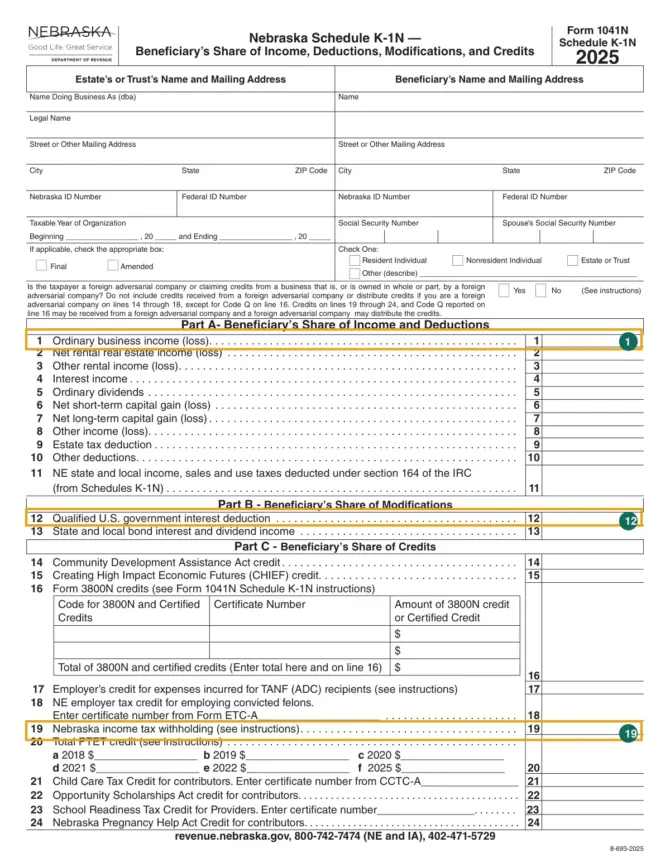
| Line | Entry | Supporting record |
|---|---|---|
| 1–10 | The beneficiary’s applicable income, losses and deductions by category | Federal K-1 and Nebraska-source calculations for nonresidents |
| 11 | The specified Nebraska and local taxes deducted under IRC section 164 | K-1Ns received from an electing partnership or S corporation |
| 12 | Qualifying interest or dividends from exempt U.S. government obligations | The investment income details and Nebraska’s obligation guidance |
| 13 | Federally exempt state and local bond income not issued by Nebraska subdivisions | Issuer and income records |
| 19 | Withholding remitted for the beneficiary | Form 1041N Schedule II, column G |
| 20 | Distributed PTET credit, with the year indicated | Credit received from an electing partnership or S corporation |
Line 12 does not include gains from selling federal securities or interest from repurchase agreements involving government obligations. Those exclusions are stated in the schedule instructions; merely seeing a U.S. government security in the investment record is not enough to place all associated income on that line.
Credits and the foreign-adversarial-company question
Answer the question near the identification block. The instructions warn that leaving it unanswered can delay or deny processing of claimed credits. The restrictions distinguish lines 14 through 18 from lines 19 through 24 and preserve the stated exception for code Q on line 16.
Line 16 requires the credit code and, for the specified certified credits, a certificate number. School Readiness Tax Credit for Providers belongs on line 23. A historic-tax-credit amount on the schedule alone does not entitle the beneficiary to claim it; the instructions require the department’s certificate.
For amended schedules, line 19 uses the larger withholding amount calculated on the original or amended Schedule II column G. Do not automatically replace it with a lower amended amount. Line 20 separately records the distributed PTET credit and its year.
Give the beneficiary a copy and file with 1041N
Use the complete four-page official PDF for the 2025 schedule and its instructions. Keep the supporting credit certificates and distribution schedules with the relevant tax records. The estate sends the schedule with Form 1041N and provides the beneficiary’s copy for their return preparation.
If the estate is also handling a refund due on the deceased person’s individual return, Form 1310N addresses that separate claim. It does not replace the beneficiary income schedule.
Official PDF: Schedule K-1N (1041N) — Official PDF (revenue.nebraska.gov)