CF83 is HMRC’s application to pay voluntary National Insurance contributions for time spent outside the UK. You send it before paying anything: HMRC reads your answers, decides whether you can pay Class 2 or Class 3, and writes back with the amounts and payment dates. This guide follows the HMRC 02/26 edition, the PDF attached to the GOV.UK CF83 guidance page that HMRC last updated on 7 April 2026 with the 2026 to 2027 rates.
Who can apply on CF83 after 6 April 2026
From 6 April 2026 you cannot pay voluntary Class 2 contributions for time abroad. For the 2026 to 2027 tax year onwards only Class 3 is available, and the residence or contribution test went up from 3 years to 10. Earlier years keep the old rules, so one application can cover gaps under both sets of conditions.
| Tax years you want to pay for | Class | Condition before you left the UK |
|---|---|---|
| 2025 to 2026 and earlier | Class 2 or Class 3 | Lived in the UK for 3 years in a row, or paid contributions (or had Class 2 treated as paid) for at least 3 years in total. Class 2 also needs you to have worked in the UK immediately before leaving and to work while abroad. |
| 2026 to 2027 onwards | Class 3 only | Lived in the UK for 10 years in a row, or paid 10 years of qualifying contributions in total. |
For the 10-year test, qualifying contributions are Class 1, 2 or 3 paid or treated as paid in the UK, Class 1 or 2 paid under a Social Security Agreement while working abroad, Class 1 paid by posted workers for their first 52 weeks abroad, and Class 2 paid as a volunteer development worker. Voluntary contributions for other periods abroad and National Insurance credits do not count.
A transitional route lets some people keep the 3-year test for Class 3 in 2026 to 2027. All three conditions apply: you applied to pay Class 2 or Class 3 for 2024 to 2025 or 2025 to 2026 on or before 5 April 2026; you pay those contributions by 5 April 2027; and you apply for 2026 to 2027 Class 3 by 5 April 2027. The route ends once you return to live or work in the UK. HMRC runs a separate online Class 3 form for this group, but only for people it has written to saying their Class 2 arrangement has ended. Anyone applying for the first time or after a break uses CF83.
The two GOV.UK sources list the 2026 to 2027 routes differently. The “If you live or work abroad” section of the voluntary National Insurance guide (gov.uk/voluntary-national-insurance-contributions) gives the two routes in the table. NI38, Social Security abroad, adds a third: Class 1 contributions paid for the first 52 weeks of your employment abroad. If that third route is the one you would rely on, ask HMRC National Insurance enquiries which applies to you: 0300 200 3500 from the UK or +44 191 203 7010 from abroad, Monday to Friday, 8am to 6pm.
HMRC cannot process CF83 if you are over State Pension age or within 6 months of reaching it; that group contacts the International Pension Centre instead. NI38 also says not to apply while you are liable for Class 1 contributions, only once that liability has ended.
What Class 2 and Class 3 count towards
NI38 says Class 3 protects your State Pension and your spouse’s or surviving civil partner’s right to bereavement benefits, but it does not count towards Bereavement Support Payment, contributory Employment and Support Allowance or Maternity Allowance. Class 2, still payable for 2025 to 2026 and earlier, can help you qualify for contributory Employment and Support Allowance when you return to the UK. Neither class gives you healthcare cover abroad.
A qualifying year needs 52 weeks of voluntary contributions; paying fewer weeks for a year does not make it qualifying. For 2026 to 2027 the weekly rates are £3.65 for Class 2 and £18.40 for Class 3. If you are below State Pension age, check your State Pension forecast or ask the Future Pension Centre whether filling a gap would increase your pension before you commit to paying.
Information to gather before you apply
HMRC’s checklist for CF83 asks for your full name, date of birth and National Insurance number, your UK address and your address abroad if you have them, the date you left the UK, details of the job you had before leaving, how long you lived or plan to live abroad, your employment or self-employment abroad, and any UK government benefit you were getting. If you are applying for more than one period abroad, have these details for each period.
The online version on GOV.UK needs a phone with a working camera and one photo ID: a UK photocard driving licence, a UK passport, a non-UK passport with a biometric chip, a UK biometric residence permit or residence card, or a UK Frontier Worker permit. The PDF version is signed by hand and posted instead.
How to fill in CF83, question by question
The paper form has 35 numbered questions in seven parts and a declaration. HMRC asks for capital letters, dates as DD MM YYYY and a black ballpoint pen. Several questions send you forward, so follow the “Go to question” notes printed next to the tick boxes.
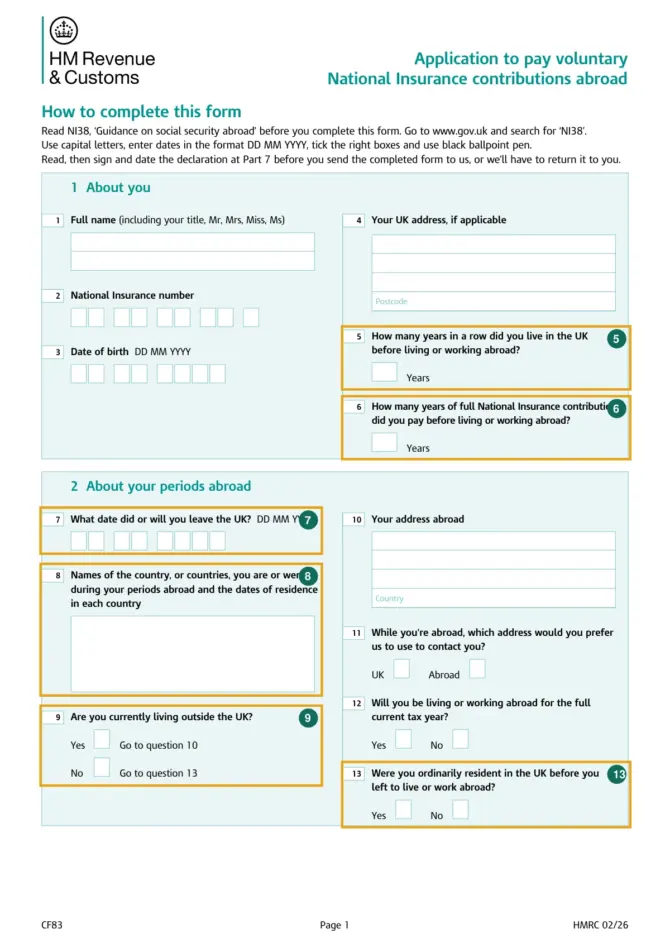
| Question | What to enter | Watch for |
|---|---|---|
| 1 to 4 | Full name with title, National Insurance number, date of birth, UK address if you have one. | The title (Mr, Mrs, Miss, Ms) is part of question 1. |
| 5 and 6 | Years in a row you lived in the UK before going abroad, and years of full National Insurance contributions paid before going. | These answers feed the 3-year or 10-year test; NI38 says HMRC checks them. |
| 7 and 8 | Date you left or will leave the UK; each country you lived in and your dates of residence there. | List every country, not only the current one. |
| 9 to 12 | Whether you live outside the UK now; if so, your address abroad, the address HMRC should write to, and whether you will be abroad for the whole current tax year. | No at question 9 skips to 13. |
| 13 | Whether you were ordinarily resident in the UK before leaving. | NI38 has a section explaining ordinary residence. |
| 14 and 15 | Future years, past gaps or both; and whether you paid voluntary Class 2 or Class 3 for 2024 to 2025 or 2025 to 2026. | Printed on page 2 after question 26. |
| 16 to 21 | Status before leaving, last UK employer and end date, end of UK self-employment, Jobseeker’s Allowance and Child Benefit with the last dates received. | Employed goes to 17, self-employed to 19, neither to 20. |
| 22 to 30 | Employer abroad with country, start and end dates, overseas government or international organisation, the same employer before leaving, contract of service, other jobs abroad, self-employment abroad with dates. | No at 22 goes to 30; no at 27 goes to 29. |
| 31 and 32 | Volunteer development workers only: salary or wage, weekly or monthly. | Include cash allowances your employer pays, not benefits in kind. |
| 33 to 35 | Payment method, an agent’s name and address, and how to pay gaps in the current tax year. | Direct Debit is not available for previous years’ gaps. |
| Part 7 | Signature, full name in capitals, daytime phone number, date. | An unsigned form is sent back. |
Questions 14 and 15 belong to Part 2 but sit at the bottom of page 2 under “About your periods abroad continued”, so they are easy to miss. Option b of question 14 is a request for information rather than a payment: HMRC writes back to confirm which gaps you are eligible to fill and at what rate. Question 15 asks about 2024 to 2025 and 2025 to 2026 because those payments decide whether the transitional route above applies to you.
Question 21 has its own condition: tick yes only if you were the person who claimed Child Benefit. In question 26, NATO, the United Nations and CERN are the form’s examples of an international organisation. Question 31 counts every cash allowance your employer pays and leaves out benefits in kind and allowances paid by anyone else.
HMRC’s guidance also covers people affected by its incorrect guidance between November 2017 and April 2019, who were refused or did not apply because of it. They can explain their situation on the application and may be able to pay at the original rates.
Paying by Direct Debit, annual payment or an agent
Do not pay anything until HMRC’s letter arrives with the amount and your payment reference. Question 33 sets the method for that letter:
- Direct Debit from a UK or Channel Islands bank or building society account. The form states that Direct Debit cannot be used for gaps in previous tax years. Class 3 is collected monthly in arrears, each payment covering 4 or 5 weeks, on or up to 3 working days after the second Friday of the month.
- Annual payment once a year in arrears, direct to HMRC. HMRC tells you each year how much and when.
- An agent, named in question 34, who pays by Direct Debit from a UK bank account or by annual payment. The agent should wait for a letter from PT Operations before paying.
Choosing Direct Debit means filling in the bank instruction at the bottom of page 4: account holder names, account number, sort code and the bank’s postal address. The service user number 991133 is already printed; put your National Insurance number under “Reference” and sign and date it. The form says not to detach this part. Question 35 then asks whether any gaps in the current tax year should be collected by Direct Debit or paid by sterling cheque.
How far back you can pay, and at which rate
Voluntary contributions can be paid for the past 6 tax years, with each year’s deadline on 5 April. Gaps in 2025 to 2026 can be filled until 5 April 2032; NI38 gives 5 April 2027 as the last date for 2020 to 2021.
Class 2 for the previous tax year and Class 3 for the previous 2 tax years are charged at those years’ original rates. Earlier years are charged at the 2026 to 2027 rate. Because Class 2 is no longer open for time abroad after 5 April 2026, a gap from 2026 to 2027 onwards can only be filled with Class 3.
Why HMRC returns a CF83 or cannot process it
- Part 7 not signed and dated: the form says HMRC will have to send it back.
- Direct Debit ticked for previous years’ gaps: question 33 rules this out, so earlier gaps need another payment method.
- Application made at or within 6 months of State Pension age: HMRC’s guidance says it cannot process it and points to the International Pension Centre.
- Application while Class 1 is still due: NI38 says to wait until the Class 1 liability ends.
- Payment sent before HMRC’s letter: the guidance says to wait for the amount and payment reference.
Getting CF83 and where to send it
The GOV.UK page “Apply to pay voluntary National Insurance contributions for periods abroad (CF83)” has the online service, the 4-page PDF, a Welsh version and a separate one-page Direct Debit instruction (CF83 DD Mandate, HMRC 02/26). The paper form goes to one of two places:
| Applicant | Send the completed form to |
|---|---|
| Everyone except volunteer development workers | PT Operations North East England, HM Revenue and Customs, BX9 1AN, United Kingdom |
| Volunteer development workers | Your recruiting organisation, which acts as your agent for paying the contributions |
If the application is approved, HMRC writes to confirm the payment dates and amounts, or asks for more information. Questions about your record or a pending application go to HMRC National Insurance enquiries on the numbers given above.
Official PDF: CF83 — Official PDF (assets.publishing.service.gov.uk)
Sources
- CF83, Application to pay voluntary National Insurance contributions abroad (HMRC 02/26)
- CF83 DD Mandate, Instruction to your bank or building society to pay by Direct Debit (HMRC 02/26)
- Apply to pay voluntary National Insurance contributions for periods abroad (CF83), GOV.UK
- Voluntary National Insurance: if you live or work abroad, GOV.UK
- Voluntary National Insurance: rates, GOV.UK
- Voluntary National Insurance: how and when to pay, GOV.UK
- NI38, Social Security abroad, GOV.UK
- Apply to pay voluntary Class 3 National Insurance contributions for periods abroad, GOV.UK
- National Insurance: enquiries, GOV.UK