A director’s loan account can leave a close company with tax to report even though the balance is an amount owed to the company. CT600A records loans to participators, certain arrangements conferring benefits, and relief for qualifying repayments. The amount outstanding at the accounting period end and the amount on which tax remains payable are separate figures on this form.
Who needs to complete CT600A?
HMRC’s CT600A completion notes cover a close company with loans to participators or their associates not repaid within the period, tax due under section 455 of the Corporation Tax Act 2010, or relevant benefit arrangements under section 464A. The loan rules also reach the partnerships and trusts described in the notes.
A close company is controlled by five or fewer participators, or by any number of participators who are directors. A participator has a share or interest in the company’s capital or income and can include a loan creditor. An associate includes a relative or partner and specified trustees. A director who is also a shareholder and has an overdrawn loan account is a concrete situation in which these rules need checking.
There are exceptions to section 455. The notes identify ordinary trading debts within the permitted credit terms, certain loans to full-time working directors or employees without a material interest, and qualifying loans to charitable trustees. They link to section 456 for the conditions. Do not decide whether an exception applies from the account’s label alone.
The notes recognise repayment through a deposit into the company’s bank account or a credit of a dividend, director’s remuneration or bonus to the loan account. A release is a formal procedure; a write-off can include the company accepting that it will not recover the debt and abandoning recovery. Keep the dates and supporting transactions identifiable when using either relief table.
Company details and Part 1: loans made in the period
The official PDF is CT600A (2026) Version 3, HMRC 04/26, for accounting periods starting on or after 1 April 2015. Enter the company name in A1, its 10-digit Unique Taxpayer Reference in A2 and the period start and end dates in A3 and A4, using DD MM YYYY. The period cannot exceed 12 months. HMRC’s publication page supplies this 2026 PDF even though its update entry still calls the document “2015”.
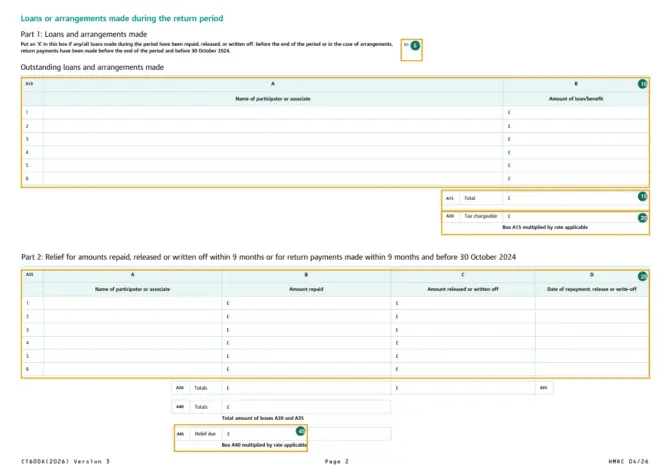
| Box | Entry | How the records feed it |
|---|---|---|
| A5 | X if any or all loans made in the period were repaid, released or written off before period end. | For benefit arrangements, the form restricts return payments to those before both period end and 30 October 2024. |
| A10 | Participator or associate name and outstanding loan or benefit amount. | Use each person’s account and the loan movements for this return period. |
| A15 | Total new loans and chargeable benefits outstanding at period end, including amounts deemed outstanding under the anti-avoidance rules. | This is the Part 1 total for the period. |
| A20 | The tax charge on A15. | Apply the rate for the date each loan was made or benefit conferred; keep workings where rates differ. |
For a current or loan account, the A10 notes start with debit entries, deduct credit entries and any credit balance brought forward, but exclude credits repaying, releasing or writing off loans made in earlier return periods. Keep those earlier loans identifiable. HMRC’s CTM61505 manual says the charge attaches to new loans in the period, rather than charging the entire accumulated debt again.
Use whole figures except where the form indicates pence or decimals. The markers on page 2 identify A5, A10, A15, A20, A25 and A45 by their box numbers.
Which rate belongs in A20?
HMRC manual CTM61505, “Rate of Section 455 tax”, lists the rates by the date the loan is made or benefit conferred:
| Loan or benefit date | Rate |
|---|---|
| Up to 5 April 2016 | 25% |
| 6 April 2016 to 5 April 2022 | 32.5% |
| 6 April 2022 to 5 April 2026 | 33.75% |
| From 6 April 2026 | 35.75% |
There is a mismatch within HMRC’s published material. The CT600A completion notes, updated 8 April 2026, still give 33.75% “from 6 April 2022” under A20, A45 and A70, while also instructing users to use the dividend upper rate for the year of the loan. CTM61505 expressly gives 35.75% from 6 April 2026. The PDF itself says to use the applicable rate and prints no percentage. If the software or your proposed calculation differs from those sources, ask HMRC Corporation Tax enquiries on 0300 200 3410 to confirm the treatment of the dated loans before filing.
Relief follows the rate applying to the original loan or benefit, as the A45 and A70 notes specify. The date of a later repayment does not turn an older loan into a new loan for the rate calculation.
How to complete Part 2 for repayments within nine months
Part 2 deals with amounts included in A15 that were repaid, released or written off after period end but before nine months and one day after the end of the accounting period in which the loan was made. For section 464A benefit arrangements, the return payment must also have been made before 30 October 2024. That cut-off concerns return payments under the arrangements rules; the form separately allows relief for loan repayments, releases and write-offs.
| Box | What to put there |
|---|---|
| A25 | Name, amount repaid, amount released or written off, and date. For several repayments on one account, use the total and the last repayment date; enter each released or written-off loan or part loan separately. |
| A30 | Total qualifying repayments or return payments. |
| A35 | Total qualifying releases and write-offs. |
| A40 | A30 plus A35. |
| A45 | Relief calculated on A40 using the applicable original loan rates. |
A repayment after year end can therefore produce relief while the loan still appears in the year-end figures. Keep the period-end balance and the later settlement dates in the working papers. HMRC’s director’s loan guidance confirms that CT600A shows the amount owed at period end even where the loan is repaid within nine months.
Part 3 and the final tax payable
Part 3 is for relief already due when the return is sent, on loans from this return period settled more than nine months after its end. HMRC says most companies will not complete it: a late repayment alone is insufficient. The notes describe a very late return, at least 21 months after the return period ends, submitted after the relief has become due. For arrangements, the return payment must additionally pre-date 30 October 2024.
CTM61610 explains that relief on a loan settled more than nine months after the original period is deferred to the tax due date for the accounting period of settlement. The director’s loan guidance expresses this as nine months and one day after the end of that later accounting period. Do not enter relief which is still waiting for its due date.
| Box | Entry or transfer |
|---|---|
| A50 | Participator or associate name, repayment or release/write-off amounts and the relevant dates for relief now due. |
| A55 and A60 | Totals for repayments/return payments and releases/write-offs respectively. |
| A65 | A55 plus A60. |
| A70 | Relief on A65 at the original applicable rates. Mark CT600 box 485 if completing A70. |
| A75 | All outstanding loans and arrangements at period end, across all periods. Include amounts treated as outstanding under the anti-avoidance rules. |
| A80 | A20 minus A45 minus A70. Copy the result to CT600 box 480. |
A75 includes older balances even though A15 concerns the new amounts for this period. In the main CT600, box 95 identifies the CT600A supplement. The CT600 declaration covers the supplementary pages; CT600A has no separate signature box.
Later claims, replacement loans and filing dates
If relief is not yet due when filing, HMRC’s notes direct the company to make a separate claim later. The director’s loan guidance distinguishes a claim made with, or by amending, the original period’s return within two years from a claim using form L2P. It directs users to L2P where the return is for a different accounting period, the amendment is in writing, or the claim is two years or more after the original period end.
CTM61600 specifies a claim limit of four years from the end of the financial year in which the repayment, release or write-off occurred. The director’s loan page gives the shorter wording “within 4 years” without that starting point; refer to CTM61600 for the stated rule and contact HMRC if the claim is near the limit. Interest paid on the section 455 charge is not reclaimable, according to the director’s loan page.
Temporary repayment followed by further borrowing can remain caught by the anti-avoidance rules. The completion notes refer to section 464C, while the CTM61600 manual refers to section 464ZA for the repayment arrangements it describes. Both require relevant amounts still treated as outstanding to be reported. Check the underlying transactions with HMRC or your adviser rather than treating a short-lived credit as an automatic release from tax.
The Company Tax Return is due 12 months after the accounting period ends. Tax payment is a separate obligation; the Company Tax Returns overview gives the usual Corporation Tax due date as nine months and one day after period end. A later relief claim does not extend the filing deadline or postpone collection while relief is not due.
Official CT600A PDF and submission
The official CT600A PDF shows all three pages. HMRC’s CT600 publication page directs companies to commercial software for the return and its supplements. Downloading or filling in the PDF does not send it to HMRC.
Paper filing is available for a reasonable excuse or a return in Welsh; the CT600 publication also provides the form for amending a return already submitted. Its address is Corporation Tax Services, HMRC, BX9 1AX. If an HMRC online service IT problem prevented online filing, include WT1 with the paper return. Accounts, tax computations and the relevant supplementary pages form the return package.
CT600A deals with the company’s loan charge and relief. The director’s loan guidance separately identifies personal Income Tax, benefits and National Insurance consequences in relevant cases. A zero A80 does not answer those separate reporting questions.
Sources
- HMRC, CT600A (2026) Version 3, HMRC 04/26.
- GOV.UK, CT600A publication page.
- HMRC, CT600A completion notes, updated 8 April 2026.
- HMRC, CTM61505: scope and rates of section 455 tax.
- HMRC, CTM61600: repayment and relief claims.
- HMRC, CTM61610: date relief is due.
- GOV.UK, Director’s loans: if you owe your company money.
- GOV.UK, Company Tax Returns.
- HMRC, CT600 (2026) Version 3.
- HMRC, Completing your Company Tax Return.
- GOV.UK, CT600 filing and postal address.
- HMRC, Corporation Tax enquiries.