CT600J reports reference numbers for disclosable tax avoidance arrangements as part of a company’s tax return. Each scheme entry has a matching date: the last day of the accounting period in which the company expects the tax advantage to arise. A scheme reported on an earlier return may still need to appear again.
HMRC’s CT600J publication page continues to provide CT600J (2015) Version 3, marked HMRC 04/15, for accounting periods beginning on or after 1 April 2015. The publication page’s 2025 update concerns links to other material; it does not label the PDF as a new 2025 edition.
When must a company complete CT600J?
HMRC’s CT600J guidance describes a company that is party to notifiable arrangements under section 306 of the Finance Act 2004, has received an eight-digit scheme reference number (SRN), and has entered into a transaction under those arrangements in the current or an earlier accounting period. The company must expect a tax advantage from them in the current or a future accounting period.
The guidance also requires these pages when a monitored promoter, or a client of one, has provided a promoter reference number (PRN) and the company expects a tax advantage from the relevant arrangements. The main CT600 guide directs the company to mark box 65 when it needs to disclose avoidance-scheme use or has been notified of such a PRN.
These are disclosure entries. The printed CT600J page asks for reference numbers and dates; it has no boxes for calculating a relief or entering a payment.
How to fill in J1 to J4
Identify the company and the accounting period covered by the supplementary page. The period cannot exceed 12 months.
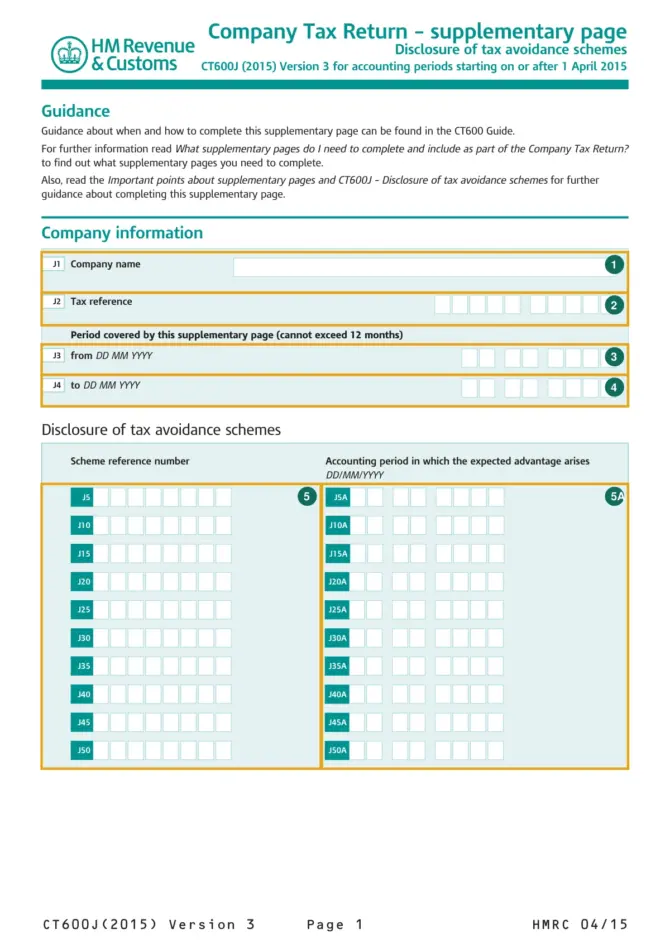
| Box | Entry | Record to use |
|---|---|---|
| J1 | The company name. | The company details for the return. |
| J2 | The company’s 10-digit Unique Taxpayer Reference (UTR). | The company’s tax reference, rather than a scheme reference number. |
| J3 | The start of the period, in DD MM YYYY format. | The accounting period covered by this return. |
| J4 | The end of that period, in DD MM YYYY format. | The same period’s closing date. |
The dates in J3 and J4 identify the return period. The date beside each scheme number below records when the expected advantage arises, which can be in a later period.
Scheme numbers J5 to J50 and their matching dates
The PDF has ten scheme-number rows. Enter the reference supplied by the promoter, another person involved in supplying the arrangements, or HMRC. The guidance covers both arrangements implemented during this return period and arrangements implemented earlier where a Corporation Tax advantage is still expected in this or a later period.
| Scheme reference | Matching date box | What the date means |
|---|---|---|
| J5, J10, J15, J20, J25, J30, J35, J40, J45, J50 | J5A, J10A, J15A, J20A, J25A, J30A, J35A, J40A, J45A, J50A, respectively | The last day of the accounting period in which the company currently expects the advantage to arise, in DD MM YYYY format. If more than one period is expected, use the earliest period. |
Repeat a scheme reference even if it was included on an earlier return, unless the company no longer expects any tax advantage in this accounting period or any later one. For example, a scheme entered into before the current return period can still be reportable when the expected advantage falls in a later period; the matching date box takes that later period’s final day.
When separate disclosure forms are needed
If the return is late, or a scheme reference was omitted from a return delivered by the filing date, HMRC says to report the SRN separately using AAG4. For an employer’s notifiable arrangements involving employees, the guidance requires annual AAG8 reporting of the scheme reference and employee details. It also directs no-promoter and certain lawyer-notification cases to AAG3.
For monitored-promoter PRNs, CT600J reporting covers expected advantages relating to Corporation Tax, Income Tax, Capital Gains Tax, VAT and National Insurance contributions. HMRC says not to use CT600J for a PRN relating to Inheritance Tax, Petroleum Revenue Tax, Stamp Duty Land Tax or Stamp Duty Reserve Tax. A PRN omitted by the filing date, or a return not delivered by that date, uses the separate AAG4(PRN) route. The official CT600J guidance links each disclosure form.
Penalties described in the CT600J guidance
Failure to provide a reportable scheme reference or the required expected-advantage period end can lead to a penalty under section 98C(3) of the Taxes Management Act 1970. HMRC lists £5,000 for each scheme, increasing to £7,500 after one previous failure in the preceding 36 months, or £10,000 after two or more previous failures in that period. The previous failures need not concern the same scheme.
The guidance separately describes monitored-promoter penalties under the Finance Act 2014. A section 252 failure to pass the PRN to a person whom the company could reasonably be expected to know is, or is likely to become, a client can attract up to £5,000 per person concerned. A section 253 reporting failure carries £5,000, rising to £7,500 or £10,000 after one, or two or more, previous failures within the preceding 36 months. Ask a tax adviser about the disclosure obligations if the arrangements or the company’s role are uncertain.
Official CT600J PDF and how to submit it
Download the CT600J (2015) Version 3 PDF. Submit the relevant supplementary information with the Company Tax Return. HMRC directs companies to commercial software for online filing. The Company Tax Return deadline is 12 months after the accounting period ends; payment of Corporation Tax has a separate deadline.
Paper filing is restricted to the circumstances described by HMRC, including a reasonable excuse or filing in Welsh. Its CT600 publication page gives this address for the completed paper return:
Corporation Tax ServicesHMRC
BX9 1AX
The same page says to include WT1 if an HMRC online-services IT problem prevented online submission. CT600J has no separate signature section; complete the declaration requirements of the Company Tax Return being submitted.