CT600E is the supplementary page that a charitable company or a community amateur sports club (CASC) adds to its Company Tax Return to claim exemption from tax on its income and gains. It sits behind the main CT600 and gives HMRC the claim itself, a breakdown of exempt income and expenditure taken from the accounts, the assets bought and sold in the period and, since April 2026, the individual legacies received. The form on GOV.UK is CT600E (2026) Version 3, printed HMRC 04/26, for accounting periods starting on or after 1 April 2015. It has four pages and the boxes run from E1 to E200.
Who sends CT600E: charitable companies and CASCs
HMRC’s guidance for the page says to complete it if the charity or CASC claims exemption from tax on all or any part of its income and gains. The completed page is the claim to exemption, made on the basis that the income and gains have been applied for charitable or qualifying purposes only.
Not every charity sends one, and not every year. GOV.UK’s charities and tax guide says a charity with no tax to pay completes a return only if HMRC asks it to, and one with income that does not qualify for relief must complete a return. The type of return depends on how the charity was set up:
- A charitable company (set up by a constitution, memorandum and articles of association, royal charter or Act of Parliament) or an unincorporated association files a Company Tax Return and includes CT600E.
- A charity set up by a trust deed or will is a trust and completes a Trust and Estate Self Assessment tax return. CT600E is not used.
- A CASC that needs to pay tax files a Company Tax Return and includes CT600E if it is claiming relief on any income or gains. With no tax to pay, it files only when HMRC asks.
Once a notice to deliver a return arrives, the CT600 itself warns that the company has to comply by the filing date or HMRC charges a penalty, even if there is no tax to pay. On page 1 of the CT600, box 115 takes an X to show that CT600E is enclosed, and the CT600 guide says to enter 8 in box 4, type of company, for a charity or a company owned by a charity.
Boxes E1 to E45: company details and the claim
Page 1 is the part HMRC labels “this section should be completed in all cases”. The markers on the image match the first column of the table.
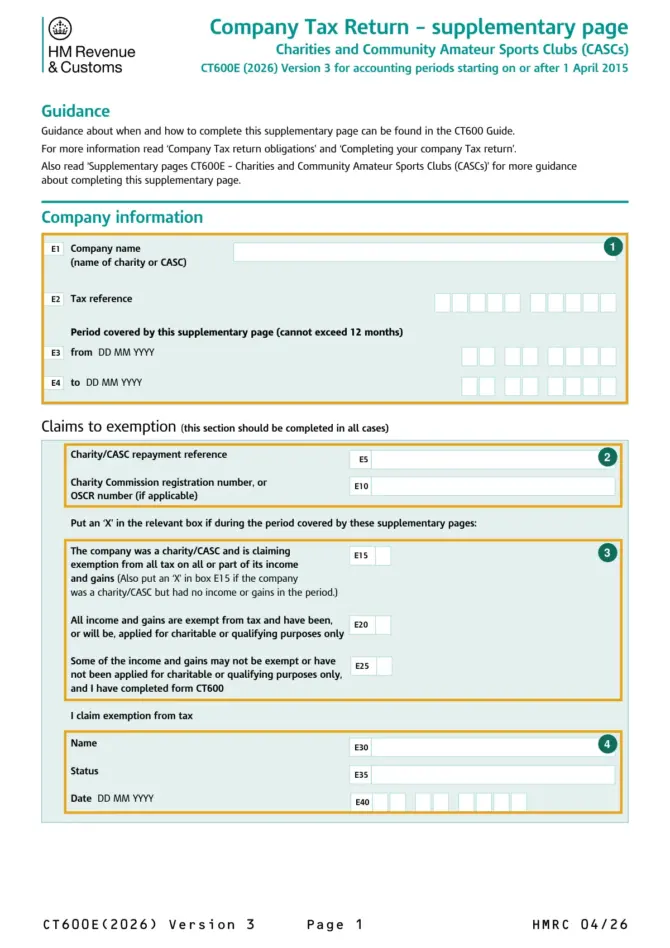
| Marker | Boxes | What to enter |
|---|---|---|
| 1 | E1 to E4 | The charity’s or CASC’s company name, its 10-digit Unique Taxpayer Reference, and the start and end dates of the period in DD MM YYYY. The period cannot exceed 12 months. |
| 2 | E5, E10 | The charity or CASC repayment reference, and the Charity Commission registration number or OSCR number, where the organisation has one. |
| 3 | E15, E20, E25 | An X in E15, and then an X in either E20 or E25. E15 also takes an X when the charity or CASC had no income or gains in the period. |
| 4 | E30, E35, E40 | Name, status and date of the person claiming exemption. For a CASC the treasurer signs. |
The choice between E20 and E25 decides whether the main CT600 needs figures. E20 means all income and gains are exempt and have been, or will be, applied for charitable or qualifying purposes only. E25 means some of them may not be exempt or have not been applied that way; the non-exempt part goes into the appropriate boxes of the CT600, and the wording of E25 itself confirms that the CT600 has been completed. If a charity or CASC carried on a trade that falls outside the exemption, HMRC’s notes ask for the Company Tax Calculation on the CT600, the About this return section on its page 1 and its declaration, with otherwise exempt income left out of that calculation.
For E35, the notes say any person authorised to do so may sign for the company, except where a liquidator or administrator has been appointed.
E45 sits at the top of page 2 and takes an X if the charity has over claimed tax in the period. Repayments are not claimed on CT600E. The form says to register and enrol for Charities Online to make a repayment claim, and HMRC’s guidance lists what that service covers: Gift Aid, other income such as bank interest, and top-up payments under the Gift Aid Small Donations Scheme.
Income and expenditure, boxes E50 to E125
Page 2 takes figures from the charity’s or CASC’s accounts for the period. Only income claimed as exempt belongs here; anything taxable goes on the CT600 instead, which is why several labels say “exclude any amounts included on form CT600”.
| Box | Printed label | Notes from HMRC’s guidance |
|---|---|---|
| E50 | Total turnover from exempt charitable trading activities | Turnover of trades whose profits are exempt under sections 525, 526 or 529 of the Income Tax Act 2007 for charities, or Chapter 9 of the Corporation Tax Act 2010 for CASCs. |
| E55 to E70 | Investment income; UK land and buildings; Gift Aid; from other charities | Exempt amounts only, each excluding anything already on the CT600. |
| E75, E80 | Gifts of shares or securities; gifts of real property | The value of gifts received under section 431 of the Income Tax Act 2007. |
| E85 | Other sources | Exempt income not caught by the boxes above, including donations from a wholly owned trading subsidiary and Case VI income. |
| E88 | Legacy income | The total from E200 on page 4. |
| E90 | Total | E50 to E88 added together. |
| E95, E100 | Trading costs; UK land and buildings costs | Costs relating to the exempt activities in E50 and E60. |
| E105 to E120 | Administration and governance; grants within the UK; grants outside the UK; other expenditure | Accounts figures. E120 is for spending not covered above or not used in working out the CT600 figures. |
| E125 | Total | E95 to E120 added together. |
A charity that runs a shop selling donated goods and a café, for example, would look at whether each trade falls within the exemptions HMRC names for E50. Turnover from an exempt trade goes in E50 and its costs in E95; profit from a trade outside the exemption goes through the CT600 calculation with E25 ticked on page 1.
Assets and investments, boxes E130 to E190
Page 3 has two columns for four kinds of asset: tangible fixed assets (E130, E135), UK investments other than controlled companies (E140, E145), shares in and loans to controlled companies (E150, E155) and overseas investments (E160, E165). The disposals column takes the total consideration received for assets disposed of in the period; the additions column takes the accounts figure for assets added in the period. Loans and non-trade debtors (E170) and other current assets (E175) have one box each.
Three boxes apply to charities only. E180 takes an X only if all investments and loans are approved, meaning they fall within sections 511 to 514 of the Corporation Tax Act 2010 or sections 558 to 561 of the Income Tax Act 2007. If the charity has made investments or loans outside those sections and is not making a claim with this return, their total value goes in E185. E190 is the number of subsidiary or associated companies the charity controls at the end of the period, leaving out companies that were dormant for the whole period.
A charity can also ask HMRC to accept a loan or investment that is not on the approved list. The claim is made in writing and must state the nature of the item, the amount, the period and the section of legislation it is made under; HMRC asks for full details and documents, such as the loan papers, any legal advice and records of how the decision was made. The loan or investment has to be made for the benefit of the charity and not for the avoidance of tax.
Legacy details, boxes E195 and E200
Page 4 lists legacies received in the period, one row per legator, with 12 rows on the paper form. Columns A to G take the forename, surname, address, UK postcode, an X for an overseas address, the date of the legacy and the amount. E200 is the total of column G, and the same figure is copied to E88 on page 2.
A charity that cannot, or chooses not to, give individual details still fills in the first row for the legacies combined: an X in each of the forename, surname, address and overseas columns, a valid date and the combined amount.
What changed on the 2026 page
HMRC updated its CT600E guidance on 6 April 2026, and the change log on that page lists what moved:
- Box E88, legacy income, was added, with guidance.
- Guidance for E85 and for E130 to E190 was updated.
- A legacy details section was added, with notes for each column.
In the asset boxes, the second column changed from assets held at the end of the period to assets added during the period. HMRC’s notes say this applies to accounting periods starting on or after 1 April 2026.
Where the 2026 form and HMRC’s notes leave gaps
Three points are not settled by the documents themselves:
- The GOV.UK CT600E publication page carries one form, CT600E (2026) Version 3, headed for accounting periods starting on or after 1 April 2015, and its asset columns are printed as additions. HMRC’s guidance says the switch from assets held at the end of the period to assets added applies to periods starting on or after 1 April 2026. Neither document says which figure to give in those columns for an earlier period.
- Next to E180 and E185 the form says “See CT600 Guide”. The CT600 guide (updated 2 June 2026) has no box notes for E180 or E185; they are on the separate CT600E guidance page.
- The CT600E notes do not explain boxes E5, E10, E30, E40 or E55 to E70 beyond their printed labels.
For any of these, HMRC’s charities and CASC enquiries line, 0300 123 1073, takes questions on completing a Company Tax Return as a charity or CASC (Monday to Friday, 8:30am to 5pm).
Checks before CT600E goes in
- E15 has an X, and so does exactly one of E20 or E25.
- If E25 is ticked, the taxable amounts are on the CT600 and not repeated on page 2 of CT600E.
- E90 equals E50 to E88 added together, and E125 equals E95 to E120.
- E88 matches E200 on the legacy page.
- The CT600 has an X in box 115.
- Any repayment is claimed through Charities Online, and E45 is ticked if tax was over claimed.
When the return is due
CT600E goes in with the Company Tax Return, which is due 12 months after the end of the accounting period it covers. Corporation Tax due has a separate payment deadline, usually 9 months and one day after the end of the accounting period. HMRC’s CT600E guidance warns that a late return may mean the loss of tax reliefs as well as financial penalties, and GOV.UK’s charities guide says a charity must complete a return when HMRC asks, even if no tax is due.
Getting CT600E and where to file it
The PDF is on the GOV.UK CT600E page, and the box-by-box notes are in Completing the CT600E page for charities and community amateur sports clubs. HMRC’s own “File your accounts and Company Tax Return” service closed on 31 March 2026, so from 1 April 2026 the return and its supplementary pages are filed through commercial software. A paper Company Tax Return is accepted only with a reasonable excuse or when filing in Welsh.
A charity that is a limited company also sends annual accounts to Companies House; GOV.UK’s charities guide lists that as a separate duty from the tax return.
Official PDF: CT600E — Official PDF (assets.publishing.service.gov.uk)
Questions about CT600E
Does a charity have to file CT600E every year?
Only when a return is needed. A charity with no tax to pay completes a return if HMRC asks it to; one with income that does not qualify for relief must complete a return. When a Company Tax Return is filed and exemption is claimed, CT600E goes with it.
Can Gift Aid be reclaimed on CT600E?
The page records Gift Aid received in E65, but the repayment itself is claimed through Charities Online. E45 is only an X box for tax over claimed in the period.
What if all of the charity’s income is exempt?
Put an X in E15 and E20 and complete the information pages. Taxable figures on the CT600 are only needed where E25 applies.
Do the investment boxes E180 to E190 apply to a CASC?
The form and HMRC’s notes mark E180 and E185 as applying to charities only. E190 is worded for companies “the charity” controls, and the notes say nothing more about CASCs for that box.
Sources
- CT600E (2026) Version 3, Charities and Community Amateur Sports Clubs (HMRC 04/26)
- Completing the CT600E page for charities and community amateur sports clubs, GOV.UK (updated 6 April 2026)
- Corporation Tax: charity and Community Amateur Sports Clubs (CT600E), GOV.UK
- CT600 (2026) Version 3, Company Tax Return (HMRC 04/26)
- Completing your Company Tax Return (CT600 guide), GOV.UK
- Charities and tax: pay tax, GOV.UK
- Running a community amateur sports club: paying tax, GOV.UK
- Claim tax back on donations using Charities Online, GOV.UK
- Company Tax Returns, GOV.UK
- Filing company accounts and tax returns if you previously used the HMRC online service, GOV.UK
- Charities and Community Amateur Sports Clubs: enquiries, HMRC