CT600I is the supplementary page of the Company Tax Return for a company with a production ring fence trade, which in practice means oil extraction and the exploitation of oil rights onshore in the UK or offshore out to the edge of the UK Continental Shelf. The page works out the supplementary charge, an extra amount charged as if it were Corporation Tax at 10% of the company’s adjusted ring fence profits (Corporation Tax Act 2010, section 330(1)), and splits the ring fence tax so that it can be shown separately on the CT600. The form on GOV.UK is CT600I (2019) Version 3, printed HMRC 04/19, for accounting periods starting on or after 1 April 2015. It has three pages: company details on page 1, the charge calculation on page 2 and transferred tax history on page 3.
Which companies complete CT600I
HMRC’s notes for the page say to complete it if, for any period beginning (or treated as beginning) on or after 17 April 2002, the company carried on a production ring fence trade under Part 8 of the Corporation Tax Act 2010. Section 277 defines a ring fence trade as oil-related activities that form a separate trade, and section 274 says oil-related activities are oil extraction activities and the acquisition, enjoyment or exploitation of oil rights. The notes add that this covers the UK and any designated area, onshore and offshore, to the outer edge of the UK Continental Shelf.
A contractor ring fence under Part 8ZA of the Act is treated differently. The CT600 guide says not to complete form CT600I, or CT600 boxes 585 and 590, for a contractor ring fence.
A company that does include the page puts an X in box 135 on page 1 of the CT600, “Supplementary charge in respect of ring fence trades – form CT600I”.
How the supplementary charge is calculated
Section 330 charges the supplementary charge on adjusted ring fence profits. These are the ring fence profits chargeable to Corporation Tax worked out on the assumption that financing costs are left out, both in the profit or loss of the ring fence trade and in any loss relief surrendered to the company as group relief (section 330(2) and (3)). That is why the page starts with the ordinary ring fence result in I5 and then adds back financing costs in I20 to I30.
HMRC’s notes list what counts as financing costs: the costs of debt finance, including debits on the company’s debtor loan relationships (Part 5 of the Corporation Tax Act 2009), exchange gains or losses on debt finance, credits and debits on derivative contracts relating to debt finance (Part 7 of the 2009 Act), the finance cost implicit in finance lease payments, and other costs of financing transactions. Only this accounting period’s financing costs go in. If net financing costs are negative and have to be taken off ring fence profits, the notes say the adjustment is made in box I50.
The rate has changed over the years. HMRC’s notes give 32% for accounting periods beginning on or after 24 March 2011, 20% from 1 January 2015 and 10% from 1 January 2016, and section 330(1) on legislation.gov.uk gives 10%. A period that straddles a change is split into two notional periods, and profits are divided between them by the number of days in each; if that gives an unjust or unreasonable result, the company can elect for a just and reasonable basis, and the notes ask companies in that position to contact their HMRC office.
Section 330(5) makes the charge subject to three reductions: the investment allowance (Chapter 6A of Part 8), the onshore allowance (Chapter 8) and the cluster area allowance (Chapter 9). On the form these all go in I60, the box printed as “Field allowance”.
Filling in boxes I1 to I85
Page 1 holds only I1 to I4: the company name, its 10-digit Unique Taxpayer Reference, and the start and end dates of the period in DD MM YYYY format. The period on the page cannot be longer than 12 months. Page 2 does the calculation, and the numbers on the image match the marker column below.
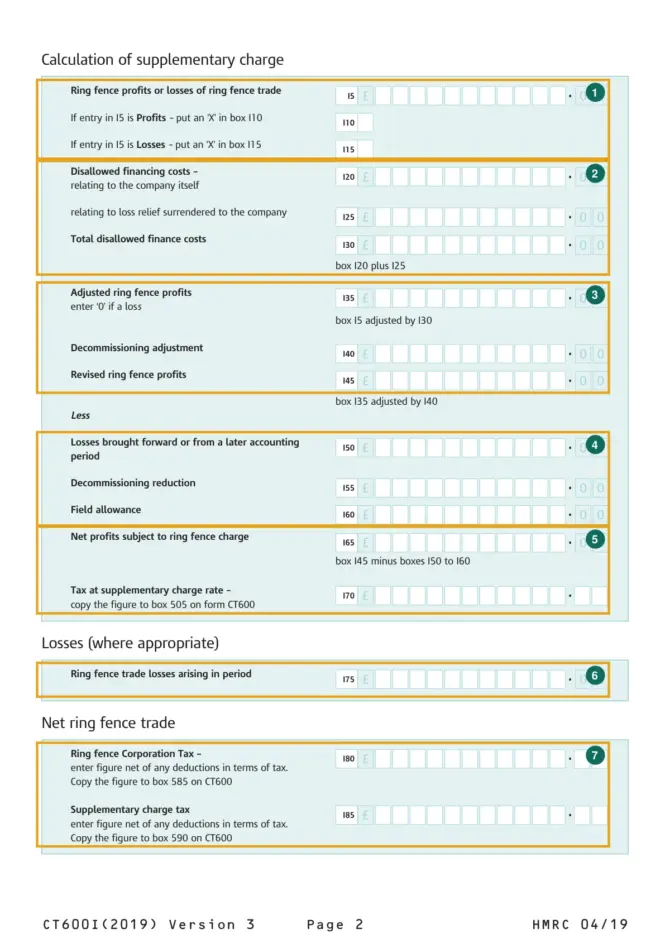
| Marker | Box | What goes in it | Source or destination |
|---|---|---|---|
| 1 | I5, I10, I15 | Ring fence profit or loss of the period after any group relief surrendered to the company and set against ring fence profits, but before losses brought forward or carried back. X in I10 for a profit, X in I15 for a loss. | The Corporation Tax computation for the ring fence trade. |
| 2 | I20, I25, I30 | Disallowed financing costs of the company itself (I20) and those in loss relief surrendered to it (I25). I30 is I20 plus I25. | Financing costs of this accounting period only. |
| 3 | I35, I40, I45 | I35 is I5 adjusted by I30: add I30 back to a profit or reduce a loss; enter 0 if the result is a loss. I40 is the decommissioning adjustment. I45 is I35 adjusted by I40. | Sections 330(2) and 330A. |
| 4 | I50, I55, I60 | Losses brought forward or carried back, recalculated without financing costs (I50, no more than I45); decommissioning reduction (I55); field, onshore, cluster area and investment allowances (I60). | Sections 330(3), 330B and 330(5). |
| 5 | I65, I70 | I65 is I45 minus I50 to I60. I70 is the tax at the supplementary charge rate on I65. | I70 goes to box 505 of the CT600. |
| 6 | I75 | Ring fence trade loss of the period, worked out without financing costs. | Section 330(3) assumption. |
| 7 | I80, I85 | Ring fence Corporation Tax (I80) and supplementary charge (I85), each net of any further deductions in terms of tax. | I80 goes to box 585, I85 to box 590 of the CT600. |
Losses in I50 are not the same figures as in the ordinary computation. The notes say losses brought forward are the accumulated losses calculated as if financing costs had been left out for every period, and losses carried back from a later period under section 37 are worked out on the same assumption. The total in I50 cannot be more than I45.
The two decommissioning boxes depend on the rate. The notes say I40 only applies when the supplementary charge rate is higher than 20%. It adds back part of the expenditure on decommissioning carried out on or after 21 March 2012 that reduced the profits, whether the expenditure is from this period or sits in losses brought forward, carried back or surrendered (section 330A). I55 is the reduction under section 330B where decommissioning expenditure has cut the Petroleum Revenue Tax charge and the resulting profits would bear the charge at more than 20%; it should be no more than is needed to bring I65 to nil. Both sections use the fraction (SC − 20%) / SC, where SC is the rate in section 330(1).
I60 has the same limit: no more than is needed to bring I65 to nil. The notes say it includes onshore allowance claims for capital expenditure incurred on and after 5 December 2013, and any high pressure high temperature cluster area allowance, onshore oil and gas allowance or investment allowance.
For I80 and I85, the only further deductions allowed are those shown on the CT600 after box 510. The notes give the example of Income Tax deducted from gross income included in other profits, which can be used to reduce either the ring fence Corporation Tax or the supplementary charge.
Where CT600I figures go on the CT600
- Box 135: X to show CT600I is included.
- Box 320, ring fence profits included: the production ring fence profits that are part of box 315, with a detailed calculation in the computations. The CT600 guide asks you to check this box is filled in when you complete 585 and 590.
- Box 505, supplementary charge (ring fence trades) payable: the figure from I70. It is one of the boxes added together in box 510, tax chargeable.
- Box 585, ring fence Corporation Tax included: the figure from I80.
- Box 590, ring fence supplementary charge included: the figure from I85.
The CT600 guide says supplementary pages form part of the company’s return and are covered by its declaration, and its warnings about prosecution, late and incorrect returns and late payment apply to them as well.
Transferred tax history, boxes I90 to I160
Page 3 is for transferable tax history (TTH). When the sale of an oil and gas licence is approved on or after 1 November 2018, the buyer and seller can jointly elect to transfer part of the seller’s tax history to the buyer under Schedule 15 to the Finance Act 2019. A company that has acquired TTH has to send details of the tracked profits of the transferred asset with its return each year. HMRC’s notes say boxes I90 to I160 give space for this information but do not form part of the company’s tax return.
| Box | What goes in it |
|---|---|
| I90, I95 | X if the company made one or more elections in this period, on acquiring assets (I90) or on disposing of them (I95). |
| I100, I105 | The same for elections made in an earlier accounting period. |
| I110, I115 | Name of the acquired field, and the asset reference HMRC gave when the election and its TTH were agreed. The reference is used in later returns and letters. |
| I120, I125 | X if the Oil and Gas Authority has approved cessation of production for the asset; X if the senior tracking officer’s certification of tracking is qualified or caveated. |
| I130 | X if a detailed schedule of accounting periods and rates is in the computations. It is needed only once the TTH has been activated and used or sold on. |
| I135, I140 | Profits and tax in the original election for ring fence Corporation Tax (I135) and supplementary charge (I140): A brought forward or acquired, B transferred on, C used this period, D carried forward, where D is A minus B and C. |
| I145 | Tracked profits or losses of the asset: A brought forward, B this period, C other adjustments, D carried forward since acquisition. |
| I150 | Decommissioning expenditure on the asset, in the same A to D layout. |
| I155, I160 | Activated TTH for ring fence Corporation Tax and supplementary charge: A previously activated, B activated this period, C total activated after any deactivation, D total used. |
Boxes I110 to I160 are completed for each asset acquired, and the notes ask for an additional sheet where there are several. TTH becomes activated once total decommissioning expenditure on the asset equals or exceeds the net profits from it, and only then is it available to relieve later losses. Part 9 of Schedule 15 requires the company to appoint a senior tracking officer, who certifies for each accounting period that the asset’s profits have been tracked properly.
Where HMRC’s notes and the form differ
The CT600I completion notes on GOV.UK (last updated 2 January 2024) do not match the printed CT600I (2019) Version 3 in three places:
- Under “I90 and I95” and “I100 and I105” the notes tell you to enter X in “box I190” and “box I195”. The form has no such boxes; it labels the election boxes I90, I95, I100 and I105.
- Under I65 the notes say “box I45 minus the figures in boxes I50 to 165”; the form prints “box I45 minus boxes I50 to I60”.
- Under I70, the paragraph for a period beginning before 1 January 2016 tells you to split it at 1 January 2015, repeating the dates of the paragraph above it.
The notes do not say which reading HMRC applies for the third point. For a period affected by it, HMRC’s Corporation Tax general enquiries line is 0300 200 3410 (+44 151 268 0571 from outside the UK); HMRC’s contact page says large businesses should contact their Customer Compliance Manager.
Checks before sending CT600I
- The trade is a production ring fence trade under Part 8, not a contractor ring fence under Part 8ZA.
- I3 and I4 match the CT600 accounting period and cover 12 months or less.
- Only one of I10 and I15 has an X, matching I5.
- I30 equals I20 plus I25, and I35 is 0 if the adjusted result is a loss.
- I50 is no more than I45, and I55 and I60 do not take I65 below nil.
- I70 is in CT600 box 505, I80 in box 585 and I85 in box 590.
- Box 135 has an X and box 320 shows the ring fence profits included in box 315.
- If the company holds TTH, page 3 is completed for each acquired asset.
Deadlines and payment
CT600I goes in with the Company Tax Return, which is due 12 months after the end of the accounting period. Late filing penalties on the GOV.UK Company Tax Returns page are £200 one day late, another £200 at three months, then 10% of unpaid tax at six months and another 10% at twelve months; three late returns in a row raise the £200 penalties to £1,000 each.
Corporation Tax is usually due 9 months and one day after the end of the accounting period. HMRC’s CT600I notes say that, for accounting periods ending on or after 1 July 2005, a large company pays Corporation Tax and supplementary charge on ring fence profits in a maximum of 3 instalments, while tax on its other profits stays at a maximum of 4.
Getting CT600I and sending the return
The blank form is on the GOV.UK publication page Corporation Tax: supplementary charge in respect of ring fence trades (CT600I), and HMRC’s box notes are at Completing the CT600I page for supplementary charge in respect of ring fence trades. The publication page was last updated on 1 April 2025 and still refers to sending an online return. HMRC’s “File your accounts and Company Tax Return” service closed on 31 March 2026; from 1 April 2026 the CT600 and its supplementary pages go through commercial software.
A paper CT600 is accepted only from a company with a reasonable excuse or one filing in Welsh, and the paper form can also be used to amend a return already submitted. The address on the CT600 publication page is Corporation Tax Services, HMRC, BX9 1AX, and a paper CT600I goes with the paper CT600 it belongs to.
Official PDF: CT600I — Official PDF (assets.publishing.service.gov.uk)
Questions about CT600I
What rate of supplementary charge goes in I70?
Section 330(1) of the Corporation Tax Act 2010, as shown on legislation.gov.uk on 1 November 2026, sets the charge at 10% of adjusted ring fence profits. HMRC’s notes give the same 10% for periods beginning on or after 1 January 2016.
Do boxes I40 and I55 apply at a 10% rate?
HMRC’s notes say I40 only applies when the rate is higher than 20%, and I55 applies where the profits would bear the charge at more than 20%. At 10%, neither condition in the notes is met.
Is page 3 part of the tax return?
HMRC’s notes say boxes I90 to I160 give space for the tracked-profit details a company with transferable tax history must send alongside its return, but do not form part of the return itself.
Sources
- HMRC CT600I (2019) Version 3, supplementary charge in respect of ring fence trades, HMRC 04/19
- Completing the CT600I page for supplementary charge in respect of ring fence trades, GOV.UK
- Corporation Tax: supplementary charge in respect of ring fence trades (CT600I), GOV.UK
- Completing your Company Tax Return (CT600 guide), GOV.UK
- HMRC CT600 (2026) Version 3, Company Tax Return
- Company Tax Return (CT600), GOV.UK
- Corporation Tax Act 2010, section 330, legislation.gov.uk
- Corporation Tax Act 2010, section 330A, legislation.gov.uk
- Corporation Tax Act 2010, section 330B, legislation.gov.uk
- Corporation Tax Act 2010, section 277, legislation.gov.uk
- Corporation Tax Act 2010, section 274, legislation.gov.uk
- Company Tax Returns, GOV.UK
- Filing company accounts and tax returns if you previously used the HMRC online service, GOV.UK
- Corporation Tax: general enquiries, GOV.UK