CT600N is the supplementary page of the Company Tax Return for Residential Property Developer Tax (RPDT). A company fills it in when it has an amount of RPDT to show in box 497 of the CT600, and a group uses it to share out its annual allowance and to claim or surrender RPDT group relief. The current form is CT600N (2023) Version 3 (HMRC 04/23), headed for accounting periods starting on or after 1 April 2022, and it is the only edition on the GOV.UK publication page.
Who has to complete CT600N
RPDT is charged at 4% on a company’s residential property development (RPD) profits above an annual allowance of £25 million. It is based on trading profits from residential property development in the UK; HMRC’s manual (RPDT01100) says it does not reach chargeable gains on land not disposed of in the course of a trade, or gains on shares. The tax is treated as an amount of Corporation Tax, so the Corporation Tax rules on returns, payments, enquiries, penalties, interest and appeals apply to it as well, and a company paying by quarterly instalments includes RPDT in those payments.
HMRC’s CT600N guidance names three uses of the page:
- a company recording RPDT in box 497 of the CT600
- a group’s allocating member allocating the £25 million allowance across the group
- surrendering and claiming RPDT group relief, unless the group does this through “simplified arrangements”
A company with RPD profits below the allowance does not always need the page. The manual’s reporting page (RPDT30300) says a company need not return its RPD profits if it is reasonable to assume it would have no RPDT liability, ignoring any deduction for RPDT losses and group relief. Losses work differently: if carried-forward losses are what bring profits under the allowance, the profit and the loss set against it are reported (RPDT20410). That page also suggests keeping records of losses even in years nothing is reported, so they can be evidenced later.
The allowance is one £25 million for the whole group, reduced pro rata for an accounting period shorter than 12 months. Without a nominated allocating member, each group company within the charge to Corporation Tax gets £25 million divided by the number of such companies. The ultimate parent nominates the allocating member in writing to HMRC, signed for the parent and stating the first accounting period it covers; it can do this through the CT600N or by email to rpdtadministration@hmrc.gov.uk.
How the CT600N links to the CT600
On the CT600 (2026) Version 3, put an X in box 144 to show the CT600N is included. The RPDT payable from box N285 goes in box 497, and box 500 adds boxes 490, 495, 496 and 497 together. The CT600 guide’s note for box 497 says only that much and points to manual pages RPDT30100 and RPDT20100 for the administration and the computation.
Page 1 of the CT600N asks for the company name (N1), the 10-digit Unique Taxpayer Reference (N2) and the start and end of the accounting period (N3 and N4, DD MM YYYY). The period cannot exceed 12 months.
Section 1: allocating the £25 million allowance
Section 1 on page 2 is the allowance allocation statement. Only the allocating member completes page 2. Put an X in N5 if the company is the nominated allocating member. If the statement for the period has already gone to HMRC separately, put an X in N10 and leave boxes N15 to N65 blank.
| Box | What to enter |
|---|---|
| N15, N20 | Start and end of the period the allocation relates to |
| N25, N30 | Name and tax reference of the allocating member, only if a different company held that role at the start of the period |
| N35, N40 | X in N35 if this company is the group’s ultimate parent; otherwise the ultimate parent’s name in N40 |
| N45 | One row per group company receiving allowance, including the allocating company itself: name (A), accounting period (B), 10-digit tax reference (C), amount allocated (D) |
| N50 | Total of column D |
| N55, N60, N65 | X in N55 if the statement has been authorised, then the full name and status of the person authorising |
The manual (RPDT20530) gives the time limit: the allocation statement reaches HMRC on or before the date 12 months after the end of the allocating member’s accounting period. If no statement is made, the allowance stays with the nominated member. Amendments are made by the allocating company, by the later of 24 months after the end of its accounting period or 30 days after an enquiry closes, an amendment notice is given or an appeal is decided. No statement is needed before quarterly instalments that include RPDT.
Take a housebuilding group whose parent is the nominated allocating member. Its two developer subsidiaries, both with years ending 31 March 2026, make RPD profits of £18 million and £14 million. The parent gives £18 million of allowance to the first and the remaining £7 million to the second. N45 then has those two rows and N50 shows £25 million. The second company is left with £7 million of profit above its allowance and, at 4%, £280,000 of RPDT; the first has none to pay.
Section 2: joint venture companies
Section 2 on page 3 is only for a relevant joint venture company whose allowance is restricted because of an excluded member and which has received an allocation of notional allowance. An excluded body is a company liable to RPDT only because it is a non-profit housing company (section 44(9) Finance Act 2022).
- N70: the notional allowance claimed.
- N75: an X if notional allowance is being allocated in respect of an excluded body. Table N80 then has to be completed.
- N80 and N85: each allocating company’s name, tax reference and amount, and the total of column C.
- N90: the excluded bodies in the group that are members of the joint venture, with their tax references.
A member company holding 10% or more of a joint venture company (together with its group) has the joint venture’s RPD profits attributed to it, and losses only if an election is made (RPDT20300). Those attributed amounts go in N240 and N245 in Section 4, not in Section 2.
Section 3: RPDT group relief claims and surrenders
RPDT group relief is separate from Corporation Tax group relief but uses the same group definition and administrative rules (RPDT20420). Section 3 has four parts, each with a seven-row table:
| Part | Who completes it | Table and total | Authorisation boxes |
|---|---|---|---|
| 1, claims to RPDT group relief (page 4) | A company claiming group relief in its RPDT calculation | N95 (surrendering company, its accounting period if different, tax reference, amount claimed); total N100, copied to N260 | N105 to N115 |
| 2, amounts surrendered (page 5) | A company surrendering an amount under the group provisions | N120 (claimant company, period, tax reference, amount surrendered); total N125 | N130 to N155 |
| 3, claims for carried-forward losses (page 6) | A company claiming group relief for carried-forward losses | N160; total N165, copied to N265 | N170 to N185 |
| 4, carried-forward losses surrendered (page 7) | A company surrendering carried-forward losses | N190; total N195 | N200 to N225 |
For a claim (Parts 1 and 3), a copy of each surrendering company’s notice of consent is attached, unless a simplified arrangement is in force. Under a simplified arrangement with no copies of consent, the claim is authorised in the boxes on the same page instead (N105 or N170 with the name and status of the person authorising). Where a tax reference is missing, the form asks for as much as possible to identify the company, such as its registration number.
For a surrender (Parts 2 and 4), each claim needs a notice of consent unless a simplified arrangement is in force. The part itself serves as the notice of consent if the surrendering company’s details (N130 to N145, or N200 to N215) are entered and an authorised person signs it off in N150 and N155 (or N220 and N225). Anyone authorised may complete this for the company, except where a liquidator or administrator has been appointed. A copy of the notice goes to the HMRC office dealing with the claimant company’s return, at the same time as that company sends the return claiming the relief.
Section 4: working out RPD profits and RPDT payable
Page 8 is the calculation. The numbers below match the markers on the image.
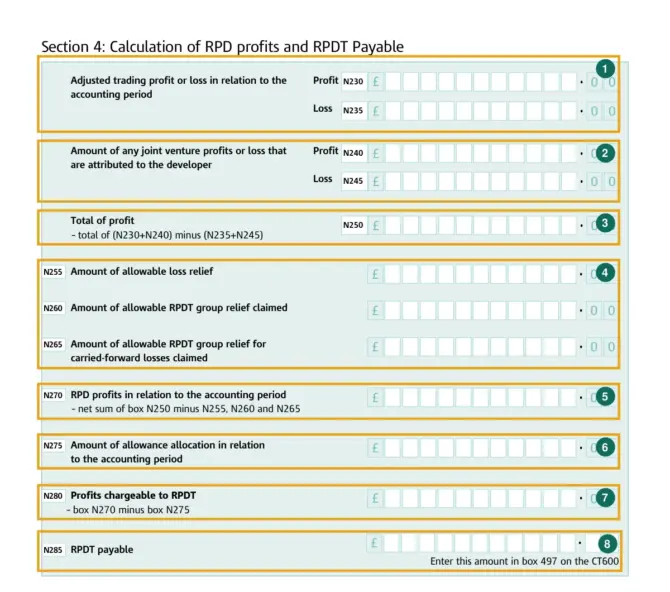
| Marker | Boxes | What to enter |
|---|---|---|
| 1 | N230 or N235 | Adjusted trading profit or adjusted trading loss for the accounting period; one or the other, not both |
| 2 | N240 or N245 | Joint venture profit or loss attributed to the developer |
| 3 | N250 | (N230 + N240) minus (N235 + N245) |
| 4 | N255, N260, N265 | RPDT losses brought forward and claimed; group relief claimed (from N100); group relief for carried-forward losses claimed (from N165) |
| 5 | N270 | RPD profits: N250 minus N255, N260 and N265 |
| 6 | N275 | The allowance allocated to the company for the period, from the allocation statement |
| 7 | N280 | Profits chargeable to RPDT: N270 minus N275 |
| 8 | N285 | RPDT payable, entered in box 497 of the CT600 |
Relief has limits. Group relief of either kind can bring a claimant’s RPD profits down to nil but cannot create a loss, and carried-forward losses (including group relief for them) are subject to a restriction similar to the Corporation Tax one, explained in RPDT20440. The manual (RPDT20100) also notes that if N230 to N250 produce no RPD profit, the rest of the calculation does not matter for that period.
In the example above, the second subsidiary would show £14,000,000 in N230, N250 and N270, £7,000,000 in N275, £7,000,000 in N280 and £280,000 in N285.
Where the form and HMRC’s notes do not line up
Two points in the published documents read differently, and the page does not settle them:
- The GOV.UK CT600N guidance (last updated 12 February 2025) tells you, under N285, to “calculate 4% of the amount in box N285”, which refers to the box itself. On the form, N280 is labelled “Profits chargeable to RPDT”, and manual RPDT20100 charges 4% on RPD profits above the available allowance; the worked figures in this guide follow that reading.
- Page 1 of CT600N (2023) Version 3 says guidance on completing it is in the CT600 Guide. The CT600 guide (updated 2 June 2026) has only the box 497 note; the box-by-box notes are on the separate CT600N guidance page. That page has no notes for N60, N65, N105 to N115, N130 to N145, N170 to N185 and N200 to N215, so this guide uses the printed labels for them.
For a figure that depends on either point, HMRC’s Corporation Tax general enquiries line is 0300 200 3410 (+44 151 268 0571 from outside the UK), Monday to Friday, 8am to 6pm. HMRC’s contact page says large businesses should contact their Customer Compliance Manager.
When the return is due and how to file it
CT600N is part of the Company Tax Return, so it follows the return’s deadline: 12 months after the end of the accounting period. Corporation Tax, and so RPDT, is usually payable 9 months and one day after the end of the period, or by instalments for companies already paying that way. A late return costs £200 after 1 day and another £200 after 3 months; at 6 months HMRC estimates the bill and adds 10% of the unpaid tax, and at 12 months another 10%.
Where to file and getting the CT600N PDF
HMRC’s “File your accounts and Company Tax Return” online service closed on 31 March 2026. From 1 April 2026 the CT600 and its supplementary pages are filed with commercial software. A paper return is only allowed with a reasonable excuse or when filing in Welsh; amendments and re-filed rejected returns can go through software, an agent, or on paper to the Corporation Tax office. The GOV.UK publication page carries the same instruction: check whether the form has to go online before downloading it to post.
The CT600N PDF (8 pages) is on the GOV.UK CT600N page, and the box notes are in Completing the CT600N page for Residential Property Developer Tax. An allocation statement or nomination sent outside the return goes to rpdtadministration@hmrc.gov.uk.
Official PDF: CT600N — Official PDF (assets.publishing.service.gov.uk)
Sources
- HMRC CT600N (2023) Version 3, Residential Property Developer Tax, HMRC 04/23
- Completing the CT600N page for Residential Property Developer Tax, GOV.UK (updated 12 February 2025)
- Corporation Tax: Residential Property Developer Tax (CT600N), GOV.UK
- HMRC CT600 (2026) Version 3, Company Tax Return
- Completing your Company Tax Return (CT600 guide), GOV.UK
- HMRC Residential Property Developer Tax Manual, RPDT01100
- RPDT20100, computation of RPDT liability
- RPDT20300, attribution of joint venture profits and losses
- RPDT20410, RPDT loss relief
- RPDT20420, RPDT group relief
- RPDT20510, RPDT allowance
- RPDT20520, nominating the allocating member
- RPDT20530, submitting the allowance allocation statement
- RPDT30100, RPDT as an amount of Corporation Tax
- RPDT30300, reporting of RPDT liabilities
- Company Tax Returns, GOV.UK
- Filing company accounts and tax returns if you previously used the HMRC online service, GOV.UK
- Corporation Tax: general enquiries, GOV.UK