IHT404 is the schedule for the deceased’s share of anything they owned in joint names in the UK: a house held with a partner or sibling, a joint bank or building society account, shares, household goods. Personal representatives fill it in when they answer Yes to question 31 on the IHT400 account, and the two net totals it produces are copied to IHT400 boxes 49 and 50. The version on GOV.UK is marked HMRC 08/26 and has 6 pages. It was last updated on 18 September 2026 to make it clearer where spouse and charity exemption amounts are entered.
Who fills in IHT404 and which assets go on it
Question 31 on IHT400 asks whether the deceased jointly owned any assets, other than business or partnership assets, with any other person. The IHT400 notes name bank and building society accounts, stocks and shares, household goods and freehold or leasehold property as the assets most often held this way. If the deceased’s home was jointly owned, it goes in IHT400 box 49 through this schedule, not in box 51 with the residence owned outright.
Two kinds of joint asset stay off IHT404. Jointly owned assets outside the UK go on Schedule IHT417, ‘Foreign assets’, and the names of the other joint owners go in the ‘Additional information’ boxes on page 19 of IHT400; the notes suggest using page 2 of IHT404 as a guide to the details HMRC wants. Assets owned jointly by a business or partnership go on Schedule IHT413 and in IHT400 box 69.
Some joint assets also need a second schedule. A jointly owned house, land, building or interest in land needs a full description on IHT405, houses, land, buildings and interests in land. Joint household goods and effects belong on IHT404, grouped in the same categories and order as IHT407, household and personal goods. If the deceased could benefit from a joint life and survivor policy, give the insurer’s name, the policy number and the value of the deceased’s interest at box 6, and fill in IHT410, life assurance and annuities as well.
Even when the estate qualifies for a reduced IHT400 because there is no tax to pay, a Yes to question 31 still means filling in IHT404. Where a joint asset passes to an exempt beneficiary such as a surviving spouse, the notes allow your own estimate of its open market value but not a nominal value.
Working out the deceased’s share
The share for Inheritance Tax can differ from the legal title. For land and buildings, the deeds usually set out each owner’s share. For other assets, each owner’s share usually matches what they put in. If the deceased’s share does not match their contribution, the notes ask you to explain why on the schedule.
Page 1 deals with accounts where one person provided all the money. An older person might add a relative’s name to an account so the relative can withdraw cash on their behalf. If the person who funded the account dies, their share is the whole balance. Money the relative took out for their own use may count as gifts, which then go on Schedule IHT403, ‘Gifts and other transfers of value’. The reverse also applies: if the deceased’s name was on a joint account they put nothing into, no part of it goes in the estate unless the other owner meant to give it to them.
When the other joint owner was the deceased’s spouse or civil partner, boxes 1 and 6 need only columns A, B, F and G. Columns C, D and E (start date of joint ownership, contributions and share of income) can be left blank.
Valuing a share in a house or land
Joint assets are valued by the same rules as assets owned outright. For an account or a shareholding, take the whole value and then the deceased’s share of it. Three people who paid equally into an account holding £12,000 at the date of death would each have a share worth £4,000.
A share in a house or land is different, because a part share is worth less on the open market than the same fraction of the whole. The IHT400 notes give a starting point that depends on which law applies:
| Where the property is | Starting point in the IHT400 notes | Worked figures for a £300,000 house owned with one other person |
|---|---|---|
| England and Wales or Northern Ireland (English law) | Reduce the arithmetical share by 10%. | Half share £150,000, less 10% (£15,000), gives £135,000. |
| Scotland (Scottish law) | Deduct £4,000 from the whole value, then take the share. The figure reflects the cost and delay of an action for division and sale. | £300,000 less £4,000 is £296,000; half of that is £148,000. |
| Either, where the other owner is the spouse or civil partner | No discount at all. | £150,000. |
These figures are only a starting point. HMRC usually asks the Valuation Office Agency for its opinion, and both the discount and the value of the whole property may be changed after the grant (or confirmation in Scotland). If the agreed value is higher than yours, more tax and interest may be due.
Page 1 of the form adds that the joint ownership discount is not an exemption or relief. Do not put it in box 4 or box 9. Enter the discounted value of the share in column G instead.
How to fill in IHT404, box by box
Start with the deceased’s name, date of death and the Inheritance Tax reference number if you have one. The rest of the form runs as two parallel sets of boxes. Boxes 1 to 5 on pages 2 and 3 are only for houses, buildings and land, and for shares and securities that gave the deceased control of a company or qualify for Business Relief. Everything else, such as bank accounts and household and personal goods, goes in boxes 6 to 10 on pages 4 and 5. Write ‘0’ in any total box that has nothing to report.
| Box | What goes in | Where the figure goes |
|---|---|---|
| 1 | Each jointly owned house, building, plot of land or controlling or Business Relief shareholding, one numbered row each, with columns A to G. Total of column G. | Box 3 |
| 2 | Mortgages and loans secured on the box 1 assets: item number, description, creditor, total outstanding and the deceased’s share. No household bills. | Boxes 3, 12 and 13 |
| 3 | Box 1 minus box 2. | Box 5 |
| 4 | Exemptions and reliefs on the box 1 assets. | Boxes 5 and 13 |
| 5 | Box 3 minus box 4. | IHT400 box 49 |
| 6 | Other joint assets, for example bank accounts (with account numbers) and household goods, columns A to G. Total of column G. | Box 8 |
| 7 | Liabilities against the box 6 assets, such as an overdrawn joint account or joint household bills like unpaid Council Tax. | Boxes 8, 12 and 13 |
| 8 | Box 6 minus box 7. | Box 10 |
| 9 | Exemptions and reliefs on the box 6 assets. | Boxes 10 and 13 |
| 10 | Box 8 minus box 9. | IHT400 box 50 |
| 11 to 13 | Assets passing by survivorship and the matching totals. | Schedule IHT421 in Northern Ireland |
The columns in boxes 1 and 6 are the same. A is the description of the asset; if it is the house at the address in IHT400 box 11, write ‘deceased’s house’ and say whether it is freehold or leasehold. B is the names of the other joint owners and their relationship to the deceased. C is the date joint ownership started. D is each owner’s contribution, as fractions or as money. E is each owner’s share of any income from the asset. F is the value of the whole item at the date of death, and G is the deceased’s share of it.
If the deceased had a joint mortgage that you deducted in box 2 and a policy was assigned to repay it, the notes ask you to put the deceased’s share of the policy proceeds in box 6 as an asset. If there is not enough room on pages 2 to 6, fill in another copy of the form.
The two IHT400 boxes are in different columns. Box 50 sits in column A and box 49 in column B. The IHT400 notes explain that tax on column B assets may be paid in 10 annual instalments as long as the assets have not been sold, with interest on the instalments, while tax on column A assets must be paid before the grant of representation.
Exemptions and reliefs in boxes 4 and 9
Box 4 covers the box 1 assets and box 9 covers the box 6 assets. Each row gives the item number, what you are deducting and the amounts. For charity exemption, enter the charity’s full name, the country where it is established and its HMRC reference if it has one. For Agricultural Relief or Business Relief, enter the percentage applied. Box 4 mentions Agricultural Relief, Business Relief and Woodlands Relief; box 9 mentions Business Relief and Woodlands Relief only.
Column C is for relief at 100%, Woodlands Relief, spouse exemption and charity exemption. Spouse and charity exemption amounts always go in column C. Column D is only for Agricultural Relief or Business Relief at 50% (in box 9, Business Relief at 50%). Column E is the total for the row. This is the point HMRC clarified in the September 2026 update.
Exemptions on joint assets are claimed here and nowhere else. IHT400 boxes 92 and 93, which hold the exemptions for assets in the deceased’s sole name, both say not to include exemptions or reliefs on jointly owned assets.
For deaths on or after 6 April 2026, relief at 100% on the combined value of qualifying agricultural and business property is limited to £2.5 million. That figure includes gifts of qualifying property made on or after 30 October 2024 and within 7 years of the death, and other property, trust property included, that is treated as part of the estate. Anything above £2.5 million qualifies for relief at 50%. Unused allowance from a spouse or civil partner who died earlier can be transferred, if the claim is made within 4 years of the survivor’s death or within 6 months of the personal representatives starting their role. Shares on a market that is not ‘listed’ for HMRC purposes, such as AIM, now qualify only for 50% relief.
Survivorship assets, boxes 11 to 13
Page 6 asks which of the assets in box 1 or box 6 passed to the other joint owners by survivorship. Those assets do not pass under the will or the intestacy rules. HMRC needs them listed because they count for Inheritance Tax but not for probate or confirmation, and because they matter when the estate qualifies for the reduced rate of Inheritance Tax for deaths after 6 April 2012.
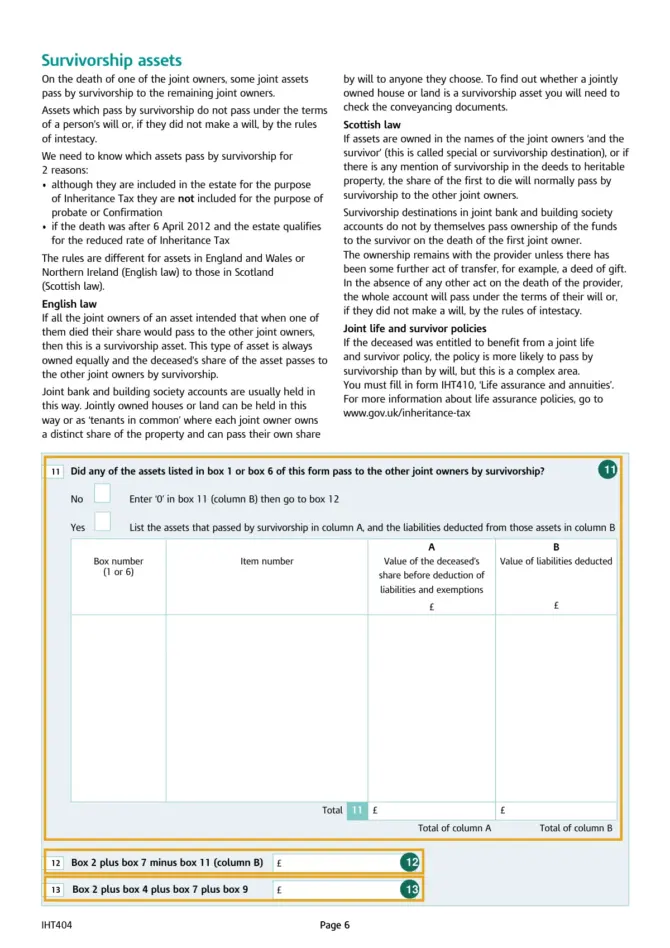
Under English law, used in England, Wales and Northern Ireland, an asset passes by survivorship when all the joint owners intended the share of the first to die to go to the others. Such an asset is always owned equally. Joint bank and building society accounts are usually held this way. A house or land may be held either this way or as ‘tenants in common’, where each owner has a distinct share they can leave by will, so check the conveyancing documents.
Under Scottish law, assets held in the names of the joint owners ‘and the survivor’ (a special or survivorship destination), or heritable property whose deeds mention survivorship, normally pass to the surviving owners. Joint bank and building society accounts are different: a survivorship destination on its own does not pass the funds. Unless there was a further act of transfer such as a deed of gift, the whole account passes under the will or intestacy of the person who provided the money.
If nothing passed by survivorship, enter ‘0’ in box 11 column B and go to box 12. Otherwise list each survivorship asset by box number (1 or 6) and item number, with the deceased’s share before liabilities and exemptions in column A and the liabilities deducted in column B. Box 12 is box 2 plus box 7 minus box 11 column B. Box 13 is box 2 plus box 4 plus box 7 plus box 9.
In Northern Ireland these totals feed the IHT421 probate summary (HMRC 01/24): box 13 is added to IHT400 box 79 in IHT421 box 1, the column A total of box 11 goes to IHT421 box 2, and box 12 is added to IHT400 boxes 83 and 84 in IHT421 box 4. If the estate is paying the reduced rate, form IHT430 also has to be filled in; it treats joint assets passing by survivorship as a separate component of the estate.
When and where to send IHT404
IHT404 has no deadline of its own and no signature box. It goes in with the IHT400 account, which the IHT400 notes say must be sent within 12 months of the date of death. Sending it later without a reasonable excuse can lead to a penalty of up to £200, and a further penalty of up to £3,000 if the delay runs to 2 years after the death. Post IHT400 and its schedules to Inheritance Tax, HM Revenue and Customs, BX9 1HT. In Scotland, if you filled in form C1, send HMRC a copy and keep the original for the Sheriff Court.
The fillable HMRC 08/26 PDF is on the GOV.UK IHT404 page, which also has a fillable Welsh version. Read it with the IHT400 notes for deaths on or after 1 January 2022, which explain joint ownership on printed pages 26 and 27. For questions about a particular asset, the Inheritance Tax Helpline is on 0300 123 1072, or +44 300 123 1072 from outside the UK.
Official PDF: IHT404 — Official PDF (assets.publishing.service.gov.uk)
Official sources
- Schedule IHT404, jointly owned assets (HMRC 08/26)
- Inheritance Tax: jointly owned assets (IHT404), GOV.UK
- IHT400 notes, deaths on or after 1 January 2022 (HMRC 04/26)
- IHT400 Inheritance Tax account (HMRC 04/26)
- IHT421 probate summary, Northern Ireland (HMRC 01/24)
- IHT430 reduced rate of Inheritance Tax (HMRC 05/24)