Form 8971 tells the IRS which beneficiaries received property from a decedent’s estate and at what estate tax value. Each of those beneficiaries gets a separate Schedule A listing only their own property, and that value becomes the ceiling on the basis they can claim when they later sell or depreciate it. The current form is Rev. August 2025 (Schedule A is dated August 2025 as well), and the instructions are Rev. December 2026, published October 27, 2026 for use with that form.

Who files Form 8971, and when it is not required
The filer is the executor of an estate that files Form 706 or Form 706-NA after July 2015, whether that estate tax return is on time or late. “Executor” here also covers a personal representative or administrator. If nobody has been appointed and is acting in the United States, every person in actual or constructive possession of the decedent’s property counts as an executor, so one estate can produce several Forms 8971, each covering only the property that person reported or had to report.
A trustee files one too, later in the chain: when a trust that received property reported on a Schedule A transfers or distributes that property (or property whose basis comes from it, such as replacement property in a like-kind exchange). That duty ends when the trust disposes of the property in a sale or other recognition event that leaves it with a basis unrelated to the estate value.
No Form 8971 is due in three situations:
- The gross estate plus adjusted taxable gifts and specific exemption is below the basic exclusion amount for the year of death.
- The estate files only another estate tax form, such as Form 706-QDT, 706-CE or 706-GS(D).
- The Form 706 or 706-NA is filed solely to elect portability of the deceased spousal unused exclusion (DSUE), solely to make a generation-skipping transfer tax allocation or election, or solely as a protective filing for a penalty or a state law requirement.
Outside those cases the form is still due when every asset is excepted property or no Schedule A has to go out yet. In that situation Part II can leave out the beneficiary list entirely.
Due date and the Florence, Kentucky address
Form 8971 goes to the IRS, and each required Schedule A goes to its beneficiary, by the earlier of two dates: 30 days after the Form 706 or 706-NA is due (including extensions), or 30 days after that return is actually filed. An estate that files its Form 706 early therefore starts its 30 days early. When the deadline falls on a Saturday, Sunday or legal holiday, the next business day counts.
The complete package, Form 8971 plus a copy of every Schedule A, is filed separately from any other return the estate files. The instructions give this address:
Internal Revenue Service
Mail Stop 824G
7940 Kentucky Drive
Florence, KY 41042
For a private delivery service, the instructions send you to the IRS page of PDS street addresses. As checked on October 31, 2026, that page lists the Austin, Kansas City and Ogden submission processing centers and does not mention Form 8971, so this guide gives no separate courier address; U.S. mail to the address above is the route the instructions spell out.
Schedules A reach beneficiaries in person, by email, or by U.S. mail or a private delivery service to the beneficiary’s last known address. Column (d) of Part II is where you certify the date each one was provided, and the instructions say to keep proof of mailing or delivery, or an acknowledgment of receipt. When the beneficiary is a trust or another estate with several trustees or executors, giving Schedule A to one of them is enough.
How to fill out Form 8971, Part I and Part II
Page 1 of the form has the decedent and executor details in Part I and the beneficiary summary in Part II; page 2 continues the beneficiary list and carries the totals. In the image, S is the supplemental filing checkbox, numbers mark Part I lines, and the letters b, d and e mark the columns of Part II, line 6.
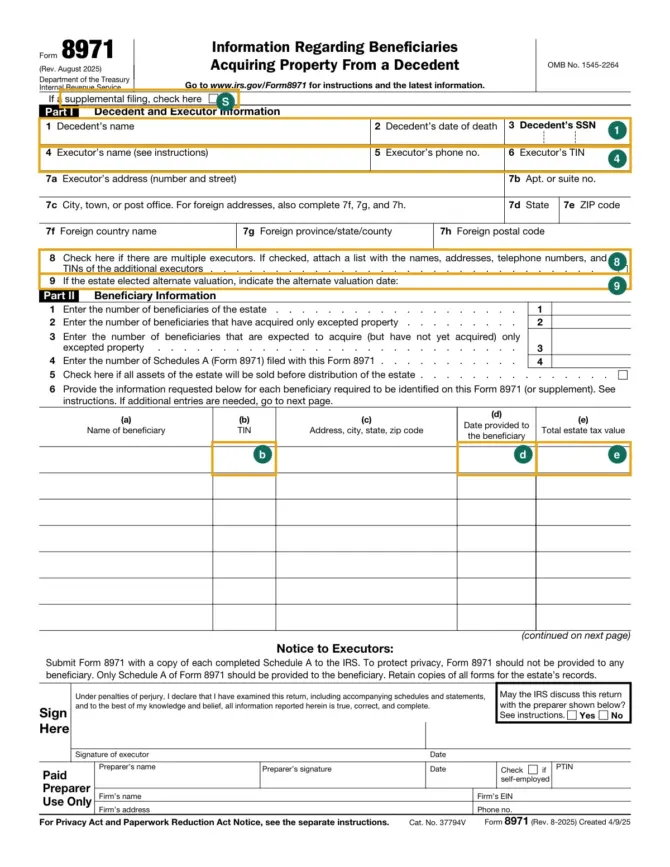
| Line | What it asks | What to enter |
|---|---|---|
| Checkbox above Part I | Supplemental filing | Check it only on a supplement to a Form 8971 already filed; the instructions call it “line A”. |
| Part I, 1 to 3 | Decedent’s name, date of death, SSN | If the decedent had no SSN, the executor applies for one on Form SS-5. |
| Part I, 4 to 6 | Executor’s name, phone, TIN | One executor only, even if there are several. |
| Part I, 7a to 7h | Executor’s address | The address of the line 4 executor; 7f to 7h for a foreign address. |
| Part I, 8 | Multiple executors | Check the box and attach a statement with the name, address, phone number and TIN of every other executor. |
| Part I, 9 | Alternate valuation date | Only if the estate elected alternate valuation under section 2032 on the estate tax return. |
| Part II, 1 to 3 | Beneficiary counts | Total beneficiaries of the estate; those who acquired only excepted property; those expected to acquire only excepted property but who have not yet. |
| Part II, 4 | Number of Schedules A | How many Schedules A are attached to this Form 8971. |
| Part II, 5 | All assets to be sold | Check if all estate property will be sold before the estate is distributed. |
| Part II, 6 (a) to (e) | One row per beneficiary | Name, TIN, address, the date Schedule A was provided, and that beneficiary’s total estate tax value. |
| Part II, 7 | Total of column (e) | Sum of column (e) on this page. |
| Part II, 8 and 9 | Totals from extra pages, grand total | Original form only. Line 8 adds line 7 of every duplicated page 2; line 9 is line 7 plus line 8 and must equal the total of line 4, column (h), on all attached Schedules A. |
Line 6 lists every beneficiary who must receive a Schedule A, an executor who is also a beneficiary included, plus anyone who already received an optional one by the filing date. The instructions allow specific entries when information is missing:
- Column (b), TIN not received after a written request to the beneficiary’s last known address: enter “requested” and attach a copy of the request. A supplement follows once the TIN arrives.
- Column (b), a beneficiary trust with no trustee or TIN by the due date: enter “trust not yet established” and attach a statement of your efforts.
- Column (b), a foreign beneficiary not required to provide a TIN: enter “Not Required” and attach a statement citing the authority.
- A beneficiary you cannot locate: enter the name, any known TIN and the last known address, write “not furnished” in column (d), and attach a page describing your efforts to find them.
Values are reported in U.S. dollars and rounded to whole dollars: drop amounts under 50 cents and raise 50 to 99 cents to the next dollar, rounding only the total when several amounts are added.
Only one executor has to sign, but every executor shown on the form or on the line 8 statement is responsible for its contents and liable for the penalties. A paid preparer signs in the preparer block and gives the executor a copy. Checking “Yes” in the box next to the signature lets the IRS discuss the Form 8971 and its Schedules A with that preparer; it does not let the preparer represent the estate.
Schedule A, column by column
Schedule A is a separate two-page PDF with a wide, horizontal page, also dated August 2025. You need the filed Form 706 or 706-NA open next to it, because columns (b) to (d) repeat what that return says. In the image, 3 marks the beneficiary’s name and TIN, 8 the reason boxes for a supplement, and the letters mark the Part II columns.
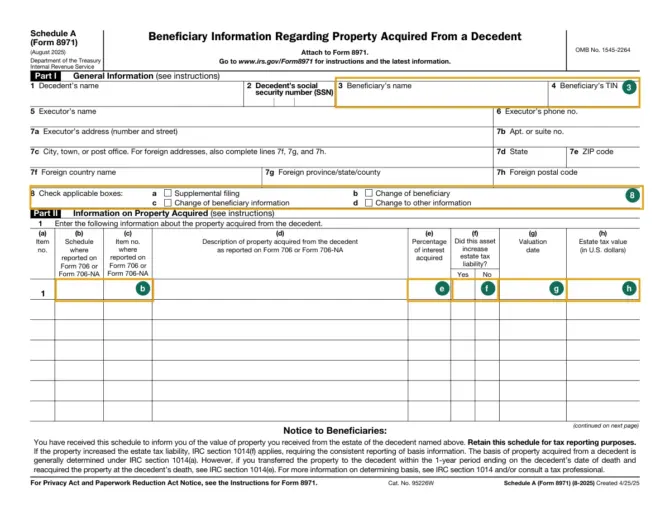
| Line or column | What to enter |
|---|---|
| Part I, 1 to 7h | Decedent’s name and SSN, the beneficiary’s name and TIN, the executor’s name, phone and address. There is no line for the executor’s TIN or the date of death. |
| Part I, 8a to 8d | 8a marks a supplemental Schedule A; on a supplement also check whichever applies: change of beneficiary, change of beneficiary information, change to other information. |
| Part II, column (a) | Item number, continuing on page 2. |
| Columns (b) and (c) | The schedule and item number where the property appears on Form 706 or 706-NA. |
| Column (d) | The description used on Form 706 or 706-NA. Type it on Schedule A; do not attach Form 706 schedules or appraisals. A bulk listing (for example, stocks in one brokerage account) may be attached instead. |
| Column (e) | The beneficiary’s interest when it is less than 100%: an undivided share, a life estate or remainder. For community property, only the share included in the gross estate. |
| Column (f) | Yes or No for every item. Yes only if estate tax was generated and this asset contributed to it. |
| Column (g) | Usually the date of death; the alternate valuation date if the estate elected it. |
| Column (h) | Estate tax value: full fair market value, not reduced by debt, even if Form 706 reported the property net of a mortgage. |
| Lines 2 to 4 (page 2) | Line 2 adds column (h); line 3 brings in totals from duplicated pages; line 4 is the total for this Schedule A. Leave lines 3 and 4 blank on any duplicate page 2. |
Column (f) drives the most consequences. Property that qualifies for the marital deduction under section 2056 or 2056A, or the charitable deduction under section 2055, generally generates no estate tax and gets “N”. The notice printed at the foot of Schedule A tells the beneficiary that when property increased the estate tax, section 1014(f) requires consistent basis reporting.
Column (h) works differently for time-limited and undivided interests. Suppose a rental building was reported on Form 706 at $750,000. If the surviving spouse gets a life estate and a daughter gets the remainder, both Schedules A show the full $750,000; the instructions say not to split basis between interests that differ only in time. If instead two sons inherit the building as equal tenants in common, each son’s Schedule A shows 50% in column (e) and $375,000 in column (h).
Each Schedule A goes only to the beneficiary named on it. Beneficiaries never receive Form 8971 itself; the notice on page 1 of the form says this is to protect privacy.
Which property needs a Schedule A
A Schedule A is required for a beneficiary who acquired property subject to reporting on or before the Form 706 due date (or the filing date, if earlier) when any of that property is not excepted. Property subject to reporting is property included in the gross estate, including property that qualified for the marital or charitable deduction, plus property whose basis is figured from it. A beneficiary acquires property when title vests under local law or when they have enough control to sell or depreciate it; property passing by contract or by operation of law is generally acquired at death.
Excepted property never appears on Schedule A. The instructions list 14 categories. Among them:
- U.S. dollars, dollar demand deposits and certificates of deposit, and money market fund shares priced in dollars.
- Life insurance on the decedent paid in a lump sum in dollars, and tax and other refunds payable in dollars.
- Household and personal effects that need no appraisal under the estate tax regulations.
- Property sold or exchanged by the estate or the decedent’s revocable trust in a recognition event before distribution, such as a pecuniary bequest satisfied in property on which the estate recognizes gain or loss.
- IRAs, Roth IRAs and other retirement plan interests expressed entirely in U.S. dollars, annuities under section 72, and income in respect of a decedent.
- Appreciated property under section 1014(e) acquired by the decedent within one year of death.
An executor may also send an optional Schedule A for property a beneficiary has not acquired yet but is expected to. Once sent, that beneficiary must be listed on Form 8971.
Supplemental Form 8971 and Schedule A
A supplement is filed with the IRS, and a supplemental Schedule A goes to each affected beneficiary, when a beneficiary acquires non-excepted property not reported on an earlier Schedule A, or when a change makes earlier information incorrect or incomplete. On both documents you check the supplemental box and report only what changed.
| What triggers the supplement | Due date |
|---|---|
| Beneficiary acquires reportable property after the Form 706 due date (or the earlier Form 8971 filing) | January 31 of the year after the acquisition |
| Change in reported information | 30 days after the executor has information showing a supplement is needed |
| Supplemental information filed for the estate tax return | 30 days after that supplemental filing |
| Value becomes the final value and differs from the reported one | 30 days after the value becomes final |
The instructions give examples: a disclaimer or death changing who receives property, newly discovered assets added to the gross estate on examination, a like-kind exchange or involuntary conversion replacing the property listed, and a corrected or finally determined value. Final value means the reported value once the assessment period runs out without an IRS adjustment, a value in a binding written agreement with the IRS, or a value fixed by a court that can no longer be appealed. The duty to supplement lasts until final values are set for all reportable property or, if later, until beneficiaries have acquired all of it.
Errors that lead to penalties
Penalties under section 6721 (filing with the IRS) and section 6722 (furnishing Schedules A) can apply even when the estate owed no estate tax. Each Form 8971 and each supplement is a separate filing for the section 6721 penalty; the section 6722 penalty applies per Schedule A and per supplement. The amounts are adjusted for inflation and published on the IRS information return penalties page.
- A wrong TIN, a wrong beneficiary surname or a wrong asset value on Form 8971 is never treated as an inconsequential error.
- On Schedule A, errors in the asset value or in a significant item of the beneficiary’s address are never inconsequential.
- A dollar error of no more than $100 on a single amount falls under a de minimis safe harbor if everything else is correct and timely, unless the beneficiary elects out of it for their Schedule A.
- A late supplement is itself a failure under both sections, as is a Form 8971 missing copies of Schedules A that were furnished or due by its due date.
Reasonable cause excuses a failure only if it came from events beyond the executor’s control or significant mitigating factors and the executor acted responsibly before and after it. Beneficiaries face their own risk: reporting a basis inconsistent with Schedule A can bring a 20% accuracy-related penalty under section 6662, rising to 40% if the basis reported is 200% or more of the correct amount.
Related forms
- Form 706 and Form 706-NA: the estate tax returns whose filing triggers Form 8971 and whose schedules and item numbers fill Schedule A, columns (b) to (d).
- Form 2848: needed if the preparer is to represent the estate on Form 8971. The executor, not the estate, is the taxpayer on line 1, with the executor’s TIN; on line 3 enter “Civil Penalties”, “Form 8971/Schedule A” and the month of death as YYYYMM. A copy may be attached to Form 8971 with “copy” written at the top.
- Form 8822: the instructions name it for reporting a change in the executor’s address.
- Form SS-5: the application for a Social Security number if the decedent never had one; the Social Security Administration handles it.
Where to get the official Form 8971 and Schedule A PDFs
The IRS About Form 8971 page links the Form 8971 PDF (Rev. August 2025, two pages), the separate Schedule A PDF (August 2025, two pages) and the instructions (Rev. December 2026, nine pages). The page also lists an April 27, 2026 update to the Part II instructions, covering lines 7 to 9 and column (e); the December 2026 instructions contain that text. Both PDFs are fillable, and each has a page 2 to duplicate when the rows run out. The IRS estimates about 15 hours of recordkeeping, 3 hours learning about the law or the form, and 2 hours preparing and sending it.
Questions about Form 8971
Does Form 8971 go in the same envelope as Form 706?
The instructions require Form 8971 and the copies of Schedules A to be filed separately from all other returns the estate files, at Mail Stop 824G in Florence, Kentucky.
Do I need Form 8971 if the Form 706 was filed only for portability?
A return filed solely to elect portability of the DSUE amount does not require Form 8971. The same goes for a return filed solely for a GST allocation or as a protective filing.
Does the beneficiary file Schedule A with their own return?
The notice printed on Schedule A tells the beneficiary to keep it for tax reporting purposes. The basis they report later cannot exceed the value on it when the consistent basis rule applies.
Official sources
- Internal Revenue Service, Form 8971, Information Regarding Beneficiaries Acquiring Property From a Decedent (Rev. August 2025)
- Internal Revenue Service, Schedule A (Form 8971), Beneficiary Information Regarding Property Acquired From a Decedent (August 2025)
- Internal Revenue Service, Instructions for Form 8971 and Schedule A (Rev. December 2026)
- Internal Revenue Service, About Form 8971
- Internal Revenue Service, Update to Part II, Beneficiary Information instructions
- Internal Revenue Service, Information return penalties
- Internal Revenue Service, Submission processing center street addresses for private delivery service (PDS)