TR2 is Revenue’s paper registration form for a company resident in Ireland that has no tax agent. One form can register the company for Corporation Tax, VAT, employer PAYE/PRSI, Relevant Contracts Tax (RCT) and Capital Gains Tax. The version on revenue.ie in October 2026 carries the print code RPC019244_EN_WB_L_2; the PDF file itself was produced on 1 August 2025.
Before any registration, the company needs the number the Companies Registration Office (CRO) issued on incorporation. Revenue then gives it a Tax Reference Number for trading and filing returns.
Who files TR2 on paper and who registers through ROS
Revenue’s page on registering a new company, published 27 October 2026, splits companies by representation. When a tax agent acts for the company, the agent must apply online through the Revenue Online Service (ROS), and the TR2 itself tells agents to use ROS. When there is no agent, the company submits a paper TR2. A non-resident company uses TR2 (FT) instead. Individuals, partnerships, trusts and unincorporated bodies use TR1, or TR1(FT) when they are not resident.
The paper route is narrow. Revenue’s registration overview says a paper application sent when an online one should have been made will not be processed; the form comes back with an instruction to register through ROS. Revenue’s VAT registration page says the same of any paper application that could have been completed online, and allows paper only in exceptional circumstances for applicants who cannot use ROS. Revenue’s eRegistration page lists the taxes a ROS user can add there: Income Tax, employer PAYE, Environmental Levy, VAT and RCT. That page also names companies with no Irish-resident directors among the customers who cannot use eRegistration at all.
A company already registered for Corporation Tax that only needs to add employer PAYE has a shorter paper form, PREM Reg, listed on Revenue’s employer registration page for those unable to use eRegistration.
How to fill in TR2, part by part
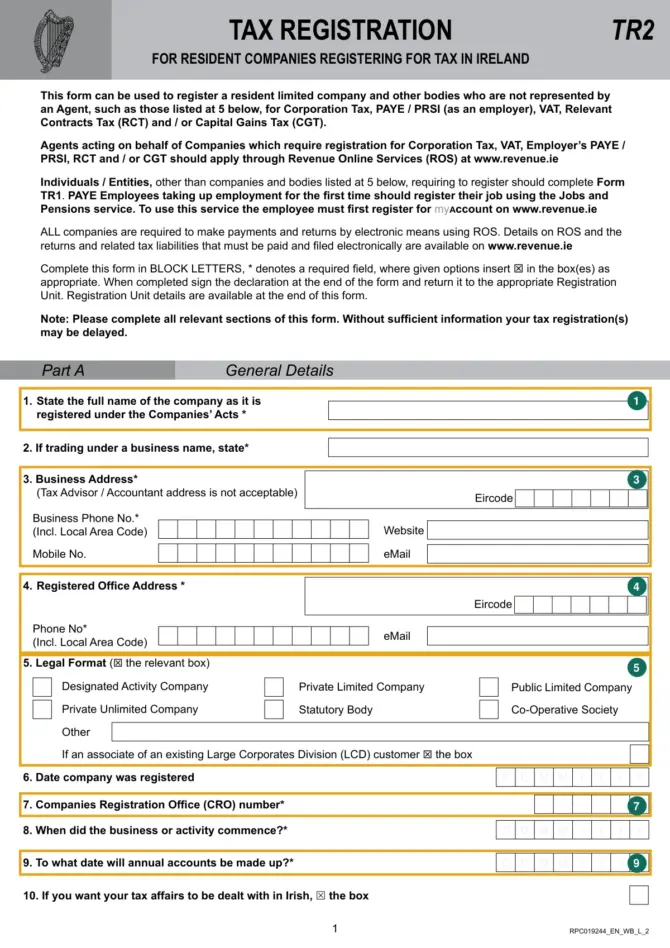
Write in block letters, tick boxes with an X and complete every field marked with an asterisk. The form warns that registration may be delayed if it lacks enough information. The marked first page shows questions 1, 3, 4, 5, 7 and 9 of Part A.
| Part | Questions | What the company gives |
|---|---|---|
| A, general details | 1 to 21 | Name as registered under the Companies Acts, trading name, business and registered office addresses, legal format, CRO number, dates, previous tax numbers, type of business, software, directors, secretary, shareholders, advisor, rented premises and any business acquired |
| B, Corporation Tax | 22 | One tick box |
| C, VAT | 23 to 34 | Start date and reason for registering, cash receipts basis, goods or services, turnover, EU trade, VIES estimate, refund bank account, property details, postponed accounting |
| D, employer PAYE/PRSI | 35 to 38 | Full-time and part-time staff numbers, first employee’s start date, payroll system, agent for PAYE correspondence |
| E, RCT | 39 to 43 | Principal, subcontractor or both, number of subcontractors, RCT start date, ROS status, earlier principal registration |
| F, Capital Gains Tax | 44 and 45 | Tick box and the date the registration is needed from |
| Declaration | End of page 7 | Name in block letters, signature, capacity, date and the signer’s phone number |
Part A, the questions with conditions attached
Question 3 asks for the business address, and the form states that a tax advisor’s or accountant’s address is not acceptable. Question 5 has seven legal formats: designated activity company, private limited, public limited, private unlimited, statutory body, co-operative society and other. Below them is a separate box for an associate of an existing Large Corporates Division (LCD) customer; ticking it changes where the form goes. Questions 6 to 9 ask for the incorporation date, the CRO number, the date the activity began and the date annual accounts will be made up to. Question 10 is the box for dealing with Revenue in Irish.
Question 11 lists any Corporation Tax, employer, VAT or RCT numbers the company held before. Question 13(b) wants a precise trade description. The form’s own examples are “newsagent”, “textile manufacturer” and “property letting”, and it rejects general words such as “consultant” or “computers”; a property activity may also need question 33. Question 13(c) asks for expected turnover over the next 12 months. Question 15 is a tick box for businesses that will supply plastic bags to customers.
Questions 16 to 18 cover people. Every company lists its directors (the form cites section 128(1) of the Companies Act 2014: at least one director), its company secretary, and any shareholder who is not a director but holds a beneficial interest of 15% or more in the issued capital. Each entry asks for a name, private address with Eircode and PPSN, and the director and shareholder entries also ask for the shareholding. Question 19 records the accountant or tax advisor with their Tax Advisor Identification Number (TAIN), and two boxes show whether VAT (VAT3) or employer PAYE/PRSI correspondence is handled by that advisor.
Question 20 applies to rented premises: the landlord’s own name and private address (an estate agent or rent collector is not accepted), the rent and how often it is paid, the date payments started, the lease term and a copy of the lease. Question 21 asks for the previous owner’s name, address and VAT number when the company bought an existing business.
The VAT questions in Part C
Question 24(a) is the date VAT registration should start. A company electing to register may only start from the current VAT period, and the form treats an application from a company that has not started trading, or whose turnover is below the threshold, as an election. Question 24(c) asks for one of three reasons: turnover over the legal limits, a voluntary election (not open to receivers), or receiving business-to-business services under the reverse charge, in which case a copy of the invoice is attached.
Revenue’s VAT thresholds page gives €42,500 for services and €85,000 for goods, with further rules on how turnover is counted. Questions 27 and 28 ask for taxable turnover so far this calendar year and for the whole previous calendar year, split between goods and services.
Question 25 is the cash receipts basis. The form accepts it on one of two grounds: annual turnover expected below €2,000,000 net of VAT, or at least 90% of turnover from customers who are not registered, such as hospitals, schools or the general public.
Questions 29 to 31 decide whether the registration is domestic-only or intra-EU. A yes to any of 29(a) to (d) (supplying or acquiring goods or services in other EU states) makes question 30 mandatory: who the customers are, the due diligence done on EU suppliers and customers, transport arrangements, the documents that will prove goods left the State, and the distribution chain if an intermediary is used. Revenue’s VAT registration manual says an intra-EU registration is automatically set up for VIES reporting. A yes to 29(a) or (b) brings question 31, an estimate of annual EU supplies in one of four bands (under €635,000, €635,000 to €1m, €1m to €10m, over €10m) and whether goods supplies will exceed €50,000 a quarter.
Question 32 is the bank or building society account for refunds: IBAN up to 34 characters and BIC up to 11. Question 33 is for developers and landlords: the property address, purchase or development date, planning reference, and a copy of the minutes of the meeting, or a signed statement, recording that the property would be sold or let in a way that creates a VAT liability, for example under the landlord’s option to tax. Minutes must show the meeting date and everyone present and be signed by the company secretary; a statement is signed by the secretary or a director.
Question 34 covers postponed accounting for VAT on goods imported from outside the EU. It asks for the type, volume and value of the goods, the suppliers and terms showing who the importer is, the customers, the record-keeping system and where records are kept, plus evidence of the business address such as a lease. A company must hold a Customs & Excise registration first, and the form states that postponed accounting will not be granted if requested proofs arrive late. Revenue’s manual adds that a company with no earlier Irish tax number registers for VAT, then for Customs & Excise using the VAT number, and then tells Revenue through MyEnquiries.
Employer, RCT and Capital Gains Tax parts
Part D counts full-time staff (usually 30 hours or more a week) and part-time staff, and asks for the date the first employee started or will start. Revenue’s employer page says a company must register as an employer and operate PAYE on directors’ pay even with no other employees, and the form notes that payroll must be reported to Revenue in real time using a ROS digital certificate. Question 38 records an agent for PAYE/PRSI correspondence if different from question 19.
Part E starts with a note that principal contractors must deal with RCT through ROS and must also register for VAT because of the reverse charge on construction services. Question 39 asks whether the company is a principal only, principal and subcontractor, or subcontractor only, with the number of subcontractors for a principal. Question 41 asks whether the company, or an agent willing to carry out all RCT functions, is registered for ROS; questions 42 and 43 ask about any earlier principal registration and when it ended. Part F is a tick box and a start date for Capital Gains Tax.
When each registration is due
TR2 has no single deadline; the timing comes from each tax.
- VAT: Revenue’s page says a business becomes accountable on completing a transaction that takes turnover over the threshold and must apply within 30 days of that transaction.
- Employer PAYE: Revenue asks for registration before the company pays an employee.
- Changes after VAT registration: Revenue’s VAT page asks for notice to the Revenue office within 30 days.
The Statement of Particulars under section 882 of the Taxes Consolidation Act 1997 is a separate form, Form 11F CRO. It is due within 30 days of the company starting to trade, and Revenue’s manual on it says a company that fails to send it may be reported to the Registrar of Companies for strike-off, with a separate penalty for the company and the secretary.
Signing TR2 and where to send it
The declaration must be made in every case before any registration. The signer gives their name in block letters, signature, capacity (the form’s examples include secretary), date and phone number. Revenue’s manual for agents says the separate agent link notification details are not needed where a TR2 containing the agent’s details has been completed and signed by the client.
The last page of the form lists three registration units:
| Company | Send to |
|---|---|
| Associate of an existing LCD customer (box at question 5) | Large Corporates Division, Office of the Revenue Commissioners, Anne Street, Wexford, Y35 E29K; largecasesdiv@revenue.ie; 01 738 3637 |
| Financial institutions other than credit unions, stockbrokers, Central Bank-regulated investment funds, REITs, IDA-supported companies with over 300 employees, aircraft leasing, insurance and reinsurance entities, ICAVs, debt securitisation entities, remote bookmakers | High Wealth & Financial Services Division, Office of the Revenue Commissioners, Anne Street, Wexford, Y35 E29K; HWFSDiv@revenue.ie |
| All other companies | Business Registrations, Office of the Revenue Commissioners, P.O. Box 1, Wexford; businesstaxesregistrations@revenue.ie; 01 738 3630 (+353 1 738 3630 from abroad) |
After registration, Revenue’s company page says every payment and return goes through ROS, and the form repeats that all companies pay and file electronically.
Official PDF: TR2 — Official PDF (revenue.ie)
Attachments and final checks
- CRO number at question 7 and a business address that is not the advisor’s office.
- A copy of the lease if question 20 applies.
- A copy of the reverse-charge invoice if question 24(c)(iii) is ticked.
- Minutes or a signed statement for a property registration under question 33.
- Postponed accounting evidence, including proof of the business address, for question 34.
- Question 30 answered in full if any question 29 answer is yes.
- Declaration signed, dated, with capacity and phone number.
Questions about TR2
Can a company register for VAT before it starts trading?
Revenue’s VAT page allows a new business to register before making taxable supplies so it can reclaim VAT on start-up costs. Its VAT registration manual says evidence of an intention to trade, such as leases, contracts or tools of the trade, may be asked for.
Does TR2 replace the Statement of Particulars?
Revenue describes the section 882 statement as Form 11F CRO and its manual says completing that form meets the obligation. TR2 asks for some of the same details, but Revenue’s guidance treats the two as separate forms.
Can the company file returns on paper after registering with TR2?
Revenue’s new company page states that once registered, all payments and returns must be filed online through ROS.
Official sources
- Form TR2, Tax registration for resident companies registering for tax in Ireland (RPC019244_EN_WB_L_2)
- How to register for tax as a new company
- Registering for tax: overview
- eRegistration
- How do you register for VAT?
- Who needs to register for VAT?
- VAT thresholds
- Registration of employers for PAYE and How to register
- Company Statement of Particulars
- Tax and Duty Manual Part 38-01-03b, Guidelines for VAT Registration (May 2026)
- Tax and Duty Manual Part 37-00-04b, Guidelines for Agents or Advisors (September 2026)
- Tax and Duty Manual Part 38-02-08, Particulars to be supplied by new companies (January 2026)