The AR K-1FE is the one-page Arkansas schedule an estate or trust fills out for each beneficiary. It shows that beneficiary’s share of income, deductions, credits and other items for the year, split into an Arkansas-resident column and an Arkansas-source column. The fiduciary attaches every AR K-1FE to the estate’s or trust’s Arkansas fiduciary return, Form AR1002F or AR1002NR. The current version is the 2025 AR K-1FE, revision R 6/30/2025, posted on the Department of Finance and Administration’s fiduciary forms page on January 8, 2026 together with its two-page instructions.
Who prepares an AR K-1FE and who receives it
The fiduciary prepares it. The Schedule B instructions in the 2025 Arkansas fiduciary booklet say a completed AR K-1FE for each beneficiary of the estate or trust is required to be attached to the AR1002F or AR1002NR, and any income properly paid, credited or distributable to a beneficiary is taxable to the beneficiary. A fiduciary return is due from every fiduciary, or at least one of joint fiduciaries, when any of these apply: income is currently distributable, the tax is payable by the beneficiaries or the grantor, net income is $3,000 or more, or any beneficiary is a nonresident.
The beneficiary uses the figures on his or her own Arkansas return. The AR K-1FE instructions tell the beneficiary to report the items the same way the estate or trust treated them on its return, and the fiduciary booklet sets out two cases:
- An Arkansas resident beneficiary includes distributions from any estate or trust in total Arkansas income when working out whether an AR1000F has to be filed.
- A nonresident beneficiary who has distributions from an Arkansas estate or trust must file an AR1000NR reporting total income from Arkansas sources, whatever the amount of the distribution.
On the individual return, the 2025 AR1000F and AR1000NR instructions put income from estates and trusts on line 19, as reported on federal Schedule E, and capital gains or losses from fiduciaries on line 14 as the taxable share. The same page states that nonresident beneficiaries pay tax only on Arkansas income.
One kind of income stays off the schedule. If a trust owns part of a business entity that is subject to a pass-through entity tax (PET) in Arkansas or another state, the AR K-1FE instructions say that income should not be included on the AR K-1FE unless there are guaranteed payments from a partnership.
What changed on the 2025 AR K-1FE
Page 1 of the instructions, headed “What’s New for 2025” (R 10/1/2025), lists one change: the column order in Part III was switched to line up with other income tax forms. Column (a) now holds the total amounts reported to Arkansas resident members, and column (b) holds the amounts allocated or apportioned to Arkansas. The same page describes column (a) as the resident total, including amounts from other states, and column (b) as the Arkansas-source figure for nonresidents and part-year residents. The printed form matches: the left heading reads “Distributive share to be reported by Arkansas Residents” and the right one reads “Distributive share allocated and apportioned to Arkansas”.
How to fill out the AR K-1FE heading and Parts I and II
The numbers in the table match the markers on the image. Items A to F are the form’s own letters.
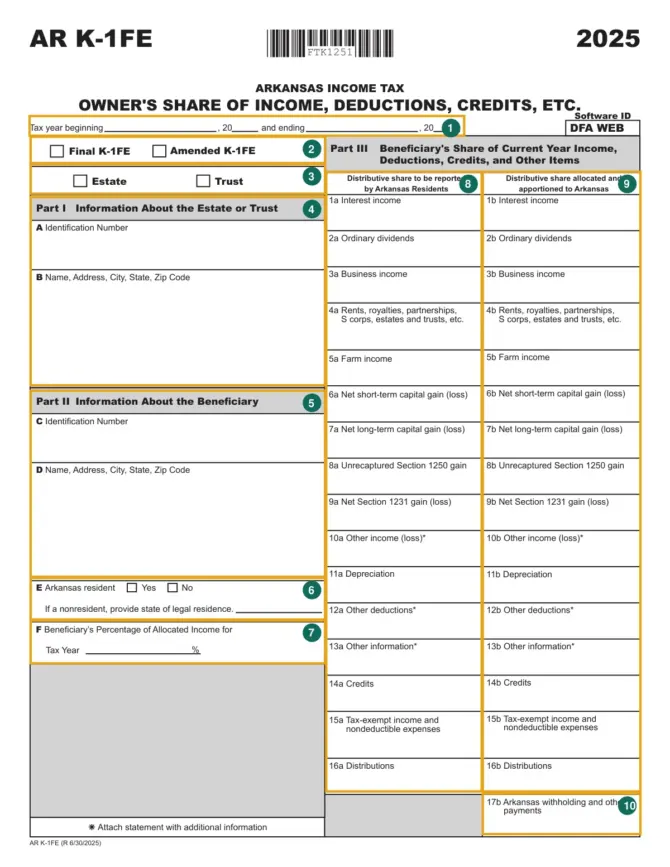
| Marker | On the form | What goes there |
|---|---|---|
| 1 | Tax year beginning … and ending | The estate’s or trust’s tax year. The fiduciary booklet asks fiscal-year filers to show the fiscal year at the top of the return; the moment of death ends the decedent’s tax year and starts the estate’s. |
| 2 | Final K-1FE, Amended K-1FE | Check boxes. The K-1FE instructions give no rule for them. |
| 3 | Estate, Trust | Check the type of entity issuing the schedule. |
| 4 | Part I, items A and B | A: identification number of the estate or trust. B: its name, address, city, state and ZIP code. Part I is completed for each estate or trust. |
| 5 | Part II, items C and D | C: the beneficiary’s identification number. D: the beneficiary’s name and address. Part II is completed for each beneficiary. |
| 6 | E, Arkansas resident | Check Yes for an Arkansas resident. Otherwise check No and write the state of legal residence. The instructions say not to leave it blank. |
| 7 | F, beneficiary’s percentage of allocated income | If applicable, the beneficiary’s percentage of allocated income for the tax year. |
| 8 | Part III, column (a), boxes 1a to 16a | Amounts for Arkansas residents. |
| 9 | Part III, column (b), boxes 1b to 16b | Amounts allocated and apportioned to Arkansas. |
| 10 | 17b, Arkansas withholding and other payments | Tax withheld or other payments made on behalf of the beneficiary. There is no box 17a. |
For item A, the fiduciary booklet’s rules for the estate’s or trust’s FEIN apply on the AR1002F and AR1002NR: a separate FEIN for each estate or trust, a complete number, and no Social Security number in its place.
Part III, box by box
Every income line has an “a” and a “b” box. The boxes marked with an asterisk on the form (10, 12 and 13) need an attached statement with additional information.
| Box | Item | Instruction note |
|---|---|---|
| 1 | Interest income | Beneficiary’s share. |
| 2 | Ordinary dividends | Beneficiary’s share. |
| 3 | Business income | The share of income or loss from the estate’s or trust’s trade or business activities. |
| 4 | Rents, royalties, partnerships, S corps, estates and trusts | More than one rental real estate activity, or income from several pass-through entities: attach a statement showing each one. |
| 5 | Farm income | Income or loss. |
| 6 | Net short-term capital gain (loss) | Points to Schedule A, line 11 of the AR1002F or AR1002NR. No loss in box 6a. |
| 7 | Net long-term capital gain (loss) | Points to Schedule A, line 3. Long-term gain distributed to beneficiaries is described as 100% exempt, claimed only once on the fiduciary return. No loss in box 7a. |
| 8 | Unrecaptured Section 1250 gain | The beneficiary reports it on the Unrecaptured Section 1250 Gain Worksheet, line 18b, in the federal Schedule D instructions. |
| 9 | Net Section 1231 gain (loss) | Beneficiary’s share. |
| 10 | Other income (loss) | Income or loss not in boxes 1 to 9; enter the total and attach a statement. |
| 11 | Depreciation | Depreciation not reported elsewhere; attach a statement. Arkansas adopted IRC Section 179 in its entirety as in effect on January 1, 2022. |
| 12 | Other deductions | Attach a statement naming each deduction. |
| 13 | Other information | Beneficiary’s share. |
| 14 | Credits | Beneficiary’s share. |
| 15 | Tax-exempt income and nondeductible expenses | Beneficiary’s share. |
| 16 | Distributions | Beneficiary’s share. |
| 17b | Arkansas withholding and other payments | Only if tax was withheld or payments were made for the beneficiary. |
The two instruction pages do not describe the columns the same way
Page 2 of the AR K-1FE instructions carries an older revision, R 6/30/2025, and still describes the previous layout. It says the first column is income allocated and apportioned to Arkansas, completed by both resident and nonresident beneficiaries, and the second column is for resident beneficiaries only, with income from all sources. Its box-by-box notes are written for the “b” boxes and say “allocated and apportioned to Arkansas”, while its own worked example puts the Arkansas share in “column 1, box 3a” and the all-sources figure in “column 2, box 3b”. Page 1 (R 10/1/2025) and the form’s printed headings say column (a) is the resident total and column (b) the Arkansas share. The “no loss in box 6a” and “no loss in box 7a” sentences also come from page 2, so it is not clear which of the two columns they were written for.
Neither page says which description wins. Before filing a schedule where the columns matter, ask the Individual Income Tax Hotline at (501) 682-1100 or (800) 882-9275, or email individual.income@dfa.arkansas.gov, the contacts printed in the 2025 fiduciary instructions.
A made-up example shows what is at stake. A trust has $80,000 of business income, $20,000 of it apportioned to Arkansas, and two beneficiaries: an Arkansas resident with 25% and a Texas resident with 75%. Following page 1 and the form headings, the resident’s schedule shows $20,000 (25% of all business income) in box 3a, and the Texas beneficiary’s schedule shows $15,000 (75% of the Arkansas share) in box 3b. Page 2, read literally, would also have the resident’s Arkansas share, $5,000, entered in the Arkansas column.
Sending the schedules with the AR1002F or AR1002NR
The AR K-1FE has no filing date, address or signature line of its own; it travels with the fiduciary return. The AR1002F lists each beneficiary again in Schedule B, Income Distribution, headed “Attach Arkansas K-1FEs”, with a separate schedule if there is not enough space.
The fiduciary return is due April 15 for calendar-year filers. Fiscal-year filers file by the 15th day of the fourth month after the fiscal year closes. A federal extension on Form 7004 gives the same extension in Arkansas plus one month; without one, Form AR1055-FE asks for a 210-day Arkansas extension. Interest runs on tax not paid by the due date even when an extension is granted.
| Fiduciary return | Mailing address |
|---|---|
| Tax due, or no tax due and no refund | Arkansas State Income Tax, P.O. Box 2144, Little Rock, AR 72203-2144 |
| Refund | Arkansas State Income Tax, P.O. Box 1000, Little Rock, AR 72203-1000 |
What the instructions say can delay the return
- Item E left empty. The AR K-1FE instructions say not to leave the residency question blank.
- A shortened FEIN. The fiduciary booklet warns that an FEIN with asterisks or X’s in place of part of the number may delay processing or lead to rejection of the return.
- A missing AR K-1FE. One completed schedule per beneficiary is required with the AR1002F or AR1002NR.
- Boxes 10, 11 and 12 without the statement the instructions ask for.
Related Arkansas forms and other states’ beneficiary schedules
The AR1002F is the Arkansas fiduciary income tax return and the AR1002NR its nonresident version; both use Schedule A for capital gains, which boxes 6 and 7 point to. Payments mailed with either return go with Form AR1002V. Beneficiaries report on the AR1000F (full-year residents) or the AR1000NR (part-year and nonresidents).
Other states use their own beneficiary schedules. Formspedia also covers Alabama Schedule K-1 (Form 41) and the Nebraska fiduciary K-1N.
Where to download the 2025 AR K-1FE
The 2025 AR K-1FE PDF and its instructions are on the Department of Finance and Administration’s Fiduciary and Estate Income Tax Forms page, next to the versions for 2020 to 2024. The PDF can be filled in on screen and has Print Form and Clear Form buttons. This page explains the schedule; it is not tax advice for a particular estate, trust or beneficiary.
Questions about the Arkansas K-1FE
Does a nonresident beneficiary with a small distribution have to file in Arkansas?
The 2025 fiduciary instructions say a nonresident beneficiary with distributions from an Arkansas estate or trust must file an AR1000NR reporting total Arkansas-source income regardless of the amount of the distribution.
Is the AR K-1FE filed separately from the trust’s return?
It is attached to the AR1002F or AR1002NR, one completed schedule for each beneficiary. The AR K-1FE has no mailing address of its own.
Can a Social Security number be used for the estate or trust?
The fiduciary booklet says a Social Security number cannot be used and a separate FEIN is required for each estate or trust. Item C asks for the beneficiary’s own identification number.
Official sources
- Arkansas Department of Finance and Administration, AR K-1FE 2025, Owner’s Share of Income, Deductions, Credits, etc. (R 6/30/2025)
- Arkansas Department of Finance and Administration, AR K-1FE instructions 2025 (pages R 10/1/2025 and R 6/30/2025)
- Arkansas Department of Finance and Administration, Fiduciary Income Tax Instructions, AR1002F and AR1002NR (2025)
- Arkansas Department of Finance and Administration, 2025 AR1002F Fiduciary Income Tax Return
- Arkansas Department of Finance and Administration, 2025 AR1000F and AR1000NR Instructions
- Arkansas Department of Finance and Administration, Fiduciary and Estate Income Tax Forms