Form PTET-E is the election form a Nebraska partnership or S corporation signs when it wants to pay Nebraska income tax at the entity level for a tax year after 2022. The entity then reports the pass-through entity tax (PTET) on its own Form 1065N or Form 1120-SN, and the partners or shareholders claim their share of what it paid as a credit. The current PDF is revision 8-896-2023 Rev. 3-2025, titled “Pass-Through Entity Tax (PTET) Election for Tax Years After 2022.”
The Nebraska Department of Revenue (DOR) also accepts the election as a checked box 5 on the return, and that box has to be checked even when Form PTET-E was uploaded earlier.
Which entities can file Form PTET-E
The form’s instructions limit the election to an eligible partnership or S corporation electing to be taxed under Neb. Rev. Stat. §§ 77-2727(6) or 77-2734.01(8). An eligible partnership is any entity treated as a partnership for federal income tax purposes, a limited liability company (LLC) included. An eligible S corporation is any entity taxed under subchapter S of the Internal Revenue Code. A publicly traded partnership cannot make the election.
DOR’s PTET FAQs settle a few edge cases:
- A disregarded LLC cannot elect. A partnership or S corporation that owns a disregarded LLC can.
- A financial institution that files a Nebraska S corporation return can elect.
- An entity that converts from an S corporation to a C corporation can still make the election, but its shareholders cannot claim the credit, because the tax is paid while the entity is a C corporation.
- The election is made separately for each tax year. A year with a Nebraska loss can be skipped; an entity that elects anyway enters the loss in the Nebraska income field and zero as the PTET.
Once made, the election for that year is irrevocable and binds the entity and its owners. DOR’s PTET page adds that it cannot be undone by amending a return.
How to fill out Form PTET-E
Page 1 is the form and page 2 holds the instructions. There is no calculation on Form PTET-E: the tax itself is worked out on the return. The numbers in the image below were added for this guide and do not appear on DOR’s PDF.
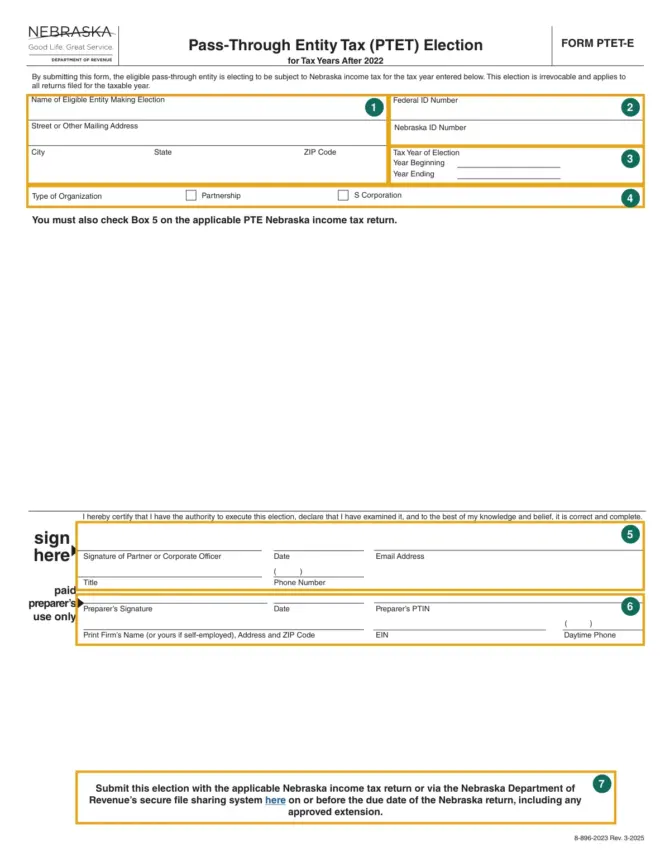
| Marker | Part of the form | What to enter |
|---|---|---|
| 1 | Name of Eligible Entity Making Election; Street or Other Mailing Address; City, State, ZIP Code | The name and mailing address of the partnership or S corporation that is electing. |
| 2 | Federal ID Number; Nebraska ID Number | The entity’s FEIN and the Nebraska ID number DOR assigned to it. |
| 3 | Tax Year of Election: Year Beginning, Year Ending | The start and end dates of the one tax year the election covers. |
| 4 | Type of Organization | Check Partnership or S Corporation. An LLC taxed as a partnership checks Partnership. |
| 5 | Signature of Partner or Corporate Officer, Date, Email Address, Title, Phone Number | Signed by a partner or corporate officer authorized to act for the entity. Write “Opt Out” in the email field if DOR should not contact the entity by email. |
| 6 | Paid preparer’s use only | Preparer’s signature, date, PTIN, firm name, address and ZIP code, EIN and daytime phone, when a paid preparer completes the form. |
| 7 | Submission note at the bottom of page 1 | The deadline and the two ways to send the form. The word “here” in the PDF links to DOR’s upload page. |
Someone other than a partner or corporate officer can sign only if a Power of Attorney, Nebraska Form 33, is on file with DOR or attached to the election. The FAQs draw the line for tax preparers: uploading a client’s Form PTET-E needs no Form 33, while signing it on the client’s behalf does. DOR also accepts digital signatures on the PTET election forms and points to Revenue Ruling 99-20-1 on signature requirements.
On the email line, the instructions say an address entered there means the taxpayer accepts that DOR may write by email, with the confidentiality risk that comes with it. DOR sends confidential information only by secure mail or through the state’s file share system.
When the election is due
The election must reach DOR on or before the due date of the partnership’s or S corporation’s Nebraska return, including any approved extension. The 2025 booklets for Form 1065N and Form 1120-SN set that due date at the 15th day of the third month after the tax year closes. A timely federal Form 7004 gives an automatic Nebraska extension for the same number of months the IRS grants, and Form 7004N is filed by the return’s due date when a tentative Nebraska payment is made or no federal extension is requested.
DOR’s FAQs confirm that an entity can make PTET payments before the year ends and upload the signed Form PTET-E closer to the return’s due date. The same answer notes that the date the election is filed may affect when the income tax deduction falls on the federal return; DOR does not go further, and that question belongs with a federal tax adviser.
Submitting Form PTET-E and the official PDF
The fillable PDF is on DOR’s Nebraska Pass-Through Entity Tax (PTET) page, file name f_PTET-E_after_2022_2023.pdf. It can go to DOR in one of these ways:
- Upload through the State of Nebraska file sharing system (ShareFile), using the “Upload PTET-E Here” link on the PTET page.
- Attach it to Form 1065N or Form 1120-SN. Both returns are e-filed or mailed to Nebraska Department of Revenue, PO Box 94818, Lincoln, NE 68509-4818.
- Skip the separate form and check box 5 on the return, which DOR treats as the election for that year.
DOR’s upload instructions walk through the ShareFile steps: enter the identifying information requested and click Continue, drag the file in or use “browse files” (several files can go at once), then click Upload. The page shows “uploaded” when it finishes. A confirmation email comes from noreply@sf-notifications.com and lists the file names, so that email is the place to check that the right PDF went through.
Whichever route is used, the instructions warn that leaving box 5 unchecked on the return may cause processing delays or an improper balance due notice.
Questions go to DOR at 800-742-7474 (Nebraska and Iowa) or 402-471-5729.
Official PDF: Form PTET-E — Official PDF (revenue.nebraska.gov)
What the election changes on Form 1065N and Form 1120-SN
On the 2025 returns, box 5 carries the statement that the entity “is electing or previously elected to be subject to income tax” and tells the filer to complete Schedule PTET. The booklets say to check it for an election made for 2025, whether now or earlier. Line 6 then takes line 5 (income reported to Nebraska) multiplied by .0520. An entity that did not elect skips lines 6 through 17. The electing entity computes the tax on its entire Nebraska source income, guaranteed payments included, even when some owners are themselves non-taxpaying entities such as an IRA.
Schedule PTET (Partner’s or Shareholder’s Share of Nebraska Pass-Through Entity Tax) carries line 6 to line 1 and splits the total among the owners who held an interest during the year. Each owner’s share then appears on their Schedule K-1N.
The election also changes nonresident withholding. A partnership or S corporation that makes the PTET election does not remit income tax for its nonresident individual owners, Schedule II is skipped when box 5 is checked, and the FAQs say Forms 12N are not required from nonresident owners of an electing entity.
PTET rates, payments and penalties
DOR’s FAQs list these rates:
| Tax year | PTET rate |
|---|---|
| 2018 through 2022 | 6.84% |
| 2023 | 6.64% |
| 2024 | 5.84% |
| 2025 | 5.20% |
| 2026 | 4.55% |
| 2027 and after | 3.99% |
For tax years after 2023, an electing entity makes estimated payments when its PTET after credits is $400 or more, and the underpayment penalty applies to tax years beginning on or after January 1, 2024. Payments only have to be electronic if DOR has already sent the entity an e-pay mandate for income tax. Online payments use tax type code 02000 or 02100 for an S corporation and 02920 for a partnership.
For 2023 and later years, a late filing penalty applies when the PTET is not paid by the due date, extensions included, and interest runs on PTET paid after the return’s due date without regard to extensions. The 2025 partnership booklet puts interest on unpaid tax at a statutory 8% from the original due date.
How owners claim the PTET credit
For tax years after 2022, a partner or shareholder claims the credit on their return for the same tax year in which the entity reported the PTET, and only once the entity has paid it. DOR counts it among the refundable credits, which means it is not treated like withholding or an estimated payment for the individual underpayment penalty. An individual’s Form 1040N claiming the credit should have the Schedules K-1N attached; DOR says it does not expect delays when they are and the entity filed Schedule PTET properly.
A trust or estate that receives the credit can keep it against income it retains and pass the rest to beneficiaries the same way income is distributed, on the fiduciary Nebraska Schedule K-1N for Form 1041N. A resident grantor trust passes the credit straight to the grantor.
If the entity amends its return and the PTET changes, it must issue amended Schedules K-1N, and each resident owner has to amend as well. The election stays in place; only the figures change. Where the change involves apportionment, DOR asks for the returns filed in the other states.
Tax years 2018 through 2022
Form PTET-E does not cover these years. Retroactive elections were made on a separate form, PTET-ER, and closed on December 30, 2025; an entity that missed that date cannot report 2018 to 2022 PTET or pass the credit to its owners. An entity that did elect in time but has not yet reported the tax on a 2025 or earlier return must report, calculate and pay it on its 2026 return, and its owners get no credit for those years until the entity pays.
Before you upload or attach the election
- The tax year beginning and ending dates match the return the election belongs to.
- Partnership or S Corporation is checked, and the entity is not a publicly traded partnership or a disregarded LLC.
- A partner or corporate officer has signed, or a Form 33 is on file with DOR or attached.
- The email field holds an address or the words “Opt Out.”
- Box 5 is checked on Form 1065N or Form 1120-SN for the same year.
- After a ShareFile upload, the confirmation email from noreply@sf-notifications.com lists the right file.
Questions about the Nebraska PTET election
Can a single-member LLC make the Nebraska PTET election?
A single-member LLC that is a disregarded entity cannot elect, but a partnership or S corporation that owns it can, according to DOR’s FAQs. An LLC taxed under subchapter S fits the form’s definition of an eligible S corporation.
Can the PTET election be revoked after it is filed?
The election is irrevocable for the tax year it covers and cannot be changed by amending a return, though an amended return is still required to correct the reported figures.
Is Form PTET-E needed if box 5 is already checked on the return?
Checking box 5 makes the election for that year on its own, so a separate Form PTET-E is optional. When the form is uploaded separately, box 5 still has to be checked on the return.
Does the PTET election depend on the federal SALT deduction cap?
DOR’s FAQs say the Nebraska PTET is not tied to the federal state and local tax limitation and stays available even if that limitation ends.
Sources
- Form PTET-E, Pass-Through Entity Tax (PTET) Election for Tax Years After 2022 (8-896-2023 Rev. 3-2025)
- Nebraska Pass-Through Entity Tax (PTET), Nebraska Department of Revenue
- Pass-Through Entity Tax (PTET) FAQs, Nebraska Department of Revenue
- How to Upload Documents to the Nebraska Department of Revenue
- 2025 Nebraska Return of Partnership Income booklet (Form 1065N and schedules)
- 2025 Nebraska S Corporation Income Tax booklet (Form 1120-SN and schedules)