Form W-4N tells a Nebraska employer, or a pension or annuity payor, how many Nebraska withholding allowances to use and whether to take out an extra amount or nothing at all. The employer applies that number to the tables in the Nebraska Circular EN. DOR’s instructions on page 2 say the form exists because federal and Nebraska law differ on standard deductions and because Nebraska allows personal exemption credits on its income tax return. The current PDF is revision 8-810-2019 Rev. 1-2022, which replaced Rev. 12-2020.
Who has to give the employer a Form W-4N
The dividing line is the date of the federal Form W-4. For every federal W-4 an employee completes on or after January 1, 2020, a Nebraska Form W-4N must also be completed. An employee whose federal W-4 was completed before January 1, 2020 does not have to submit a W-4N; the employer keeps using the marital status and allowances from that older federal form for Nebraska withholding.
When an employee files a post-2019 federal W-4 but no W-4N, the 2027 Circular EN tells the employer to withhold as if the employee were single with no allowances, regardless of marital status. DOR’s withholding FAQ says the same and adds that the single tables must be used in that case. Extra Nebraska withholding is also only possible through the W-4N: the Circular EN’s reminders page says an employee must complete one to request additional state income tax withholding.
Pension and annuity payments follow the same pattern with a later date. If the payee completed federal Form W-4P before January 1, 2022, the payor uses the allowances and marital status from that W-4P. A W-4P completed on or after January 1, 2022 needs a Nebraska W-4N alongside it.
How to fill out Form W-4N, line by line
The top half of page 1 is the certificate you hand in; the bottom half, below the cut line, is the Personal Allowances Worksheet you keep. The numbers in the image were added for this guide and match the first column of the table.
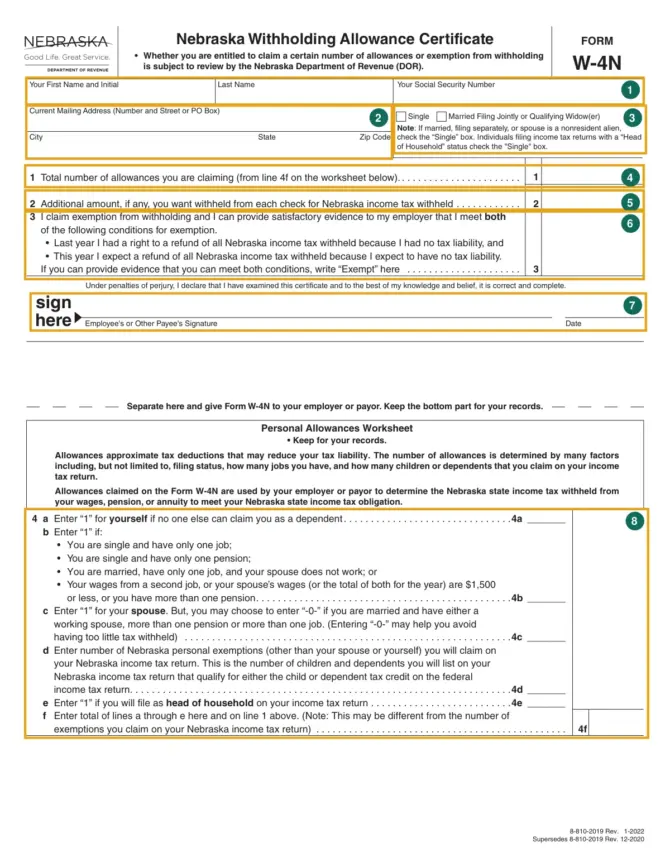
| Marker | Part of the form | What to enter |
|---|---|---|
| 1 | Your first name and initial, last name, Social Security number | Your own name and SSN. |
| 2 | Current mailing address, city, state, ZIP code | Street address or PO box where you get mail now. |
| 3 | Single / Married Filing Jointly or Qualifying Widow(er) | Check one. Married filing separately, a spouse who is a nonresident alien, and head of household filers all check “Single”. |
| 4 | Line 1, total number of allowances | The figure from worksheet line 4f. |
| 5 | Line 2, additional amount | A dollar amount to be withheld from each check on top of the amount the allowances produce. Leave blank if you want nothing extra. |
| 6 | Line 3, exemption | The word “Exempt”, only if you meet both conditions printed on the form and can prove it to the employer. Lines 1 and 2 are then skipped. |
| 7 | Signature and date | Signed by the employee or other payee under penalties of perjury. An exemption claim is not valid without the signature. |
| 8 | Personal Allowances Worksheet, lines 4a to 4f | Your count of allowances; it stays with you. |
Head of household filers check “Single” at marker 3 and then pick up an extra allowance on worksheet line 4e, so the status box and the allowance count do not have to agree. DOR prints a reminder at the top of the form that the number of allowances or an exemption claim is subject to its review.
The Personal Allowances Worksheet (lines 4a to 4f)
Each line adds either “1” or a count:
- 4a: enter 1 for yourself if no one else can claim you as a dependent.
- 4b: enter 1 if you are single with one job, single with one pension, married with one job and a spouse who does not work, or if wages from a second job or your spouse’s wages (or both together) are $1,500 or less for the year, or you have more than one pension.
- 4c: enter 1 for your spouse. The form lets you enter 0 instead if you are married and have a working spouse, more than one pension or more than one job, and says that may help avoid too little withholding.
- 4d: the number of Nebraska personal exemptions other than you and your spouse, meaning the children and dependents on your Nebraska return who qualify for the federal child or dependent tax credit.
- 4e: enter 1 if you will file as head of household.
- 4f: the total of 4a through 4e, copied to line 1. The form notes this can differ from the exemptions on your Nebraska income tax return.
Take a married employee with one job, a spouse who does not work and two children who qualify for the federal child tax credit. Lines 4a, 4b and 4c are 1 each, line 4d is 2 and line 4e is 0, so line 1 shows 5 allowances. Under the 2027 Circular EN percentage method, one allowance on a biweekly payroll is worth $96.54, so the employer subtracts $482.70 from each biweekly taxable wage before applying the married table. For wages paid during 2026 the biweekly value is $93.85.
The instructions warn that claiming every allowance you are eligible for may leave too little withheld, and that underpaying through withholding or estimated payments can bring a penalty. They point to the worksheet in the Nebraska Individual Estimated Income Tax Payment Vouchers booklet for estimating the year’s liability.
Claiming exemption from Nebraska withholding on line 3
Line 3 lists two conditions, and both must be true: last year you had a right to a refund of all Nebraska income tax withheld because you had no tax liability, and this year you expect the same. You write “Exempt” on line 3, skip lines 1 and 2, and sign.
- The exemption lasts one year. To keep it, give the employer a new Form W-4N by February 15 each year.
- You cannot claim it if another person can claim you on their tax return and your total income is over $1,100 and includes more than $350 of unearned income.
- An employer subject to the special withholding procedures in the Circular EN may ask for documents supporting the exemption.
- The Circular EN adds that if the IRS requires withholding for someone who previously claimed exemption, that person is also subject to Nebraska withholding.
Pension and annuity payees have a different rule. A payee who chose no federal withholding on Form W-4P may write “Exempt” on line 3, and that exemption stays in effect until the payee changes the W-4P to withhold federal tax or files a new W-4N asking for Nebraska withholding. There is no February 15 renewal for these payees in the instructions. Changing the W-4P to withhold federal tax requires a new W-4N for Nebraska withholding.
Pension, annuity and rollover payments
For periodic payments of employer-provided pensions and annuities, Nebraska withholding is figured the same way as on wages, using the Circular EN payroll period that matches the payment (monthly or quarterly). DOR’s FAQ says the special 1.5% procedures described below do not apply to pension or annuity payments.
Nonperiodic payments and eligible rollover distributions that fall under the federal 10% or 20% withholding rates are handled by a flat state rate. The W-4N instructions (Rev. 1-2022) still print 5% and say these payments cannot be exempt. The 2026 Circular EN, for payments on or after January 1, 2026, and the 2027 Circular EN, for payments on or after January 1, 2027, both set the rate at 3.5% of the distribution. The Circular EN is the document payors withhold from, and its 3.5% is the newer figure. A payee can ask for more on line 2 of a W-4N, and a payee with no federal withholding can ask for Nebraska withholding the same way. The Circular EN also states that premature IRA distributions are not subject to Nebraska withholding.
What the employer does with Form W-4N
The employer multiplies the number on line 1 by the allowance value for the payroll period and subtracts the result from taxable wages before using the percentage method tables, or reads the wage bracket table column for that number of allowances. The annual value of one allowance is $2,440 in the 2026 Circular EN and $2,510 in the 2027 edition. The wage bracket tables go up to ten allowances; for more than ten, the employer subtracts the value of the extra allowances from wages and uses the ten-allowance column. Any amount on line 2 is withheld on top of the calculated figure.
Low claims run into Nebraska’s special withholding procedure. Every employer with more than 24 employees must withhold at least 1.5% of each employee’s taxable wages unless the employee documents why less is justified, for example by verifying children or dependents, marital status, or itemized deductions. DOR’s FAQ counts 25 or more employees at any one time during the year. The shaded amounts in the wage bracket tables are the ones below that minimum. Without documentation, withholding has to come from the non-shaded area, which can mean reducing the number of allowances used for Nebraska only. The FAQ also says the employer does not need to keep birth certificates or mortgage statements in payroll files; a summary signed by the employee stating the allowances were reviewed and found reasonable is enough, and DOR links a sample letter and worksheet for this.
The penalties printed on page 2 of the form:
- An employer may face a penalty of up to $1,000 for each employee under-withheld when the low withholding is not substantiated.
- A taxpayer who intentionally claims an excessive number of exemptions is guilty of a Class II misdemeanor.
- Willfully attempting to evade Nebraska income tax, or willfully failing to withhold and pay over withheld tax, is a Class IV felony.
The certificate goes to the employer or payor, and the form prints no DOR mailing address for it. Withholding itself is reported on Form 941N and reconciled on Form W-3N, which is due January 31. An employer that stops making payments subject to Nebraska withholding can cancel its withholding certificate on Form 941N or with a Nebraska Form 22 change request. If the employer’s Nebraska ID number or e-file PIN is lost, only an authorized owner or officer may ask DOR for it; anyone else needs a Nebraska Form 33 power of attorney.
Nonresident employees working in Nebraska
An employer with an office or business in Nebraska must withhold Nebraska tax on wages paid to every employee, nonresidents included, for services performed in the state. A nonresident who works for the same employer in Nebraska and other states can also file Form 9N, which states the percentage of wages subject to Nebraska withholding. The employer first computes withholding on total wages with the percentage or wage bracket method and then multiplies it by that percentage. Someone working 100% of the time in Nebraska does not file Form 9N.
Since tax years beginning on or after January 1, 2025, two special rules can remove withholding for nonresidents who work in more than one state:
- Conference or training wages are not subject to withholding if the employee is present and working in Nebraska seven employment duty days or less during the year and earns $5,000 or less for work done while in Nebraska.
- An employee paid convenience rule wages who works seven employment duty days or less in Nebraska has no Nebraska withholding on any wages. Once the employee goes over seven employment duty days, all days worked in Nebraska are subject to withholding, the first seven included.
Partial days in Nebraska count as full days. DOR’s FAQ names three groups whose Nebraska wages are not subject to withholding when they live in another state: railroad crews, airline flight crews and interstate truck drivers. The spouse of an active duty servicemember who elects the servicemember’s state of legal residence files Form 9N so that no Nebraska tax is withheld. Nonresidents paid for personal services who are not employees, such as consultants or entertainers, fall under Form W-4NA, which sets withholding at 4% or 6% of the net payment, and Form W-4NB, not Form W-4N.
Where to get the official Form W-4N
DOR publishes the Form W-4N PDF on its income tax withholding forms page. It is three pages: the certificate and worksheet on page 1 and instructions for employees, employers and pension payees on pages 2 and 3. The fields can be typed into before printing. Revision 8-810-2019 Rev. 1-2022 is printed in the lower right corner of page 1.
The allowance values and tables the employer uses are in the Circular EN. DOR’s withholding page says to keep using the 2026 edition through December 31, 2026 and to begin using the 2027 edition, revision 8-2026, on January 1, 2027. Questions go to DOR Taxpayer Assistance at 800-742-7474 (Nebraska and Iowa) or 402-471-5729.
Questions about Form W-4N
Do I need a new Form W-4N every year?
Only when you claim exemption: that claim expires after one year and needs a new W-4N by February 15. Otherwise the instructions suggest a new form when your personal or financial situation changes.
I filled out a federal W-4 at my new job but not the W-4N. What happens?
The employer withholds Nebraska tax as if you were single with zero allowances, whatever your actual marital status. Handing in a W-4N lets the employer use your real allowance count.
Can I have more Nebraska tax withheld without touching my federal W-4?
Line 2 of Form W-4N takes a fixed extra dollar amount for each paycheck. It is added to the amount figured from your allowances.
Official sources
- Nebraska Department of Revenue, Form W-4N, Nebraska Withholding Allowance Certificate, 8-810-2019 Rev. 1-2022
- Nebraska Department of Revenue, 2027 Nebraska Circular EN, 8-429-1998 Rev. 8-2026
- Nebraska Department of Revenue, 2026 Nebraska Circular EN, 8-429-1998 Rev. 11-2025
- Nebraska Department of Revenue, Income Tax Withholding FAQs
- Nebraska Department of Revenue, Nebraska Income Tax Withholding
- Nebraska Department of Revenue, Income Tax Withholding Forms